Why I'm not cheering for a winner in the AI race. Opinion
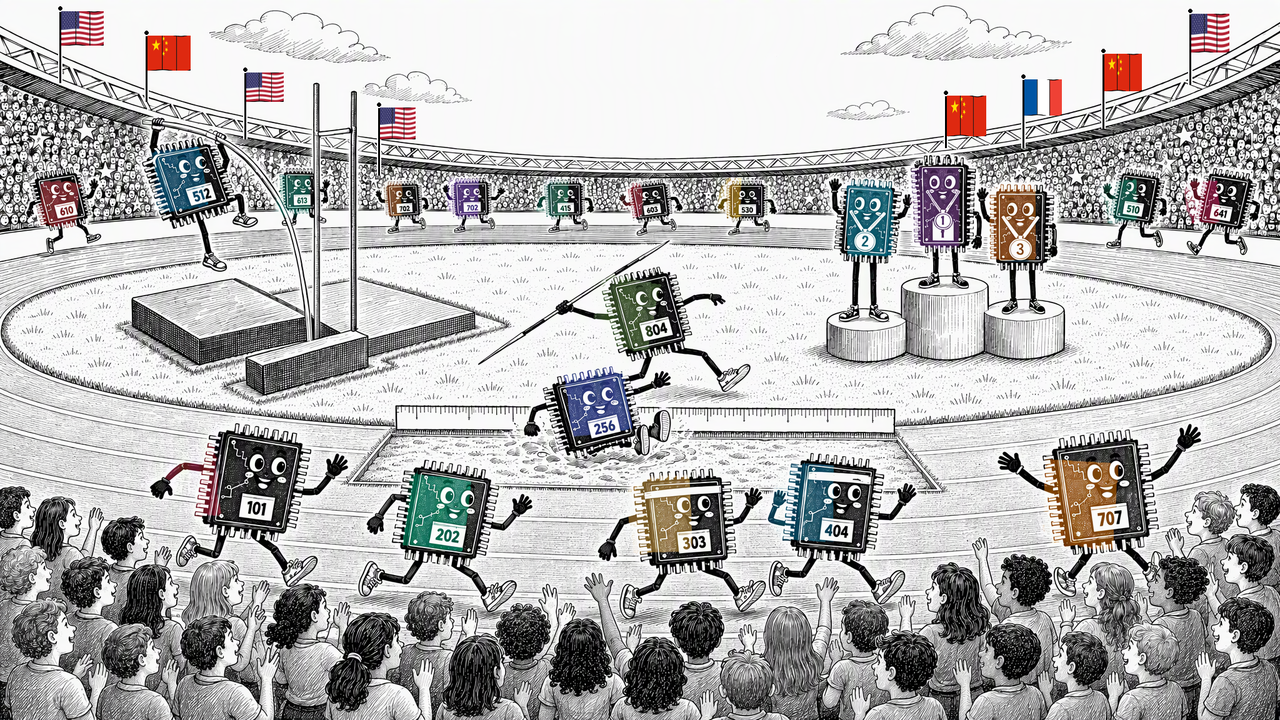
Open-weight models are as important as those from OpenAI and Anthropic – as increasing costs and uncertain outages show all too well.
As a tech journalist whose job it is to keep up to date with the latest innovations, I'd consider myself a more intensive AI user than the average person. I pay for access to some of the world's most capable closed AI systems – OpenAI gets $20 a month from me, as does China’s Z.AI, while I also have a subscription to Opencode, which grants me access to a variety of leading-edge models.
But alongside the monthly subscriptions that leave my bank account, I also run open-weight, local AI models on computers I own, where the data I feed into them never has to leave the room.
And if you told me I could only have either the closed AI systems or my locally hosted ones, I'd keep the local ones in a heartbeat. The reason why is choice.
For much of the time since the generative AI boom was first triggered by the release of ChatGPT in November 2022, the assumption has been that the most capable models are built by a handful of enormously wealthy US companies. But that picture has changed. Chinese developers have released increasingly capable open-weight systems, while France's Mistral has continued to develop models that can be downloaded and run elsewhere, keeping Europe in the race.
RECOMMENDED FOR YOU
Brazil has a special place in Trump’s tariff plan. How’s it working out?
The frontier labs’ advantage is still there – but it has narrowed. Stanford University’s 2026 AI Index found that, as of March, the leading closed model outperformed the best open model by 3.3%. The difference between the best US and Chinese models was just 2.7%, and is small enough that the lead has repeatedly changed hands.
That competition was thrown into focus in July when Beijing-based Moonshot’s release of Kimi 3 shocked US markets by offering comparable performance to the two frontier models with a fraction of their compute. That was just days after Xi Jinping had affirmed as policy China’s commitment to open-source development.
Closed models are a little like hiring a brilliant consultant who works somewhere else. You send them your problem, and they send back an answer, but you have limited visibility into what happens in between. Open-weight models give you a glimpse into how they work, and better still, allow you to change the “weights” that encode what the model learned during training to your needs.
For end users, that can be a boon – and for countries outside the two dominant AI powers, it can be particularly valuable. Europe is discovering the same problem faced by governments and businesses across Africa, Asia and Latin America: using AI is a massive benefit until you become dependent on somebody else’s AI infrastructure – particularly those owned by companies operating with a capricious president who loves to wage trade wars.
Back in June, the US government briefly ordered Anthropic to block foreign nationals from accessing the world’s most powerful model. And statements from Trump since have indicated that he sees himself as the global regulator for what he describes as “Super Intelligence.”
However, Trump is not the only American who would like to adjudicate how AI should be developed and distributed. In the past week, executives at several leading US AI laboratories have warned that frontier development may need to slow because of the risks posed by increasingly capable systems.
And disruption can have other causes too: at the beginning of September, ChatGPT, Anthropic and Grok models suffered near simultaneous outages, the cause of which is still being questioned.
Different models, different tasks
RECOMMENDED FOR YOU
Different times, shared hearts: What brings China and the US together — Opinion
Which is why we need more competition, including through the likes of the locally hosted models I use daily alongside those subscriptions. Because if one provider raises prices, changes its rules, withdraws a model or decides a market is no longer worth serving, it gives customers – all of us – an alternative route that is almost as good anyway.
A bank may prefer a closed model for one task and a locally hosted open-weight one for another – and indeed, many companies I speak to are choosing to build their AI systems on open-weight models they control, rather than closed frontier models they don’t. Governments have signed deals to use commercial chatbots for routine work, but could benefit from keeping sensitive data inside its borders and on locally hosted models. Start-ups may build on the likes of Qwen, Kimi, DeepSeek or Mistral because doing so is cheaper or gives it greater control.
And that choice is likely to become more important, not less. The AI race is often presented as a competition to build the single cleverest model, as if the rest of us are simply waiting to discover which company wins and whose product we should then use. But that would be a pretty miserable outcome for a technology likely to become embedded in businesses, governments and our everyday lives. Part of the excitement is seeing how different models are better suited to different needs. I once interviewed tech tinkerers in Egypt and elsewhere taking those open-weight models and adapting them to better represent their language and culture. That’s the future we need – not one where we all speak in a Silicon Valley American accent.
AI sovereignty is an important goal, and it’s one that’s changed definition in the last few years thanks to the rise of open-weight AI systems. It doesn’t mean every country needs to spend billions building its own frontier model. But it should mean having enough options that no country or company is forced to accept whatever one supplier decides to offer it.
OpenAI, Anthropic and the other frontier labs will remain important – and they'll keep getting my $20 a month for the foreseeable future. But the computers sitting beside my desk are a reminder that they no longer have to be the only game in town.
Chris Stokel-Walker is an author, university lecturer and journalist specialising in media and technology. He appears regularly on television and in print around the world. The opinions expressed are his own.
