Why most renters doubt they will ever afford a home
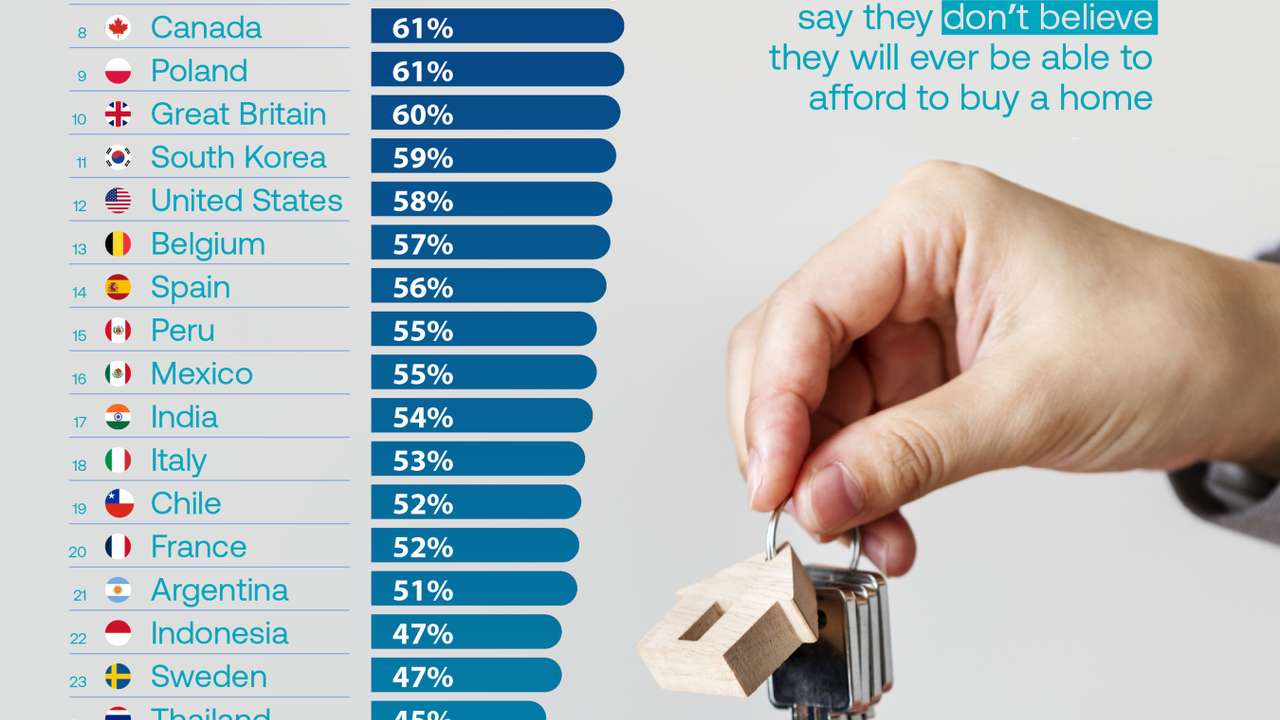
More than half of renters across nearly 30 countries say they do not believe they will ever be able to afford their own home, highlighting widespread anxiety over housing costs even as homeownership remains a goal for many.
Main points
- 56% of renters doubt they will ever afford a home
- Germany records the highest share at 70%
- Rising housing costs are squeezing would-be buyers
More than half of renters across nearly 30 countries say they do not believe they will ever be able to afford their own home, highlighting widespread anxiety over housing costs even as homeownership remains a goal for many.
The Ipsos Housing Monitor 2025 found that 56% of renters on average believed they would never be able to afford to buy a home. That contrasts with the 71% who said they would like to own one, showing a large gap between the desire for homeownership and expectations of achieving it.
Germany recorded the highest level of pessimism, with 70% of renters saying they did not believe they would ever be able to afford a home. Australia followed at 69% and Japan at 68%. The Netherlands and Türkiye were both at 65%, while Ireland stood at 64%.
The concern extends beyond those countries. The infographic, based on Ipsos data, shows 61% in Canada, 60% in Great Britain, 59% in South Korea and 58% in the United States saying they doubt they will ever be able to afford a home.
RECOMMENDED FOR YOU
Argentina takes Britain to International Court, demands halt to Falklands oil project
At the other end, renters were less pessimistic in Brazil, where the figure was 36%, followed by Colombia and South Africa at 38%. That does not necessarily mean homes are more affordable in those countries, however. The survey measures people's expectations about their ability to buy, rather than comparing house prices with incomes.
Housing costs have climbed
The pessimism comes after substantial increases in housing costs in many economies.
In the European Union, house prices rose 53% between 2010 and 2024, according to Eurostat. By the first quarter of 2026, prices were another 5.1% higher than a year earlier, while rents had risen 3%.
The pressure is also evident in the United States. Harvard University's Joint Centre for Housing Studies reported that the median existing-home price reached a record $412,500 in 2024, while the typical monthly mortgage payment on a median-priced home reached $2,560. A record 22.6 million renter households were also spending more than 30% of their income on housing and utilities.
Data from the National Association of Realtors show how the difficulties are affecting entry into the US housing market. First-time buyers accounted for just 21% of home purchases in its 2025 survey, the lowest share since the organisation began tracking the figure in 1981. Their median age reached a record 40.
A global affordability problem
The Ipsos findings suggest that housing concerns go beyond current rent or mortgage payments. Seven in ten people across 30 countries said that even young people who work hard and secure good jobs will have difficulty getting the housing they need.
Housing markets differ sharply between countries, and factors such as wages, interest rates, housing supply, mortgage rules and government support all affect affordability. The OECD has similarly highlighted housing affordability as a challenge across many member countries, particularly for younger and lower-income households.
This story is written and edited by the Global South World team, you can contact us here.