World’s sunniest regions get more than 4,000 hours of sunshine a year
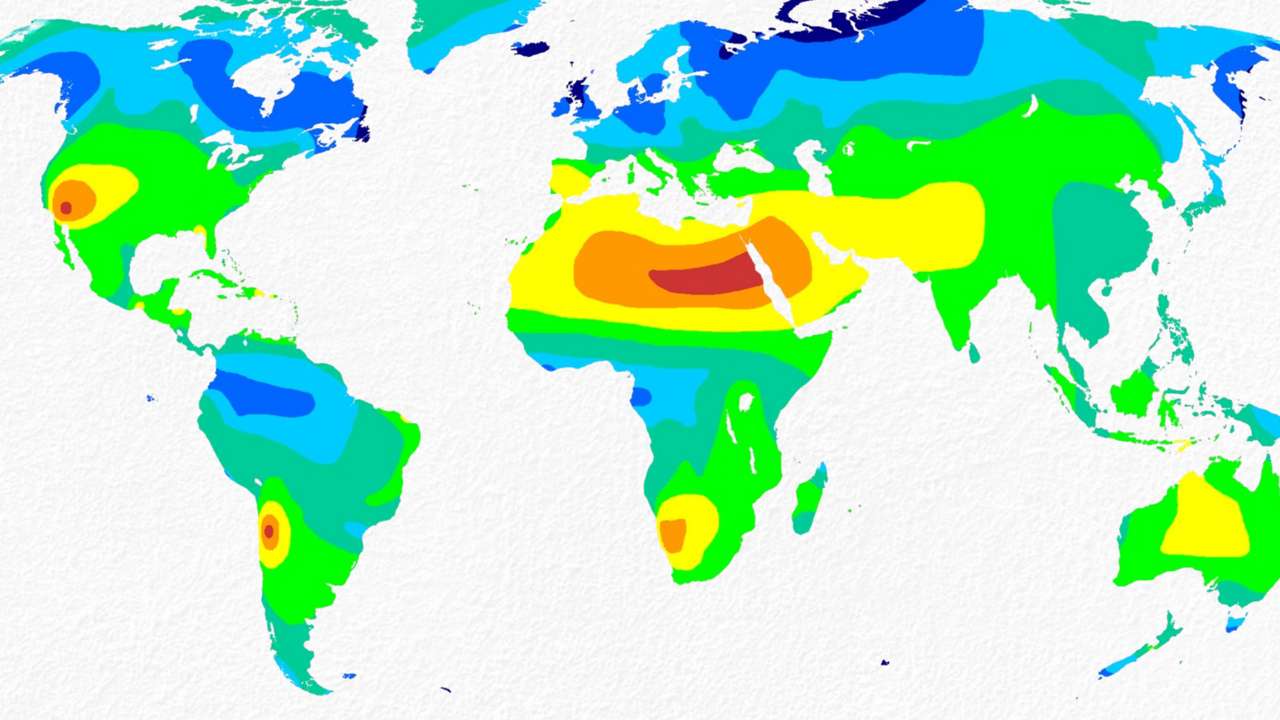
The amount of sunshine people experience each year varies dramatically around the world, with some desert regions receiving more than 4,000 hours of bright sunshine annually, while some northern and persistently cloudy areas get less than 1,200.
Key points
- Some desert regions exceed 4,000 sunshine hours
- Northern Europe records far fewer sunny hours
- Cloud cover helps explain the global divide
The amount of sunshine people experience each year varies dramatically around the world, with some desert regions receiving more than 4,000 hours of bright sunshine annually, while some northern and persistently cloudy areas get less than 1,200.
The map shows the highest totals across the world's dry subtropical regions. Parts of the Sahara and Arabian Peninsula exceed 4,000 hours a year, while large areas of North Africa and the Middle East fall between 3,000 and 4,000 hours.
Similar sunny zones appear in the southwestern United States, western South America, southern Africa and inland Australia. These areas are home to some of the world's major deserts and tend to experience long periods with little cloud cover.
The pattern changes sharply farther north. Much of northern Europe, northern Canada and parts of Russia receive fewer than 1,600 hours of sunshine annually, with some areas falling below 1,200 hours.
RECOMMENDED FOR YOU

Argentina takes Britain to International Court, demands halt to Falklands oil project
The world's sunniest places are not necessarily those closest to the equator.
Many of the highest totals occur roughly 20 to 35 degrees north and south of the equator, where large subtropical high-pressure systems help create dry, stable conditions and suppress cloud formation. This is one reason many of the world's major deserts are found within these belts.
Equatorial regions can actually receive less bright sunshine. Although the sun is high in the sky throughout the year, frequent clouds, thunderstorms and heavy rainfall across tropical regions can reduce the number of hours when direct sunlight reaches the surface.
Europe shows the same relationship between climate and sunshine. Satellite-based climate data for 1991-2020 show annual sunshine generally increasing from northern Europe towards the Mediterranean and North Africa, with some parts of North Africa recording more than 3,500 hours a year.
“Sunshine hours” do not simply mean the number of hours between sunrise and sunset.
The World Meteorological Organisation defines sunshine duration as the time when direct solar radiation exceeds 120 watts per square metre. It is therefore a measure of bright sunshine reaching a location rather than the total amount of daylight available.
Sunshine duration is also different from solar energy or insolation. Two places with similar sunshine hours can receive different amounts of solar energy because the strength and angle of sunlight also matter.
RECOMMENDED FOR YOU

Venezuela's Machado pushes for 2027 presidential election after return
This story is written and edited by the Global South World team, you can contact us here.