Air strikes and lentil soup: life grinds on in wartime Gaza

Air strikes and lentil soup: life grinds on in wartime Gaza
By Fadi Shana and Bassam Masoud
Children poke at rubble with their feet after an air strike and pick up household items from the debris. Families queue for sacks of flour distributed by U.N. workers. Volunteers cook lentil soup to warm up displaced people drenched by rain.
Life was grinding on across the Gaza Strip on Tuesday, in the seventh week of the war between Israel and Hamas, with a new normal defined by destruction, displacement and the daily hardship of looking for food and trying to stay dry.
RECOMMENDED FOR YOU

New Asia Forum: Indonesia to set out progress on sustainable AI data centres
In Khan Younis, the town in southern Gaza where hundreds of thousands of residents of the north have fled to escape intensive Israeli bombardment, neighbours said an overnight strike on an apartment had killed seven people, mostly children.
"Flesh is on the walls and in the streets here. What's the guilt of those children?" said Younis Abd al-Hady, a local resident who was among several surveying the wreckage.
Around him, children were picking at the rubble strewn on the street below the targeted building, which was still standing but with one floor almost entirely gone, its only remaining fragments of walls blackened.
Israel says its strikes are aimed at Hamas infrastructure, based on intelligence. It blames Hamas for civilian casualties, saying the Islamist group it has vowed to destroy uses them as human shields.
But that argument held no sway with al-Hady, who raged at Israel, which he blamed for the deaths and misery.
"We are all targeted, wherever we go we are targeted. Child, man, elderly, all are targeted. In Gaza City or in any other place they are after us. They are asking people to leave and then strike them on the road, hundreds of people," he said.
The war was triggered by Hamas militants rampaging through southern Israel on Oct. 7, killing 1,200 Israelis and abducting 240, according to Israel, which has responded with a military assault that has killed some 13,000 Palestinians, according to health officials in the Hamas-controlled enclave.
In Jabalia in the northern Gaza Strip and in Rafah in the south, Tuesday morning brought tragically familiar scenes of adults and children wounded in bombardments being rushed into overcrowded hospitals.
RECOMMENDED FOR YOU

Europe recruits migrant workers. So why doesn't it tell them how to see a doctor?
FLOUR AND LENTILS
In Rafah, an aid truck full of sacks of flour was being unloaded by U.N. workers in distinctive blue vests. People were carrying them away on bicycles, donkey carts or on their backs.
Life-saving for hundreds of thousands of Gazans, the food aid coming through the Rafah border crossing is nevertheless insufficient to feed everyone adequately.
"We are 13 people. These three or four bags (of flour) they're giving us are not enough for us. We used to take eight, 10 bags. This is not nearly enough," said Taghreed Jaber, a woman displaced from Beit Hanoun in the north of the strip.
Jaber said her family were living in tents and were unable to stay dry when it rained. She said the children were too cold sleeping on the floor, and they needed blankets. Before the arrival of the flour, they had been eating only rice for days.
"Flour can't be found anywhere. I came from the north 20 days ago and haven't been able to find any flour. I bought some rice and we're surviving on rice," she said.
Back in Khan Younis, a group of volunteers had banded together to cook large pots of lentil soup for displaced people in one of the tent cities that have sprung up, with donors providing money or ingredients to make the project possible.
Men, women and children lined up with empty bowls and plastic food containers, waiting for their share of the fragrant soup simmering in three large metal pots, as men stirred it with a ladle and a long plank of wood.
RECOMMENDED FOR YOU
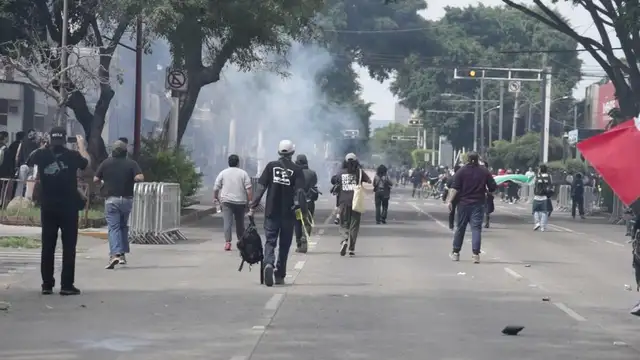
‘We want water, not poison’ - Guadalajara protests end in fires and vandalism
"Lentil soup used to be an ordinary dish that no one cared about, but for us now it's better than lamb meat. We are thankful that the lentil soup is now available to us, thanks to these volunteers," said displaced woman Mounira al-Masry.
Hussein Abu Ramadan, also displaced, was organising the cooking of the soup, which was taking place on small fires built on damp sandy ground, with tarpaulin tents all around.
"Lentil soup is a traditional dish for Palestinians," he said.
"When it rained no one was safe in their tent. The rain and cold have reached everyone, especially those with children. Because of this, volunteers started to think about serving lentil soup, the winter dish that can warm people."
While the soup was enough to bring a measure of comfort, even children could not forget the desperate situation.
"It's not a life that we are living now. No life, no food, no drink, nothing. Even the rain is pouring on us. We can't sleep because of it," said Maram al-Tarabeesh, a young girl with braided hair.
This article was produced by Reuters news agency. It has not been edited by Global South World.