The origin of Europe's rising extremism is in the last place you might expect: Opinion

The rise of radical parties also says something uncomfortable about mainstream politicians: in an increasingly uncertain world, they are no longer able to offer people a direction they can understand and trust.
A few years ago, a victory of a political party considered extremist in a European election seemed like an exception that demanded serious explanation. Today, such results occur often enough to have become part of the political landscape. The radical right wins elections or becomes a major parliamentary force. The radical left mobilises voters whom mainstream parties can no longer persuade. The centre's response is predictable: surprise, indignation and a promise to communicate better next time.
The forms vary from Germany to Portugal, from France to Czechia, and the categories should not be conflated. Some forces are radical, others merely populist, and the distinction matters. Nor has the trajectory been the same everywhere. In the Netherlands, D66 defeated the PVV; in Hungary, Tisza brought Viktor Orbán's government to an end. These examples do not undermine the argument that follows. They reinforce it: in both cases, the winner offered a direction voters could sum up in two sentences. The more interesting question, then, is why some parties manage to become credible alternatives while others, long accustomed to governing, no longer do.
Policy indecision
The convenient explanation is that people have become radicalised. The uncomfortable one is that parties of the centre have become hard to understand and, above all, impossible to predict. What weakens them is not moderation, but the impression that they change their positions as they go, without being able to say where they are headed. Today a measure is indispensable; tomorrow it is impossible because of the budget or an EU decision. Today an alliance is ruled out; after the election it becomes proof of responsibility.
RECOMMENDED FOR YOU
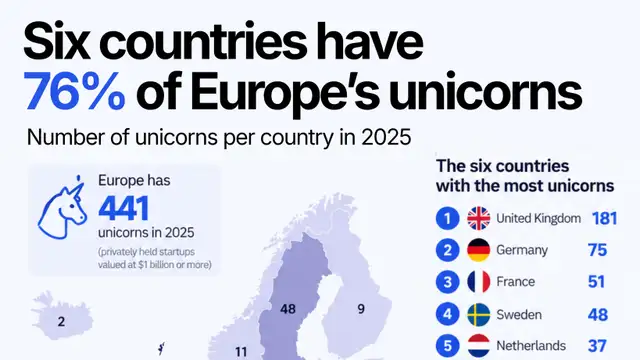
Six countries account for three-quarters of Europe’s unicorn startups
Germany offers a clear example of how this works. Friedrich Merz campaigned on a promise of fiscal discipline and a halt to new debt. Immediately after the election, he negotiated a sweeping relaxation of that commitment with the SPD. One can argue that circumstances required it. But voters backed a man who promised one thing and got one who did something quite different. Their conclusion is: "I may not know whom to vote for next time, but I know whom I will not vote for." Voters treat him the way they treat a stopped clock, which is right twice a day: they do not accuse it of lying; they simply stop consulting it.
The need for certainty grows in a world where almost everything feels provisional: prices, jobs, security, the rules by which decisions are made. Radical parties respond with a simple story. They identify the problem, name the culprit, announce a direction and promise not to stray from it. Their solutions may be unrealistic or dangerous. But they offer something the centre increasingly fails to convey: the sense that voters can anticipate what they will do in power.
The centre talks about complexity, balance and compromise. Radicals talk about cause, culprit and solution. The first account is more honest about the constraints of governing; the second is instantly understood and gives people a sense of control. People do not vote simply for the best-supported programme. They also seek, and vote for, a direction they can recognise.
Firefighting arsonists
Romania illustrates the cost of this rupture. In November 2024, Călin Georgescu, an almost unknown candidate, came first in the opening round after a campaign conducted predominantly on TikTok. The Constitutional Court, alerted to allegations of blatant foreign interference in the manipulation of the election, annulled the vote. The authorities accused Russia of heavy-handed interference and promised to make the evidence public. Almost two years later, that evidence has not been presented to Romanians. What has emerged instead is clear information about electoral conduct by the governing parties that is, at the very least, questionable—the very parties that had called for democracy to be defended. Whoever raises the fire alarm must not be found holding the match. The coalition's credibility was damaged, and when the election was rerun in 2025, its candidate, Crin Antonescu, did not even reach the second round. The warning worked as an alarm, not as a programme. And an alarm that sounds without evidence no longer frightens anyone; it only teaches people to stop looking up when it rings.
This is also where the explanation that attributes the rise of the extremes primarily to Russia falls short. The threat is real, and some European parties do appear to promote positions favourable to Moscow's interests. But the label "pro-Russian" does not, on its own, explain why a citizen abandons the party they supported until yesterday for another branded extremist. If people are told that their vote serves Moscow, yet no one gives them convincing answers about housing, income, public services or safety, the warning sounds like further proof that no one is listening.
Here lies the paradox mainstream parties refuse to confront. They denounce Russia's actions against European democracies, yet through ineffectiveness, abandoned promises and a habit of answering discontent with stock phrases and labels, they produce an effect from which Russia benefits: they drive voters towards forces that challenge Western institutions and Europe's Western orientation. To say that this effect favours Europe's adversaries is not to attribute those adversaries' intentions to mainstream parties. It is to ask them to take responsibility for the consequences of their own failures.
Radical parties should not be spared scrutiny either. It is easy to promise to stop immigration, nationalise housing or rapidly change energy policy. It is much harder to show how to do any of this legally, how to pay for it and how to avoid making worse the very problem they claim to solve. Clarity of purpose does not guarantee competence in government. But that observation will not save the centre if its only offer remains an explanation of why nothing can be done. Voters are tired of explanations; they want results. Explanations without results are merely well-articulated excuses.
Mainstream parties will not regain trust by asking people to accept confusion as the price of responsibility. They need clear priorities, credible deadlines and a willingness to answer for results. Compromise remains necessary in a democracy; the direction must still be recognisable after the compromise.
RECOMMENDED FOR YOU

Olympic flame arrives on African soil for first time as Senegal begins Dakar 2026 countdown
Europe is not inevitably heading towards the extremes. But the centre opens the door to them every time it confuses defending democracy with defending its own seats. The warning "the extremists are coming" no longer frightens anyone when it comes from people who have never said where they themselves are going. Anyone asking for trust must first earn it.This article exclusively represents the opinions of its author Silviou Predoiu and not those of Global South World.
