Amazon rainforest spans nine territories, with most of it in Brazil
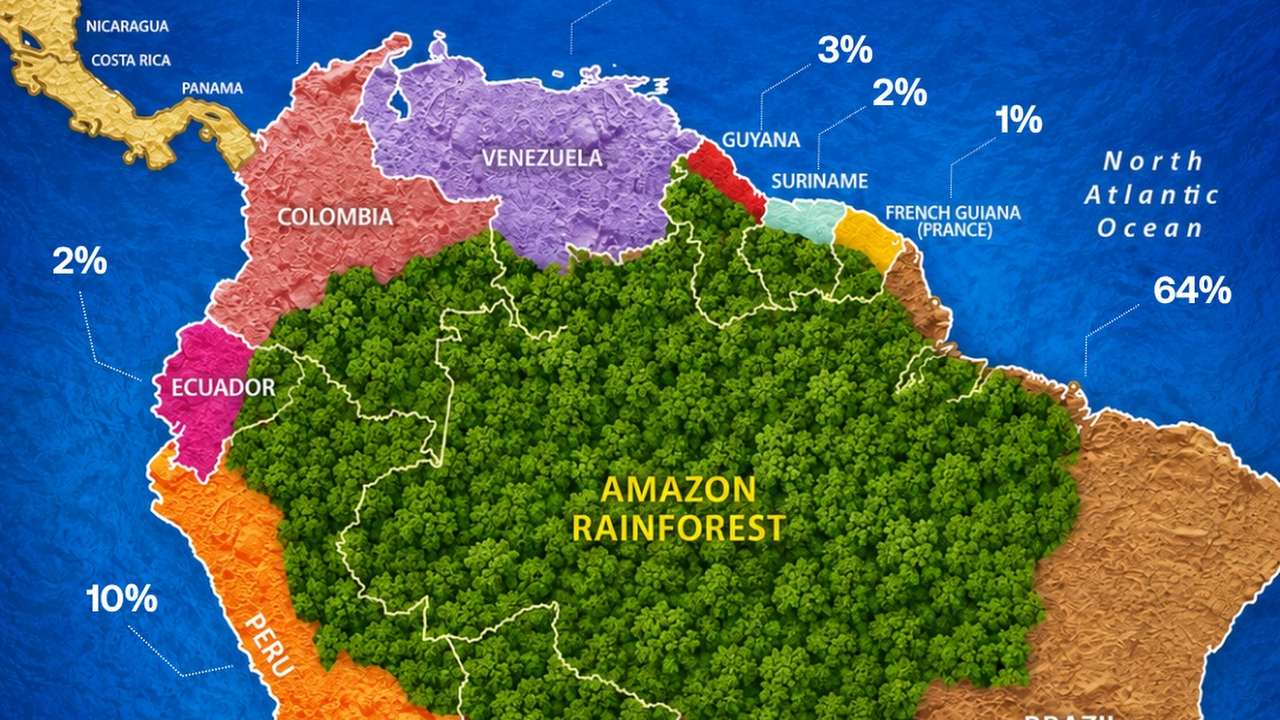
The Amazon rainforest stretches across eight South American countries and French Guiana, making it the world's largest tropical rainforest and one of the planet's most important ecosystems.
Key Points
- The Amazon stretches across eight countries and French Guiana
- Brazil holds about three-fifths of the Amazon biome
- The region contains about 10% of Earth's known species
The Amazon rainforest stretches across eight South American countries and French Guiana, making it the world's largest tropical rainforest and one of the planet's most important ecosystems.
The Amazon biome covers about 6.7 million square kilometres, according to WWF. It extends across Brazil, Bolivia, Peru, Ecuador, Colombia, Venezuela, Guyana and Suriname, as well as French Guiana, an overseas territory of France.
Brazil contains by far the largest share. WWF estimates that roughly three-fifths of the Amazon biome is in Brazil, followed by Peru, Colombia, Venezuela, Bolivia, Guyana, Suriname, Ecuador and French Guiana by area.
The attached graphic gives Brazil a 64% share and Peru a 10% share, but these figures should be treated with caution. Different sources use different boundaries for the Amazon rainforest, Amazon biome, and Amazon basin, resulting in different percentages. WWF sources commonly put Brazil's share at around 60%.
RECOMMENDED FOR YOU
Why Gaddafi once wanted Switzerland split between three countries
The Amazon also holds extraordinary biodiversity. WWF says the region contains about 10% of Earth's known species, while its vast river system plays an important role in freshwater flows and climate regulation.
The forest crosses national borders, making its protection an international issue. Eight Amazon countries are members of the Amazon Cooperation Treaty, signed in 1978 to promote cooperation across the region. French Guiana is part of France and is not one of the treaty's eight member states.
The Amazon faces continuing pressure from farming, cattle ranching, logging, mining, infrastructure development and climate change. WWF says protecting the forest requires cooperation across the countries that share it rather than action by any single government.
This story is written and edited by the Global South World team, you can contact us here.