Bosnia's peace envoy moves to unblock state finances, Serbs cry foul
By Daria Sito-Sucic
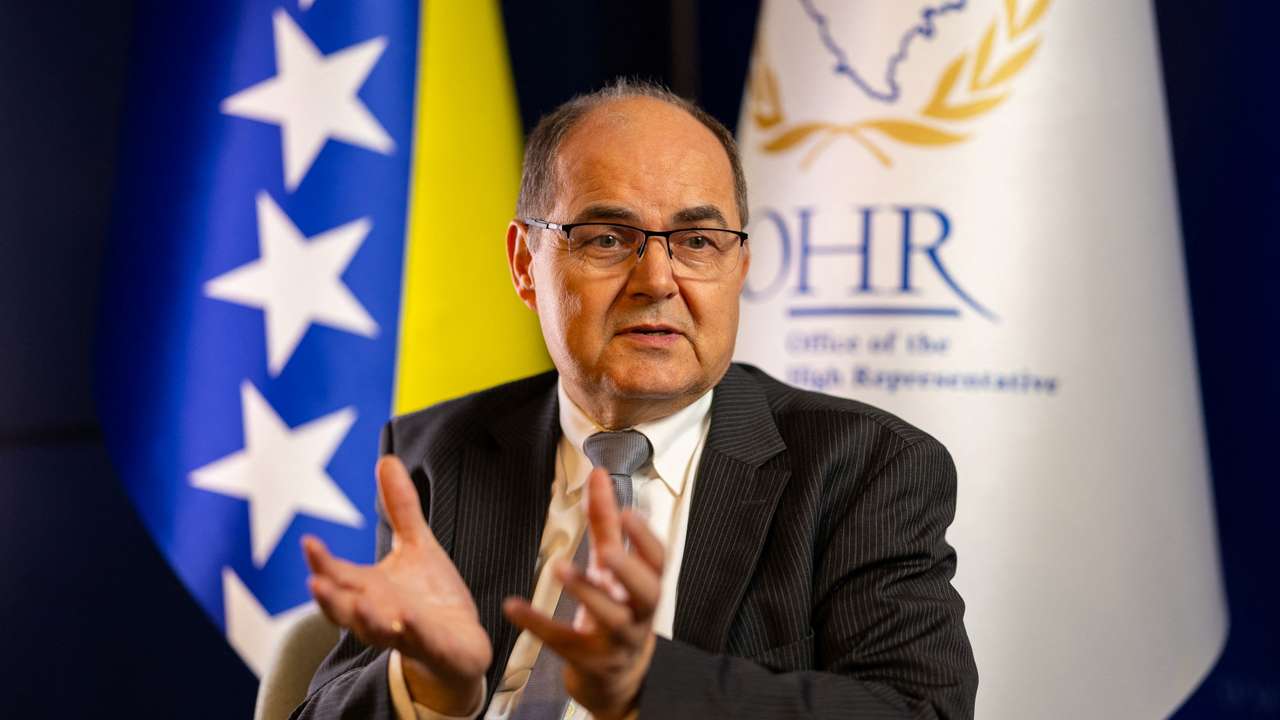
Bosnia's peace envoy issued a ruling on Thursday to clear a long-standing state debt that has blocked the 2025 budget and deepened a political crisis, but Serb politicians rejected his move, raising the prospect of more turmoil.
Envoy Christian Schmidt, using his powers to intervene in laws and finance, ruled that debt would be paid out of the autonomous Serb Republic's share of road tolls, and said his final decision would come into force immediately.
Serb ministers - who argue the debt to Slovenia's Viaduct company should be paid out of the profits of Bosnia's national central bank - said Schmidt's imposition of a ruling undermined the fractured nation's complex balance of powers.
RECOMMENDED FOR YOU
Netanyahu warns Israel’s enemies of harsher strikes ahead of election
The dispute underlined the challenges of governing a country - an EU candidate made up of the Bosniak-Croat Federation and the Serb Republic - under the fragile Dayton peace agreement that ended Bosnia's 1992-95 war.
Schmidt has his powers under a separate accord, though the Serbs do not recognise his appointment.
"Schmidt ... does not have the right to make decisions and everything he does is breaking Bosnia and Herzegovina down," Serb Republic President Milorad Dodik told a press conference.
"This shows that European politics here has collapsed," added Dodik, a pro-Russian nationalist who wants the Serb Republic to secede from Bosnia. Dodik had accused the EU of backing Schmidt, a former German government minister.
HYDRO-POWER DEBT
The Serb Republic incurred the debt to Viaduct after it terminated a contract for the building of a hydro-power plant in 2013, said Zeljka Cvijanovic, a Serb member of Bosnia's presidency who was the Serb Republic premier at the time.
The company took the regional government to arbitration through the Washington-based International Centre for Settlement of Investment Disputes, Schmidt said in his ruling.
That body ruled in April 2022 that Bosnia as a whole should pay Viaduct nearly 80 million Bosnian marka ($47.4 million) - with interest fees taking it to its current level of about 120 million marka, Schmidt added.
RECOMMENDED FOR YOU

Indonesia's 2026 forest fires burn nearly 2 million hectares as crisis worsens
Bosniak and Croat members of the country's tripartite inter-ethnic presidency have refused to approve the 2025 state budget until it is clear how the debt will be paid.
The stand-off is part of a broader political crisis that erupted after Dodik was sentenced in February to one year in jail and banned for six years from politics for defying Schmidt's decisions. He appealed against the court's ruling.
On Thursday Schmidt ruled that 120 million marka from the Serb Republic's share of road tolls would be allocated to the Treasury to settle the Viaduct claim. "This approach is in line with a principle that one who incurs the debt must pay for it," he said.
In a separate ruling, he said that the central bank's profits could now be used to pay to upgrade voting systems ahead of general elections due in 2026.
Serb Republic Prime Minister Radovan Viskovic said his government will ask Serb ministers in the national government to dispute Schmidt's decisions.
This article was produced by Reuters news agency. It has not been edited by Global South World.