Brazil alone accounts for about half of South America’s economy
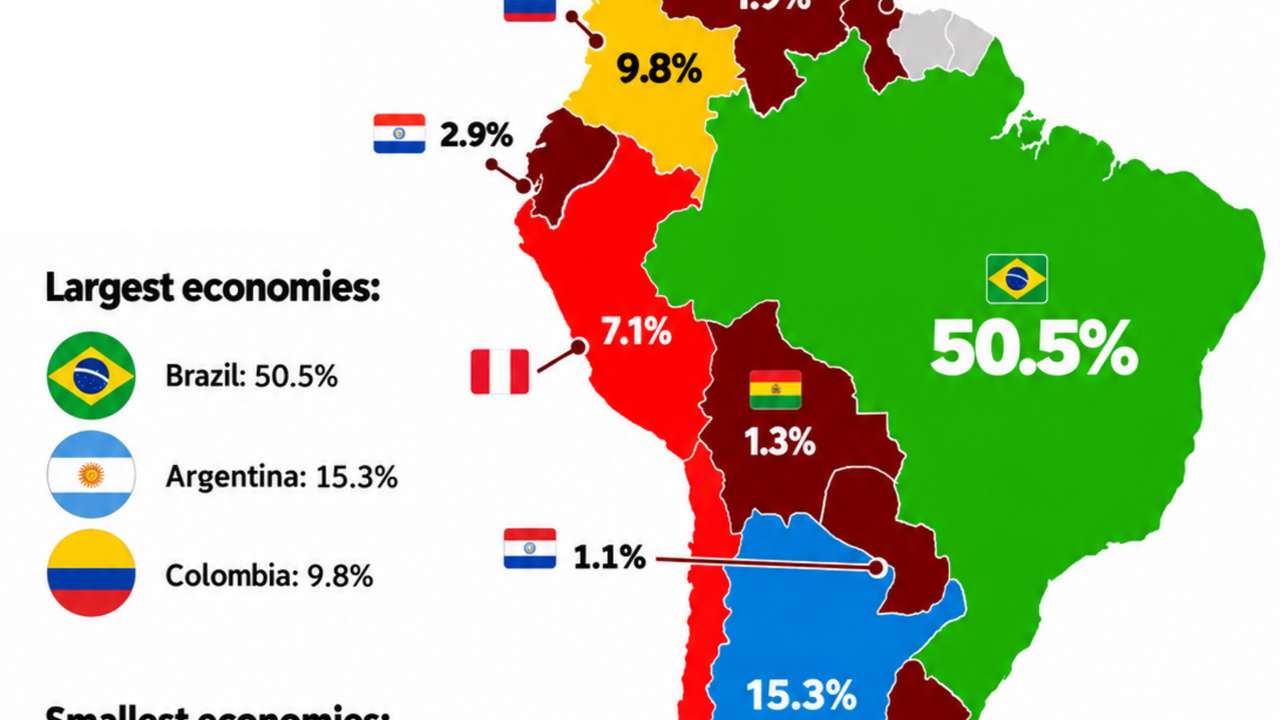
Brazil accounts for roughly half of South America’s economic output, highlighting the enormous difference in economic scale between the region’s largest country and its neighbours.
Key points
- Brazil produces about half of regional GDP
- Argentina and Colombia are the next largest
- Exchange rates can quickly change the shares
Brazil accounts for roughly half of South America’s economic output, highlighting the enormous difference in economic scale between the region’s largest country and its neighbours.
The infographic puts Brazil at 50.5% of South America’s nominal GDP, followed by Argentina at 15.3% and Colombia at 9.8%. Chile and Peru account for 7.8% and 7.1%, respectively.
Together, those five economies represent more than 90% of the total shown, leaving a much smaller share divided among the continent’s other countries.
Brazil is in a league of its own
The broad picture is consistent with IMF data, although the precise shares depend on the year and dataset used. The IMF’s April 2026 World Economic Outlook projects Brazil’s economy to grow by 1.9% in 2026, compared with 3.5% for Argentina and 2.3% for Colombia.
RECOMMENDED FOR YOU

Can Indonesia be Asia’s next EV powerhouse?
Brazil’s dominance is partly a matter of scale. It is South America’s most populous country and has a large, diversified economy spanning agriculture, mining, manufacturing and services.
The IMF’s latest figures also show that nominal GDP rankings can shift substantially when currencies move. Because the map compares economies in current US dollars, a sharp rise or fall in a local currency can change a country’s share even without an equally dramatic change in actual production.
The graphic puts Guyana at just 0.6% of regional GDP, Paraguay at 1.1% and Bolivia at 1.3%. But a small share does not necessarily mean slow growth.
Guyana is the clearest example. Its oil boom has made it one of the world’s fastest-growing economies, with the IMF forecasting 16.2% real GDP growth in 2026, far above Brazil and most of its South American neighbours.
This story is written and edited by the Global South World team, you can contact us here.