Canada and EU deepen ties on defence, trade and energy
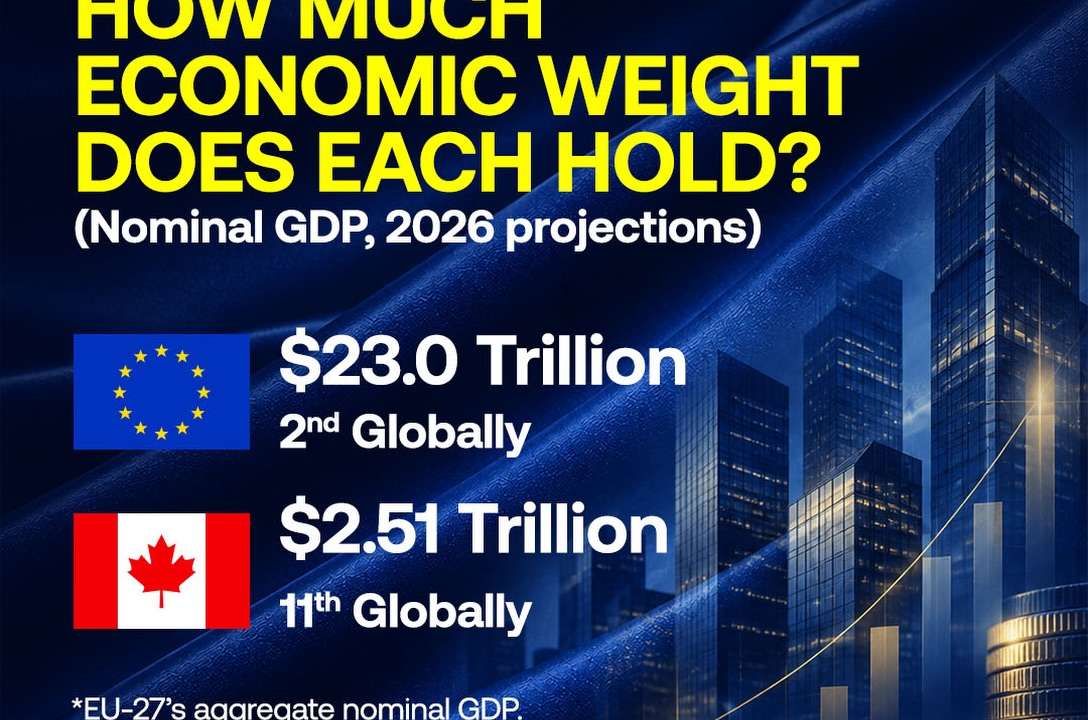
Canada and the European Union are moving towards a broader strategic partnership spanning defence, energy, critical minerals, technology and trade, as both sides seek to reduce their exposure to increasingly uncertain global supply chains and security risks.
Main points
- Canada is the first non-European country in SAFE
- Defence and critical minerals are driving closer ties
- Canadians increasingly support deeper EU cooperation
Canada and the European Union are moving towards a broader strategic partnership spanning defence, energy, critical minerals, technology and trade, as both sides seek to reduce their exposure to increasingly uncertain global supply chains and security risks.
The relationship has accelerated since Canada and the EU signed a Security and Defence Partnership in June 2025. Canada became the first non-European country to participate in the EU's Security Action for Europe, or SAFE, after an agreement was signed in February 2026 and formally concluded by the EU Council in June.
SAFE provides up to €150 billion in loans to EU member states for defence investment and joint procurement. Canada cannot itself borrow from the fund, but the agreement allows Canadian companies and products greater participation in SAFE-funded contracts. That distinction is important: Canada has joined the procurement framework, not gained access to €150 billion for its own defence spending.
The cooperation comes as both sides increase defence investment and strengthen support for Ukraine. Their security partnership covers areas including military mobility, maritime and space security, cyber threats, critical infrastructure and emerging technologies. NATO remains the foundation of collective defence for Canada and the EU countries that belong to the alliance.
RECOMMENDED FOR YOU
Asia produces the largest share of global GDP
Energy and minerals add another layer
Canada's natural resources strengthen the economic case for closer cooperation.
It was the world's largest potash producer in 2024, accounting for 32.8% of global output, and the second-largest uranium producer, responsible for 24%. Canadian government data also rank the country as the world's fourth-largest crude oil producer.
Those resources have become more strategically important as Europe restructures its energy supplies following Russia's invasion of Ukraine.
Russia supplied about 45% of EU gas imports in 2021, but its share had fallen to around 12% by 2025. Norway became the EU's largest gas supplier, while the United States sharply increased its role, particularly in liquefied natural gas.
Europe nevertheless remains heavily dependent on imported energy. Eurostat says net imports supplied 57% of the EU's energy needs in 2024. That leaves scope for deeper cooperation with Canada in uranium and critical minerals, although geography and infrastructure mean Canadian oil and LNG cannot automatically replace other suppliers.
Trade relationship is already growing
Closer ties are not starting from scratch.
The EU is Canada's second-largest trading partner, and bilateral goods trade grew 65% between 2017, when the Comprehensive Economic and Trade Agreement provisionally took effect, and 2024, reaching €75.6 billion. Canadian merchandise exports to the EU then increased another 23.4% in 2025.
The two sides are now negotiating a digital trade agreement and exploring deeper cooperation in artificial intelligence, high-performance computing, quantum technology, research and critical minerals.
RECOMMENDED FOR YOU
From Suomi to Zhongguo, why some countries have completely different names at home
Canadian Prime Minister Mark Carney pushed the relationship further during a September 17 address to the European Parliament, proposing deeper cooperation in energy security, defence production, AI, computing, space and payments, as well as more seamless digital trade.
European Commission President Ursula von der Leyen has also floated the possibility of Canada becoming the EU's first “associate member”, but what that status would mean has not been defined. Reuters reported that the proposal faces questions from EU governments and Canadian officials, meaning it should be understood as an emerging political idea rather than an established form of EU membership.
Canadians increasingly look towards Europe
The shift also has considerable public support in Canada.
An Abacus Data survey conducted September 4-9 among 1,479 Canadian adults found 80% supported deeper strategic cooperation with the EU on foreign policy, defence and economic priorities. Another 81% supported closer integration while Canada remained outside the bloc.
The poll found 61% believed closer European ties would increase Canada's economic independence by giving it better access to markets and essential supplies without relying too heavily on one country. Thirty-nine percent were more concerned about continued dependence on the United States, compared with 16% who were more concerned that closer EU ties could damage Canada's relationship with Washington.
There are limits to how quickly the relationship can change. The United States remains deeply integrated with Canada's economy and defence system, while Europe is geographically farther away and has its own regulatory and political barriers. Reuters reported that the two sides still need to work through what substantially deeper integration would mean in practice.
For now, the clearest change is not Canadian membership in Europe but diversification. Canada offers resources, defence production and technology, while the EU offers a large market, investment, research capacity and an expanding defence procurement system. The next Canada-EU summit, scheduled for October 29-30 in Canada, is expected to provide the next test of how far that partnership can go.
This story is written and edited by the Global South World team, you can contact us here.