China and India climb global economic rankings
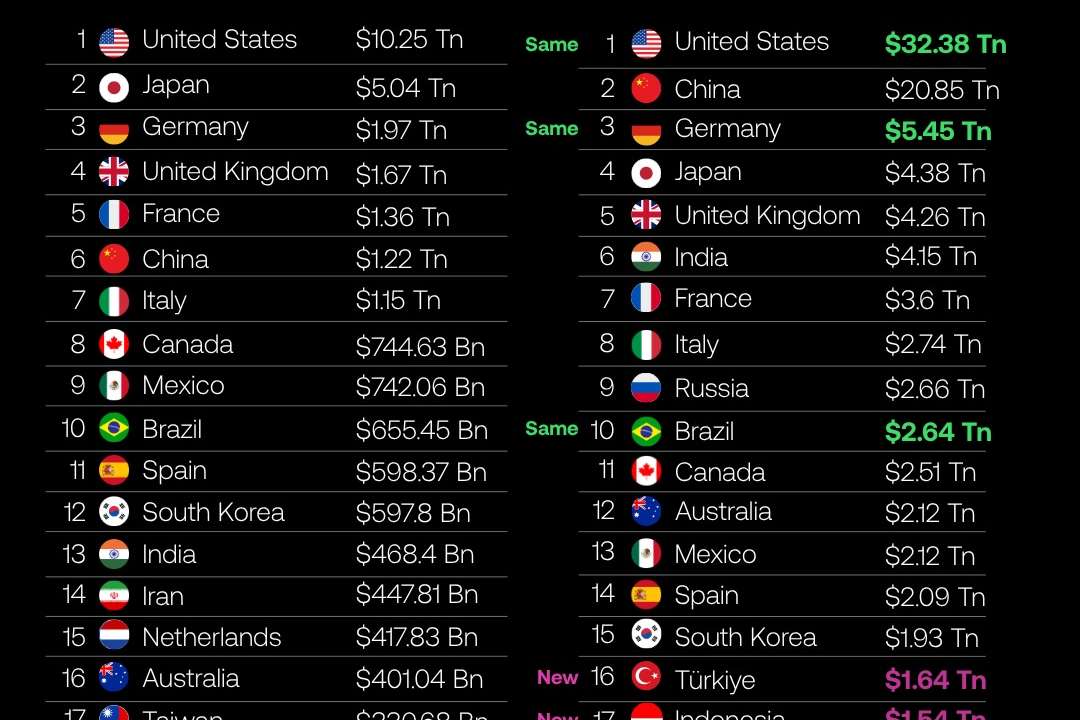
The world's biggest economies have changed substantially since 2000, with China and India recording some of the largest jumps while the United States remains firmly in first place, according to the International Monetary Fund.
Main points
- The United States remains the largest economy
- China has risen from sixth to second
- India has climbed from 13th to sixth
The world's biggest economies have changed substantially since 2000, with China and India recording some of the largest jumps while the United States remains firmly in first place, according to the International Monetary Fund.
The IMF's April 2026 World Economic Outlook projects US nominal GDP at about $32.38 trillion in 2026, making it the world's largest economy at current US dollar exchange rates. China follows at $20.85 trillion, while Germany ranks third at about $5.45 trillion.
Japan, once the world's second-largest economy, is projected to rank fourth at $4.38 trillion, narrowly ahead of the United Kingdom at $4.26 trillion. India follows at $4.15 trillion, ahead of France and Italy.
China and India make the biggest advances
The change since 2000 is particularly striking for Asia's two most populous countries.
RECOMMENDED FOR YOU
Can Indonesia be Asia’s next EV powerhouse?
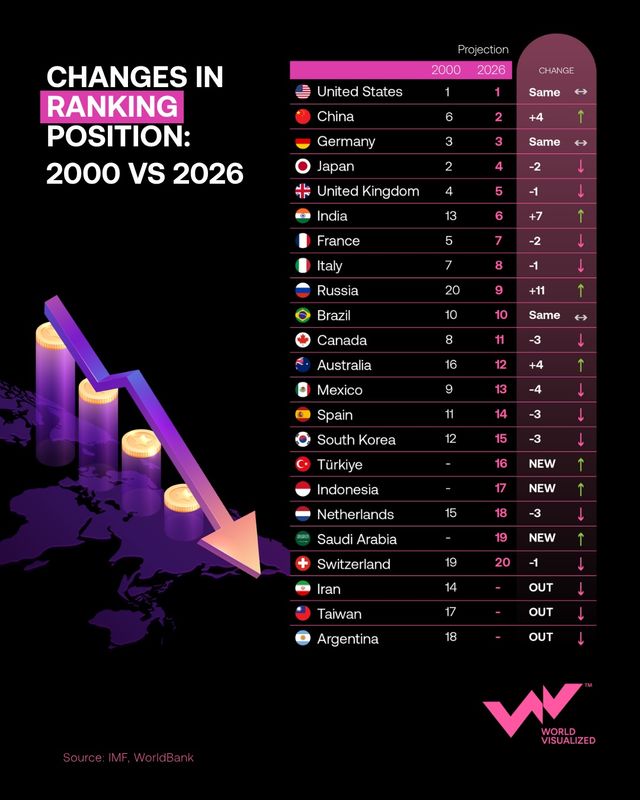
China was the sixth-largest economy in 2000, with a nominal GDP of roughly $1.22 trillion. It is projected to rank second in 2026, an increase of four places.
India has moved even further up the table. It ranked 13th in 2000, with a GDP of about $468 billion, but is projected to reach sixth place in 2026. That represents a seven-place rise.
Russia also shows a large change in the graphic, moving from 20th in 2000 to a projected ninth in 2026. Australia rises from 16th to 12th.
Meanwhile, several established advanced economies have slipped in relative position. Japan falls from second to fourth, France from fifth to seventh, Canada from eighth to 11th and Spain from 11th to 14th.
Türkiye, Indonesia and Saudi Arabia are projected to be among the top 20 in 2026 after sitting outside it in 2000. Iran, Taiwan and Argentina, which were among the 20 largest economies at the start of the century, are no longer in the group under the graphic's comparison.
The rankings do not measure living standards
These figures measure nominal GDP in current US dollars, so they show the total dollar value of each economy rather than how wealthy individual residents are. Exchange-rate movements can also change a country's dollar GDP and therefore its ranking even without an equivalent change in its real economic output.
The 2026 figures should also not be treated as final results. They are IMF projections based on information available through April 1, 2026. The IMF says its historical figures are also updated as new information becomes available.
The April outlook projects global economic growth of 3.1% in 2026, but the IMF warns that geopolitical tensions, trade disruption and other risks could weaken the outlook.
RECOMMENDED FOR YOU

Russia warns Europe of swift military response if war breaks out
This story is written and edited by the Global South World team, you can contact us here.