China dominates global solar power capacity with more than half of top 10 installations
Main Points
- China holds more than half of the top 10 solar capacities
- US ranks second but trails China by over 470 GW
- Global solar capacity reached 1,419 GW in 2023
China held an overwhelming lead in global solar power capacity at the end of 2023, with about 610 gigawatts installed, more than four times the capacity of the United States, as a record year of renewable-energy expansion strengthened Asia's position at the centre of the global solar industry.
Data published by the International Renewable Energy Agency (IRENA) show global solar capacity reached about 1,419 GW at the end of 2023, after the world added a record 346 GW during the year, an increase of 32.2%. Solar accounted for nearly three-quarters of all new renewable capacity installed worldwide.
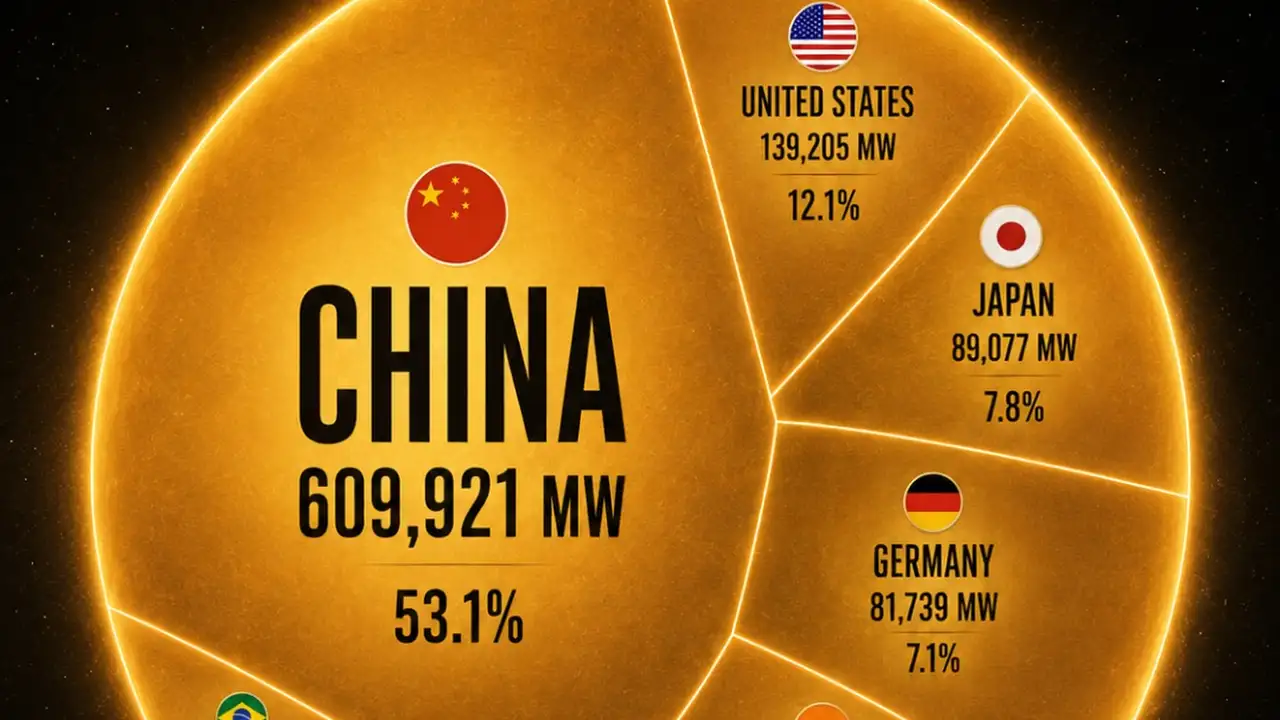
The infographic, based on IRENA's 2024 statistics, puts China at 609,921 MW, representing about 53% of the combined solar capacity of the 10 countries shown. The United States ranked second with 139,205 MW, followed by Japan with 89,077 MW, Germany with 81,739 MW and India with 73,109 MW.
The remaining five were Brazil with 37,449 MW, Australia with 32,612 MW, Spain with 31,016 MW, Italy with 29,795 MW and the Netherlands with 23,904 MW.
RECOMMENDED FOR YOU
From Suomi to Zhongguo, why some countries have completely different names at home
China's 609.9 GW total was about 470.7 GW greater than the United States', illustrating the extraordinary scale at which the world's second-largest economy had deployed solar generation.
Its installed capacity was also larger than the combined totals of the other nine countries displayed in the ranking.
China's position forms part of a broader concentration of renewable-energy growth in Asia. IRENA said 69% of all new renewable capacity installed globally in 2023 was in Asia. Solar and wind together accounted for 97.6% of worldwide net renewable additions during the year.
The United States' 139.2 GW placed it comfortably second in the ranking but left its installed base at less than one-quarter of China's.
Japan remained third at 89.1 GW, reflecting years of solar deployment following changes to the country's energy system after the 2011 Fukushima nuclear disaster.
Germany, Europe's largest economy, ranked fourth at 81.7 GW, making it the highest-ranked European country in the graphic.
India followed at 73.1 GW. Its position is particularly significant as New Delhi continues to expand renewable generation to meet rapidly increasing electricity demand while reducing the carbon intensity of its power system.
Record installations still fall short of 2030 target
Despite 2023's record expansion, IRENA said deployment was not yet fast enough to meet the global commitment agreed at COP28 to triple renewable power capacity by 2030.
RECOMMENDED FOR YOU
Asia produces the largest share of global GDP
The agency estimated that roughly 1,050 GW of renewable capacity would need to be added annually for the remainder of the decade to remain aligned with its 1.5°C pathway, more than twice the 473 GW of total renewable capacity added in 2023.
The subsequent expansion has been even faster. IRENA says global solar capacity climbed to about 1,865 GW by the end of 2024, after more than 451 GW of new solar PV was installed in a single year.
That acceleration underscores the central feature of the 2023 ranking: solar deployment has become global, but its installed capacity remains exceptionally concentrated in China.
This story is written and edited by the Global South World team, you can contact us here.