Europe’s pension divide exposed as wide East–West gap refuses to close
Pension income across Europe remains sharply uneven, with retirees in southern and eastern countries receiving significantly lower monthly payments than their northern counterparts, according to recent data compiled from Eurostat and the OECD.
Pension income across Europe remains sharply uneven, with retirees in southern and eastern countries receiving significantly lower monthly payments than their northern counterparts, according to recent data compiled from Eurostat and the OECD.
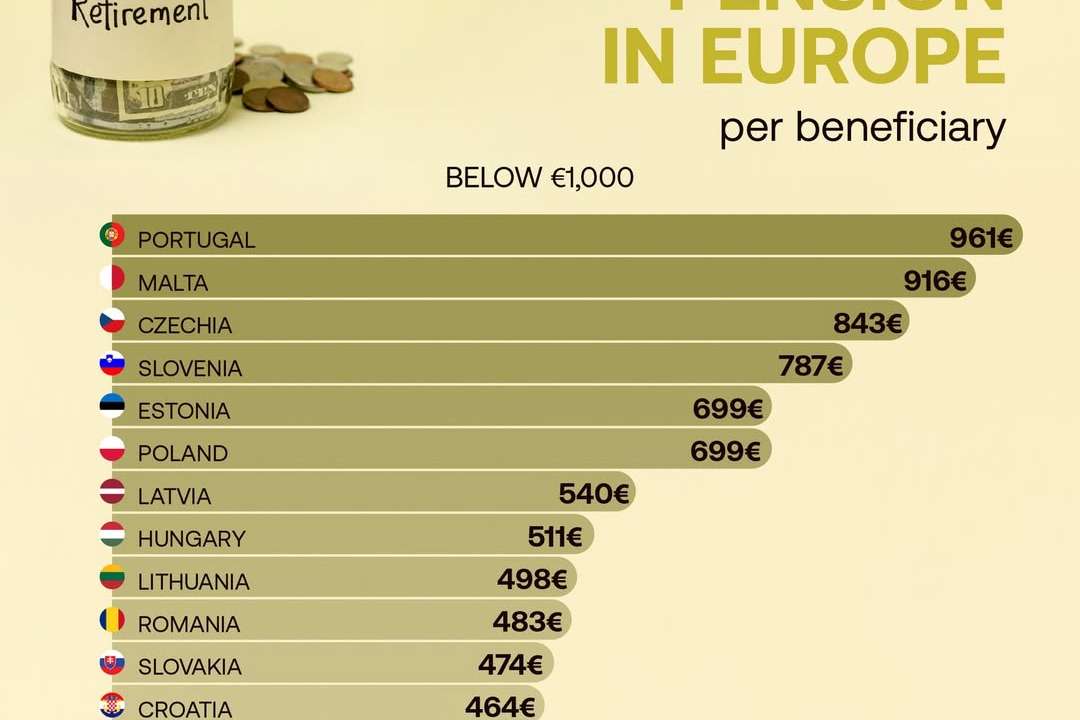
A new visual dataset highlights how average monthly pensions in several European countries fall below €1,000 ($1,050), underscoring structural disparities that policymakers have long struggled to address.
The figures show Portugal at €961 ($1,010) per month, followed by Malta (€916 / $960) and Czechia (€843 / $885). Further down the scale, countries in Eastern and Southeastern Europe report markedly lower pensions, including Romania (€483 / $507), Serbia (€353 / $371), and Turkey (€281 / $295).
These figures align with broader Eurostat findings, which estimate the average pension across the European Union at roughly €1,345 per month (about $1,410) in 2022.
RECOMMENDED FOR YOU
From Suomi to Zhongguo, why some countries have completely different names at home
Annual pension income ranges from just €3,611 in Bulgaria to over €31,000 in Luxembourg, reflecting differences in wages, contributions, and welfare systems across member states.
Countries in the Balkans and Eastern Europe dominate the lower end of the spectrum. Bosnia and Herzegovina (€305 / $320) and Montenegro (€382 / $401) sit among the lowest, consistent with Eurostat data showing several of these economies have annual pensions below €8,000.
Turkey, a candidate country, remains at the bottom of the ranking, with pensions significantly affected by currency depreciation in recent years.
The OECD notes that public pensions account for more than 70% of older people’s income in many European countries, rising above 80% in some cases, making these disparities especially consequential for living standards.
Here’s the thing: pension outcomes in Europe are less about generosity and more about underlying economics.
Countries with higher wages, stronger tax bases, and mature social security systems, particularly in Northern and Western Europe, can sustain higher payouts. Meanwhile, lower-income economies tend to rely on more limited contribution systems.
The OECD estimates that, on average, pensions replace about 52% of pre-retirement income across member countries, though this varies widely depending on earnings level and national policy design.
Differences in retirement age, contribution rates, and the balance between public and private pension schemes further widen the gap.
RECOMMENDED FOR YOU
Asia produces the largest share of global GDP
Demographics are adding urgency to the issue. The OECD projects that the ratio of retirees to working-age people will rise sharply in the coming decades, putting additional strain on pension systems.
Across OECD countries, the population aged 65 and over is expected to surge, while the working-age population declines, raising concerns about sustainability and adequacy.
At the same time, replacement rates are projected to fall over time, meaning future retirees could receive a smaller share of their previous earnings.
When adjusted for purchasing power, disparities appear less extreme. Eurostat data show the gap between the highest and lowest pensions shrinks significantly when accounting for cost-of-living differences, though inequalities remain substantial.