Europe’s pension divide: Why retirees in Iceland earn three times more than others
Retirement in Europe does not come with a standard price tag. Depending on where you live, your monthly pension could mean financial comfort or careful budgeting.
Retirement in Europe does not come with a standard price tag. Depending on where you live, your monthly pension could mean financial comfort or careful budgeting.
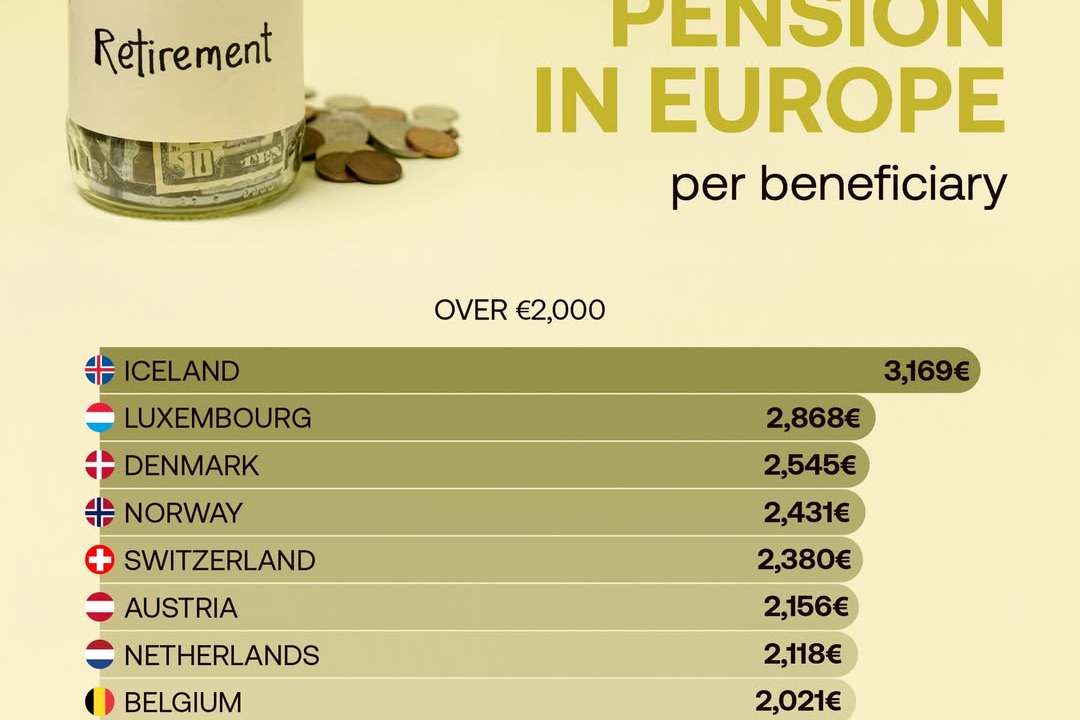
A summary of the average monthly pensions across Europe highlights just how wide that gap has become. At the top sits Iceland, where retirees receive more than €3,100 ($3,645) a month on average. At the lower end of the high-income bracket, countries like Ireland and Belgium hover just above €2,000 ($2,351).
According to OECD and Eurostat data, Northern and Western European countries consistently rank highest in pension payouts.
Iceland leads with roughly €3,169 per month per beneficiary, followed by Luxembourg (€2,868) and Denmark (€2,545). Norway and Switzerland also sit comfortably above €2,300.
RECOMMENDED FOR YOU
From Suomi to Zhongguo, why some countries have completely different names at home
These countries share a common model, and that is a strong public pension system combined with occupational and private schemes. OECD analysis shows that multi-pillar pension systems, where state support is supplemented by employer-backed and private savings, tend to deliver higher retirement incomes.
There is also a broader economic context where higher wages during working life translate into larger contributions and, ultimately, higher pensions.
Countries such as Austria (€2,156), the Netherlands (€2,118) and Belgium (€2,021) fall slightly behind the Nordic leaders but remain above the €2,000 mark.
Eurostat data indicate that these countries benefit from mature social security systems with wide coverage, though replacement rates, the share of income maintained after retirement, vary depending on career length and contribution history.
Ireland, at around €2,005, rounds out the group. While its public pension is relatively modest, it is often supplemented by private retirement savings, which OECD reports say are increasingly important across Europe.
Why the gap exists
The variation in pension levels comes down to a few key factors:
- Contribution systems: Countries with mandatory occupational pensions or higher contribution rates tend to deliver larger payouts.
- Demographics: Ageing populations put pressure on pension systems, particularly where fewer workers support more retirees.
- Policy choices: Retirement age, indexation rules, and benefit formulas all shape outcomes.
Eurostat has repeatedly warned that Europe’s ageing population will intensify these pressures in the coming decades, with the ratio of working-age people to retirees continuing to shrink.
RECOMMENDED FOR YOU
Asia produces the largest share of global GDP
However, Higher pensions do not automatically mean better living standards.
Countries like Switzerland and Norway, while offering higher monthly payouts, also have significantly higher costs of living. OECD comparisons show that purchasing power can vary widely, meaning €2,000 in one country may stretch further than €3,000 in another.