Flávio Bolsonaro leads Lula in Brazil election as presidential race heads to runoff
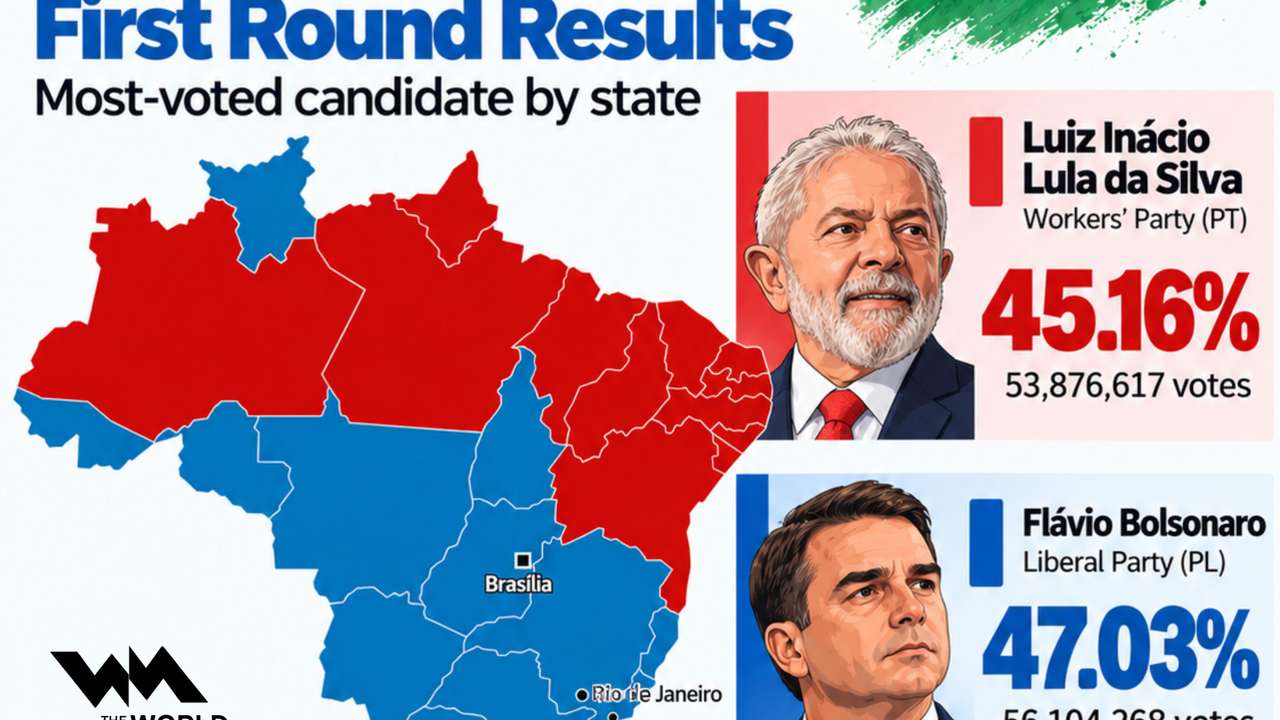
Brazilian Senator Flávio Bolsonaro finished ahead of President Luiz Inácio Lula da Silva in the first round of Brazil's presidential election, sending the two candidates into a runoff after neither secured the majority needed to win outright.
Key points
- Bolsonaro won 47.03% of valid votes
- Lula followed with 45.16%
- The runoff will be held on October 25
Brazilian Senator Flávio Bolsonaro finished ahead of President Luiz Inácio Lula da Silva in the first round of Brazil's presidential election, sending the two candidates into a runoff after neither secured the majority needed to win outright.
With 99.99% of ballot boxes counted, Bolsonaro of the Liberal Party received 56,104,268 votes, or 47.03% of valid votes, while Lula of the Workers' Party took 53,876,617 votes, or 45.16%, Brazil's Superior Electoral Court (TSE) said.
The result put just over 2.2 million votes between the two candidates and set up a second round on October 25. Brazil requires a presidential candidate to win more than half of valid votes to avoid a runoff.
The results also revealed a strong geographical split.
RECOMMENDED FOR YOU

Six countries account for three-quarters of Europe’s unicorn startups
Lula won most states across the Northeast and parts of the North, while Bolsonaro performed strongly across the South, Southeast and Centre-West, as well as several northern states.
Bolsonaro won the country's two biggest electoral prizes. In São Paulo, he received 51.93% against Lula's 38.20%, while in Rio de Janeiro he took 53.01% compared with Lula's 39.41%.
The outcome marked a turnaround from several opinion polls before the vote, which had generally put Lula numerically ahead. A Datafolha survey in mid-September, for example, had Lula at 39% and Bolsonaro at 36%, a statistical tie within the poll's margin of error.
Millions of votes remain outside the top two
Bolsonaro and Lula together accounted for just over 92% of valid votes, leaving roughly nine million votes cast for other presidential candidates. How those voters behave in the second round will be closely watched, although first-round results alone cannot predict where their support will go.
One detail in the infographic needs correction. The TSE reports 125,272,513 valid votes, rather than the 119,980,885 shown in the graphic. It recorded 2,300,781 blank votes and 3,674,149 null votes.
Nearly 158.8 million Brazilians were eligible to vote in the 2026 elections. The October 25 runoff will determine who leads Latin America's largest economy when the next presidential term begins in January 2027.
This story is written and edited by the Global South World team, you can contact us here.