Ghana's capital Accra submerged as floods expose long-running urban drainage crisis
Key Takeaways
- Ghana's National Disaster Management Organisation (NADMO) issued an urgent flood alert at 7:30 a.m. GMT on June 29, warning residents to avoid flood-prone areas, move to higher ground where necessary and avoid driving or walking through floodwaters.
- Emergency personnel from the Ghana Armed Forces and police have been deployed for rescue operations, while the country's main power distributors, GRIDCo and ECG, temporarily shut down power substations in some areas to reduce the risk of electrocution.
- Accra experiences severe flooding almost every rainy season. The capital has recorded major flood events over the last decade, with the city's deadliest flood disaster occurring on June 3, 2015, when floodwaters mixed with leaking fuel triggered an explosion that killed more than 200 people.
- According to Ghana's national disaster records covering 1935 to 2023, floods have caused more than 3,000 deaths nationwide and displaced over 700,000 people, with Accra accounting for many of the country's largest urban flood disasters.
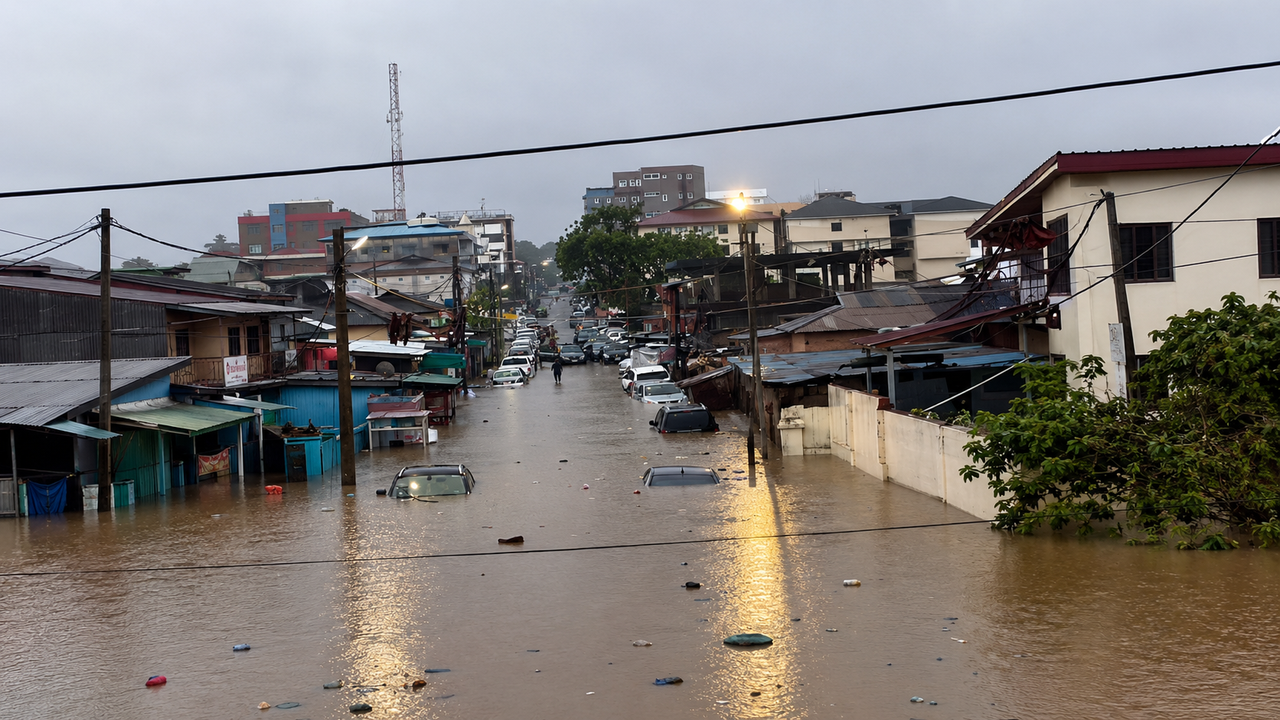
Extensive flooding has paralysed large parts of Ghana’s capital, Accra, after heavy rainfall that began late Sunday and intensified on Monday morning.
Major roads, including the N1 Highway, the Accra-Kasoa Highway and areas around the Kwame Nkrumah Interchange, were submerged, leaving commuters stranded and disrupting business activity across the city.
The National Disaster Management Organisation issued an urgent flood alert at 7:30 a.m. GMT on June 29, warning residents and motorists to avoid low-lying communities and flood-prone areas. It advised the public not to drive or walk through floodwaters and urged people in affected areas to move to higher ground.
Interior Minister Alhaji Mohammed Mubarak Muntaka appealed for public cooperation and urged residents to remain indoors where it was safe to do so.
“We are expecting heavier rains before midday. We are therefore pleading with everyone to stay where they are if it is safe to do so,” he said.
RECOMMENDED FOR YOU
Six countries account for three-quarters of Europe’s unicorn startups
Emergency teams, including personnel from the Ghana Armed Forces and the police, have been deployed for rescue operations in various locations. The country's main power distributors, Ghana Grid Company (GRIDCo) and Electricity Company of Ghana (ECG), also temporarily shut down power substations in select areas to reduce electrical risks. At the same time, the Ghana School of Law postponed examinations scheduled for Monday.
A city that floods almost every year
For many residents, the latest flooding is not an isolated disaster but part of a pattern that has persisted for over a decade.
Accra has experienced repeated major floods in 2010, 2015, 2016, 2022, 2023, 2025 and 2026, with the same communities, including Kaneshie, Odawna, Adabraka, Alajo, Weija, Circle and parts of the Odaw River basin, regularly among the worst affected.
The city's most devastating disaster occurred on June 3, 2015, when torrential rain flooded much of Accra before fuel floating on floodwaters ignited at a GOIL filling station near Kwame Nkrumah Circle. The combined flood and explosion killed more than 200 people, making it one of Ghana's deadliest peacetime disasters.
According to national flood records covering 1935 to 2023, Ghana has recorded more than 3,000 flood-related deaths and over 700,000 people displaced, with Accra accounting for many of the country's most destructive urban flood events.
In 2023 alone, researchers identified around 20 separate flooding incidents, while a storm in May 2025 killed four people and displaced more than 3,000 residents.
A recent United Nations Development Programme (UNDP) Ghana analysis described Accra’s floods as a familiar crisis, noting that homes, businesses and transport systems were again affected after heavy rainfall in early June 2026.
Why Accra keeps flooding
Urban planners say heavy rainfall alone does not explain the severity of flooding.
RECOMMENDED FOR YOU
Tunisia Roundup: Drug cases triple, 10,000 students face housing squeeze and businesses target African expansion
Researchers have consistently identified a combination of rapid urbanisation, construction on wetlands and floodplains, inadequate drainage infrastructure, blocked waterways caused by waste disposal and weak enforcement of planning regulations as the main drivers of Accra's flood risk.
The President of the Ghana Institution of Engineers has criticised the country’s long-term approach to urban planning, saying, “We have done things the wrong way for over 30–40 years.”
Rapid population growth has also transformed natural floodplains into densely populated neighbourhoods, while large areas of permeable land have been replaced by concrete, increasing surface runoff during storms.
Climate experts say heavier rainfall associated with climate change is further increasing the frequency and intensity of flooding across coastal West African cities, including Accra.
Economic costs
Accra is Ghana's commercial centre and the Greater Accra Region generates more than 40% of the country's non-oil GDP, meaning repeated flooding disrupts national supply chains, transportation and commerce.
Small businesses are among the hardest hit, with floods regularly destroying inventory, damaging equipment and forcing temporary closures.
The World Bank committed US$150 million in additional financing under the Greater Accra Resilient and Integrated Development (GARID) Project to improve flood management, drainage systems and solid waste management for more than 2.5 million people living within the Odaw River Basin.
RECOMMENDED FOR YOU
Sheinbaum pushes back at Trump and rejects any interference in Mexico
However, UNDP has argued that infrastructure alone will not solve the problem. It has supported work on a Greater Accra flood contingency plan and parametric flood insurance model designed to provide faster payouts after severe flooding, especially for vulnerable households in low-income and informal settlements.
Public frustration grows
Residents say the repeated nature of the crisis has deepened public frustration.
“We are reliving the same story every rainy season… when it rains like this, we know trouble is coming,” one resident said.
The Ghana Meteorological Agency has forecast continued rainfall across southern Ghana, including coastal areas, while authorities have urged residents to report emergencies through the national emergency number 112.
This story is written and edited by the Global South World team, you can contact us here.
