Global carbon emissions hit record highs, rising more than 4,000-fold since 1750

Global carbon dioxide emissions have surged to unprecedented levels, climbing from just a few million tonnes in the 18th century to more than 38 billion tonnes today, according to the latest Global Carbon Budget 2025.
Global carbon dioxide emissions have surged to unprecedented levels, climbing from just a few million tonnes in the 18th century to more than 38 billion tonnes today, according to the latest Global Carbon Budget 2025.
The long-term trajectory, illustrated by historical data, shows emissions accelerating sharply after the mid-20th century, a shift scientists link to industrialisation, population growth and the expansion of fossil fuel use.
In 1750, at the dawn of the industrial era, global CO₂ emissions were minimal, measured in just a few million tonnes annually.
By contrast, emissions from fossil fuels and cement were projected to reach around 38.1 billion tonnes (GtCO₂) in 2025, marking a new all-time high, according to the Global Carbon Project.
RECOMMENDED FOR YOU

From Suomi to Zhongguo, why some countries have completely different names at home
This represents an increase of more than 4,000 times over pre-industrial levels, highlighting the scale of human impact on the atmosphere.
While emissions rose gradually during the 19th century, the steepest increase came after World War II, as economies expanded rapidly and energy demand surged.
Global emissions jumped from around 6 billion tonnes in 1950 to over 25 billion tonnes by 2000, before accelerating further in the 21st century.
Researchers say this period, often referred to as the “Great Acceleration”, transformed emissions from a slow-growing trend into a steep upward curve.
Coal, oil and gas continue to account for the vast majority of global emissions. The 2025 budget indicates that all major fossil fuel sources are still contributing to growth, despite the expansion of renewable energy.
China, the United States and India remain the largest emitters globally, reflecting both population size and industrial activity.
The rise in emissions has translated directly into higher concentrations of CO₂ in the atmosphere.
Global average atmospheric CO₂ levels reached around 422–425 parts per million in 2024–2025, roughly 50% higher than pre-industrial levels, according to the Global Carbon Budget.
RECOMMENDED FOR YOU
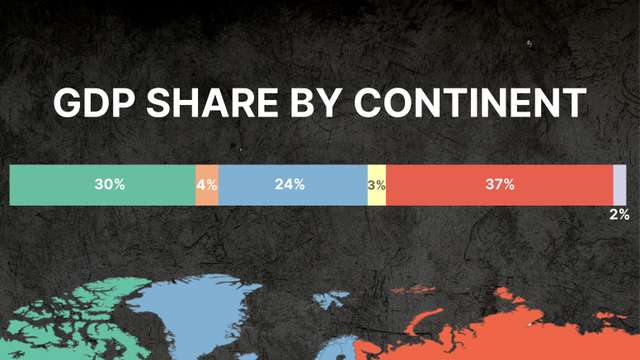
Asia produces the largest share of global GDP
Scientists warn that this increase is a key driver of global warming and climate instability.
Despite decades of climate negotiations, emissions continue to rise. The Global Carbon Budget projects a further 1.1% increase in 2025, suggesting that global emissions have yet to reach a definitive peak.
While around 35 countries have managed to reduce emissions while growing their economies, these gains have been outweighed by increases elsewhere.
Scientists warn that the remaining “carbon budget”, the amount of CO₂ humanity can emit while limiting warming to 1.5°C, is rapidly being depleted.
At current emission rates, that budget could be exhausted within the next decade, raising the risk of more severe climate impacts, including extreme weather, sea-level rise and ecosystem disruption.