Gulf currencies dominate list of world’s strongest currencies against the US dollar
- #GazaHealthcare
- #CorneaTransplant
- #GazaEyeHospital
- #JusticeForVictims
- #UNPeacekeepers
- #AidWorkerAbuse
- #road blockades
- #health crisis
- #La Paz
- #ChildProtection
- #HumanitarianSafeguarding
- #AidSectorReform
- #GlobalSouthConversations
- #DNAJustice
- #IntersecAction
- #Haryana
- #chemical factory
- #explosions
- #Tomahawk
- #Amnesty International
- #Visualized
- #World Visualized
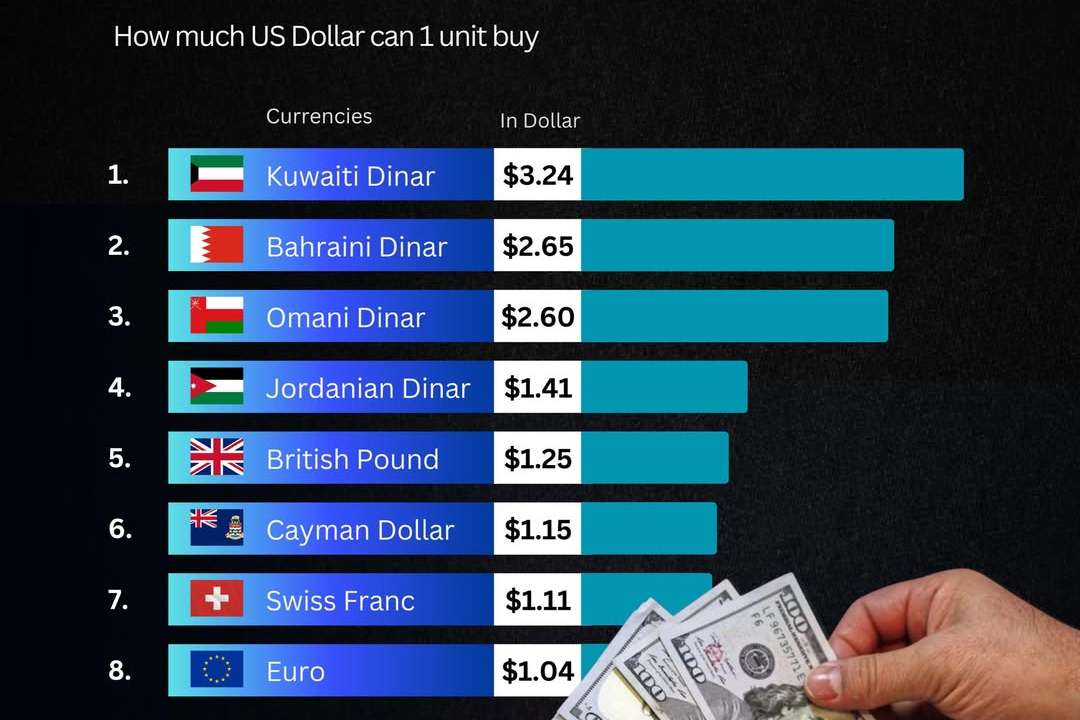
Gulf currencies continue to dominate global rankings against the US dollar, with the Kuwaiti dinar maintaining its position as the world’s strongest currency by value, according to a visual analysis created by World Visualized in collaboration with Seasia Stats.
Gulf currencies continue to dominate global rankings against the US dollar, with the Kuwaiti dinar maintaining its position as the world’s strongest currency by value, according to a visual analysis created by World Visualized in collaboration with Seasia Stats.
The ranking compares how much one unit of each currency can buy in US dollars, highlighting the enduring strength of several Middle Eastern currencies that are backed by energy exports, currency pegs and substantial sovereign wealth reserves.
According to the Seasia Stats research, one Kuwaiti dinar currently buys approximately $3.24, placing it well ahead of every major global currency. The Bahraini dinar ranked second at $2.65, followed closely by the Omani dinar at $2.60.
The Jordanian dinar and the British pound rounded out the top five, while the Cayman Islands dollar, Swiss franc and euro also traded above parity with the US currency.
RECOMMENDED FOR YOU
Asia produces the largest share of global GDP
Kuwait, Bahrain and Oman all maintain exchange rate systems closely linked to the US dollar, helping stabilise their currencies against volatility in global markets.
Kuwait’s dinar, first introduced in 1961, has long been regarded as one of the strongest currencies globally due to the country’s massive oil reserves, relatively small population and strong external financial position.
The Kuwaiti central bank manages the dinar through a basket-based exchange system designed to reduce exposure to fluctuations in any single foreign currency.
Similarly, Bahrain and Oman benefit from significant oil and gas revenues that help sustain investor confidence and foreign reserve strength.
Analysts note that a “strong” currency in nominal terms does not necessarily mean a country has the world’s largest economy. Instead, it reflects the exchange value of one unit of currency relative to another.
The British pound ranked fifth on the list, with one pound buying around $1.25.
Sterling remains one of the world’s oldest continuously used currencies and continues to play a central role in global finance despite economic pressures linked to inflation, Brexit-related trade shifts and slowing growth in the United Kingdom.
Currency strategists say the pound’s resilience is supported by London’s role as a global financial hub and investor confidence in UK financial institutions.
RECOMMENDED FOR YOU
Argentina equals Germany's record with fourth FIFA World Cup final defeat
The Swiss franc and euro also appeared among currencies stronger than the US dollar.
The Swiss franc, often viewed as a global safe-haven asset during economic uncertainty, traded at roughly $1.11 per franc in the Seasia Stats ranking.
Switzerland’s political neutrality, low inflation environment and stable banking system have historically strengthened demand for the currency during periods of geopolitical instability.
The euro, used by 20 European Union member states, remained slightly above the US dollar at around $1.04.
Although the euro has faced pressure in recent years from energy crises, inflation and slower industrial growth in parts of Europe, it remains the world’s second-largest reserve currency after the US dollar.
Despite several currencies holding higher nominal values than the dollar, the US currency remains the dominant force in global finance.
The dollar accounts for the majority of international trade settlements, central bank reserves and cross-border borrowing worldwide, according to International Monetary Fund and Bank for International Settlements data.
The US Federal Reserve’s interest rate policies also continue to heavily influence global currency markets, often affecting capital flows into emerging and developed economies alike.
RECOMMENDED FOR YOU
Nearly half the world now lives in cities as urban growth accelerates
This story is written and edited by the Global South World team, you can contact us here.