How Axis powers reached their greatest territorial expansion during World War II in 1942
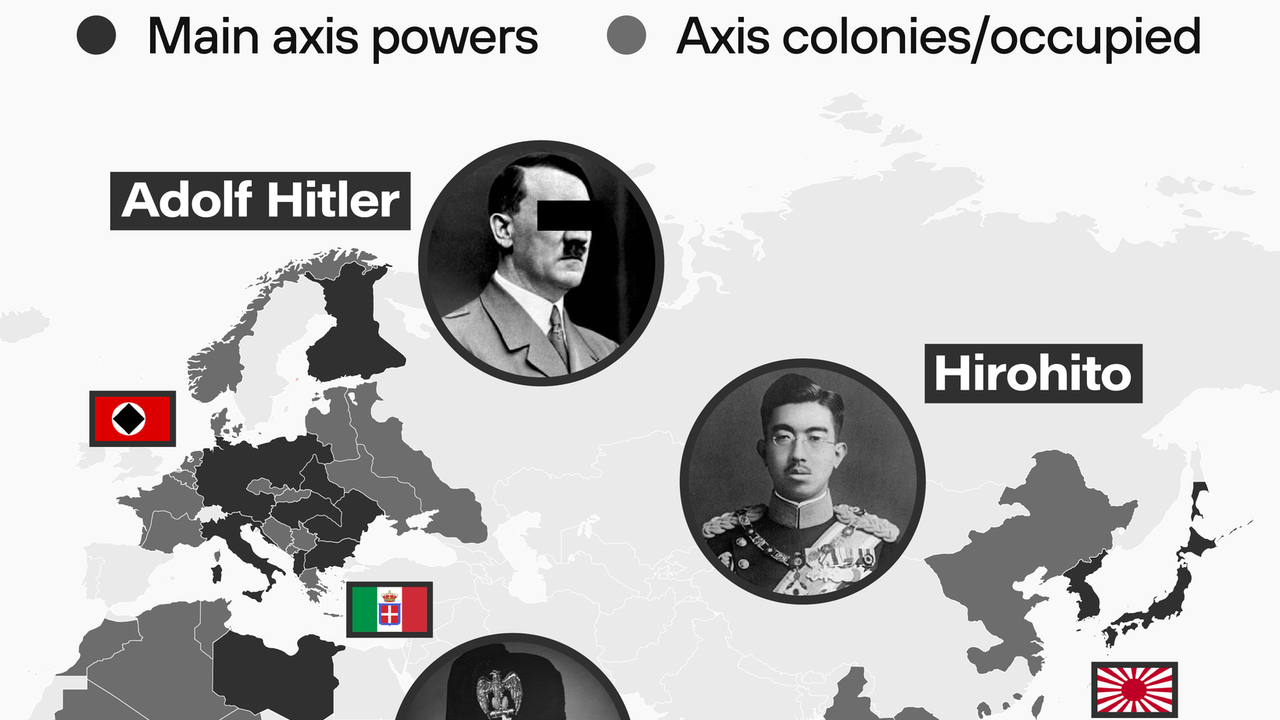
Nazi Germany, Fascist Italy and Imperial Japan controlled vast territories across Europe, Africa and Asia in 1942, marking the height of Axis expansion during World War II before a series of Allied victories began reversing their gains.
Key points
- Axis powers reached their greatest territorial expansion in 1942.
- Germany dominated much of Europe while Japan controlled large parts of Asia.
- Allied victories in 1942 began reversing Axis territorial gains.
Nazi Germany, Fascist Italy and Imperial Japan controlled vast territories across Europe, Africa and Asia in 1942, marking the height of Axis expansion during World War II before a series of Allied victories began reversing their gains.
The Axis powers reached their greatest combined territorial reach in 1942, when Germany dominated much of continental Europe, Japan controlled large parts of East and Southeast Asia, and Italy held territories around the Mediterranean and North Africa.
A historical map published by The World in Maps illustrates the extent of Axis control, highlighting territories occupied or administered by the three major powers under Adolf Hitler, Benito Mussolini and Japan's Emperor Hirohito.
Germany had conquered or occupied much of Europe, including France, Poland, the Netherlands, Belgium, Norway and large areas of the Soviet Union. Its armies advanced towards Stalingrad and the Caucasus in 1942, seeking to weaken Soviet resistance and capture important oil resources.
RECOMMENDED FOR YOU

US tops Pakistan’s salt export markets by value
Japan had expanded across the Pacific and Southeast Asia following its December 1941 attack on Pearl Harbour. By mid-1942, Japanese forces had occupied the Philippines, Malaya, Singapore, the Dutch East Indies and Burma, while maintaining control over Korea, Taiwan and parts of China.
Italy, meanwhile, controlled Libya and occupied territories in the Balkans and parts of southern France. However, its earlier East African empire had largely collapsed by 1941 following British-led military campaigns.
Despite their extensive territorial gains, the Axis powers were already facing major setbacks by late 1942.
The United States defeated Japan's navy at the Battle of Midway in June 1942, weakening Japan's ability to expand across the Pacific. In October and November, British forces defeated German and Italian troops at El Alamein in Egypt, forcing them to retreat.
The Soviet Union also launched a counteroffensive at Stalingrad in November 1942, trapping a large German army that surrendered in February 1943. These defeats marked a major shift in the war.
By 1943, the Axis powers were losing territory across several fronts. Italy surrendered to the Allies that September; Germany was defeated in May 1945, and Japan surrendered in August 1945, bringing World War II to an end.
The map illustrates the scale of Axis expansion but simplifies the political situation. Some territories were directly occupied, while others were governed by Allied states or puppet administrations. The Axis powers also reached their territorial peaks at different times, meaning the map should not be read as an exact snapshot of a single date in late 1942.
RECOMMENDED FOR YOU

Africa must unite to gain greater influence within BRICS, analyst says
This story is written and edited by the Global South World team, you can contact us here.