How colonial history and regional identity shaped Africa’s main official languages
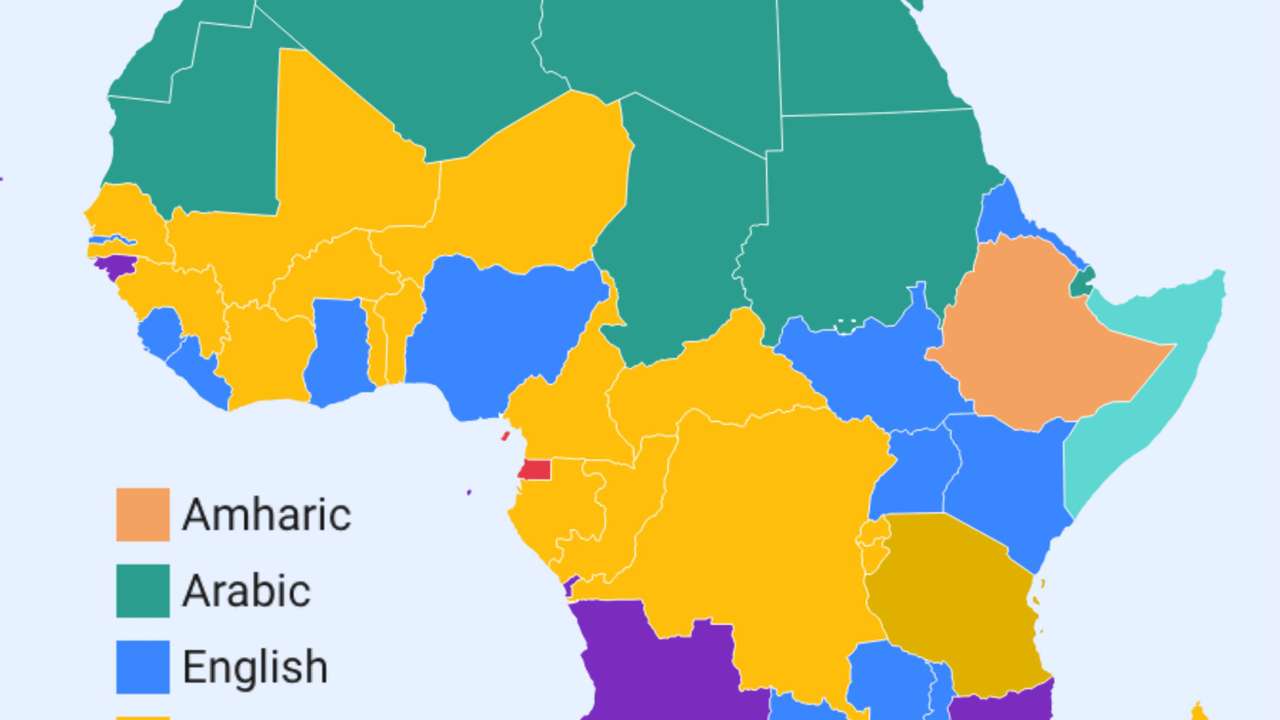
Africa is the most linguistically diverse continent on Earth. Linguists estimate that more than 2,000 languages are spoken across its 54 countries, according to UNESCO. Yet when it comes to government, education, diplomacy and administration, a much smaller group of languages dominates.
Africa is the most linguistically diverse continent on Earth. Linguists estimate that more than 2,000 languages are spoken across its 54 countries, according to UNESCO. Yet when it comes to government, education, diplomacy and administration, a much smaller group of languages dominates.
Colonial rule, trade networks, religion and regional cooperation all helped shape the main official languages used across Africa today. As a result, languages such as French, English, Arabic and Portuguese became official in many states, while influential African languages like Swahili, Amharic and Somali also play key national roles.
French is the official language in a large number of West and Central African countries, including Senegal, Mali, Côte d’Ivoire, Niger, Chad, Burkina Faso and the Democratic Republic of Congo.
This widespread use stems from the period when France controlled vast territories across Africa during the 19th and early 20th centuries. After independence in the 1950s and 1960s, many newly formed governments kept French as their official language to maintain administrative continuity and facilitate communication among diverse ethnic groups.
RECOMMENDED FOR YOU

France split into three nearly equal populations shows how unevenly the country is settled
According to the Organisation Internationale de la Francophonie, Africa now has more French speakers than any other region in the world, with over 160 million people using the language.
English serves as the official language in several African countries, including Kenya, Uganda, South Africa, Botswana, Zambia, Zimbabwe and Namibia.
Its presence reflects the legacy of the British Empire, which governed large parts of eastern and southern Africa until the mid-20th century. English often functions as a neutral administrative language in multilingual societies.
In countries like Kenya and Uganda, English is widely used in government, media and higher education, while local languages such as Swahili remain central to everyday communication.
Across North Africa, Arabic is the primary official language in countries such as Egypt, Libya, Tunisia, Algeria, Morocco and Sudan.
Arabic spread throughout the region beginning in the 7th century with the expansion of Islamic civilisation. Over centuries, it became the dominant language of administration, religion and literature.
Today, Modern Standard Arabic is used in government and media, while regional dialects are spoken in daily life.
Portuguese remains the official language in several African countries that were once Portuguese colonies, including Angola, Mozambique, Guinea-Bissau, Cape Verde and São Tomé and Príncipe.
RECOMMENDED FOR YOU
Gold mining resumes near Central African Republic border after deadly landslide
In Angola and Mozambique in particular, Portuguese has evolved into a widely used national language that connects dozens of ethnic groups.
The Community of Portuguese Language Countries (CPLP) estimates that tens of millions of Africans now speak Portuguese, making it an important administrative and cultural language in southern Africa.
Despite the dominance of a handful of official languages, most Africans are multilingual, often speaking two or three languages daily, a local language, a regional lingua franca and an official administrative language.