How women's suffrage spread across Europe over nearly 80 years
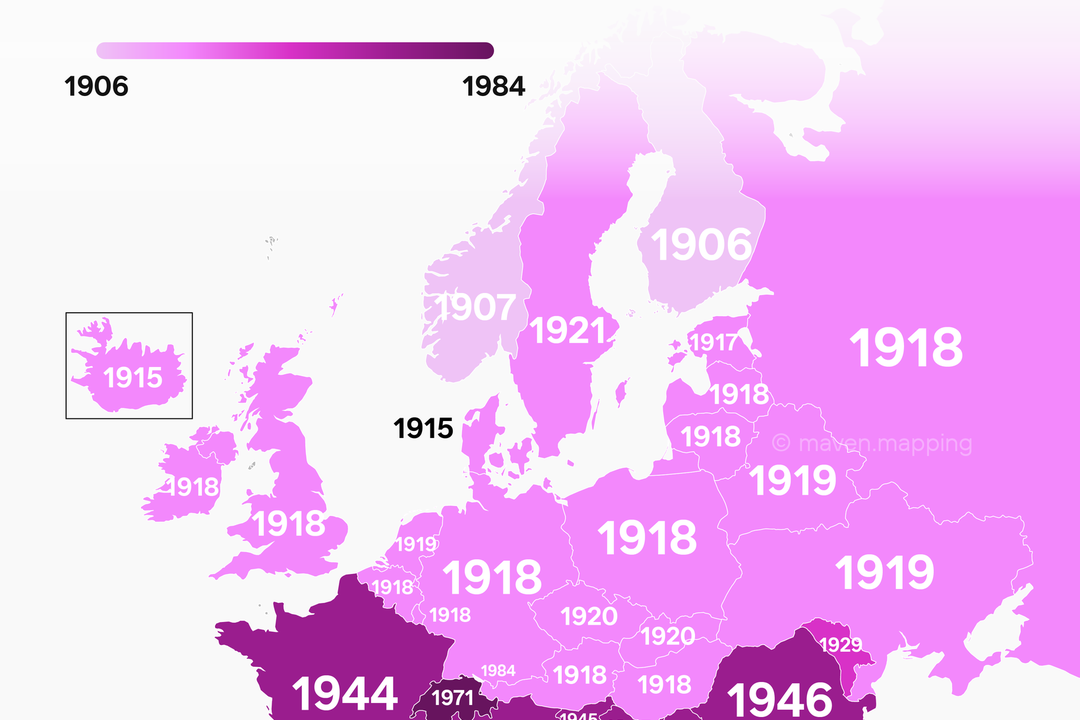
Women’s voting rights across Europe did not come overnight. Instead, the right to vote spread gradually across the continent over nearly eight decades, beginning in the early 20th century and continuing into the late 20th century, according to historical data compiled by The World in Maps.
Women’s voting rights across Europe did not come overnight. Instead, the right to vote spread gradually across the continent over nearly eight decades, beginning in the early 20th century and continuing into the late 20th century, according to historical data compiled by The World in Maps.
The timeline shows that Finland was the first European country to grant women full voting rights in 1906, while Liechtenstein became the last in 1984, highlighting the long and uneven path toward political equality.
Finland made history in 1906 when it granted women both the right to vote and the right to stand for election. According to the European Parliament’s historical archives, Finland was also the first European country to elect women to parliament, with 19 women elected in the 1907 parliamentary elections.
This milestone positioned Finland as a global pioneer in democratic participation and women’s political rights.
RECOMMENDED FOR YOU

More than 6 billion people are now online as global internet access reaches new high
Shortly afterwards, other Nordic nations followed:
- Norway – 1907 (expanded to full suffrage in 1913)
- Denmark – 1915
- Iceland – 1915
World War I accelerated suffrage across Europe
A major wave of reform occurred following World War I, when many European governments expanded democratic rights amid social and political change.
Several countries granted women voting rights during this period:
- United Kingdom – 1918 (initially for women over 30; equal voting age achieved in 1928)
- Germany – 1918
- Poland – 1918
- Austria – 1918
- Ireland – 1918
- Netherlands – 1919
Historians note that women’s contributions to wartime labour and public life helped strengthen the case for political equality.
According to Britannica, the suffrage movement across Europe had been growing since the late 19th century, but the war accelerated political reforms.
In contrast to Northern and Central Europe, several countries in Southern Europe introduced women’s suffrage later in the 20th century.
Key milestones include:
- Spain – 1931
- Turkey – 1934
- France – 1944
- Italy – 1946
- Greece – 1952
France’s decision came after decades of debate. Women first voted in French municipal elections in 1945, shortly after the end of World War II, following a decree issued by the provisional government led by Charles de Gaulle.
RECOMMENDED FOR YOU
Asia produces the largest share of global GDP
Italy followed shortly after, allowing women to vote in a 1946 referendum that abolished the monarchy and established the Italian Republic.
Despite Europe’s democratic reputation, some countries introduced women’s suffrage much later.
Switzerland granted women the right to vote at the federal level in 1971, after a national referendum approved the reform.
Even more striking, Liechtenstein did not allow women to vote until 1984, when male voters narrowly approved the measure in a national referendum. The vote passed by a margin of just 51%.
The gradual expansion of suffrage across Europe reflects broader social and political transformations throughout the 20th century.
Women’s suffrage movements were driven by decades of activism, including demonstrations, petitions, and campaigns led by suffragists across Europe.
Today, universal suffrage is widely recognised as a fundamental pillar of democracy. Yet historians often note that the path to equal political rights varied dramatically across countries.
RECOMMENDED FOR YOU

UN backs remote address by Palestinian President Abbas after US denies visa
This story is written and edited by the Global South World team, you can contact us here.