Iran airports record 100% disruptions as regional aviation faces major shutdown
Air travel across the Middle East faced an unprecedented wave of disruptions between February 28 and March 5, with several major airports recording cancellation rates above 90%, according to aviation analytics firm Cirium.
Air travel across the Middle East faced an unprecedented wave of disruptions between February 28 and March 5, with several major airports recording cancellation rates above 90%, according to aviation analytics firm Cirium.
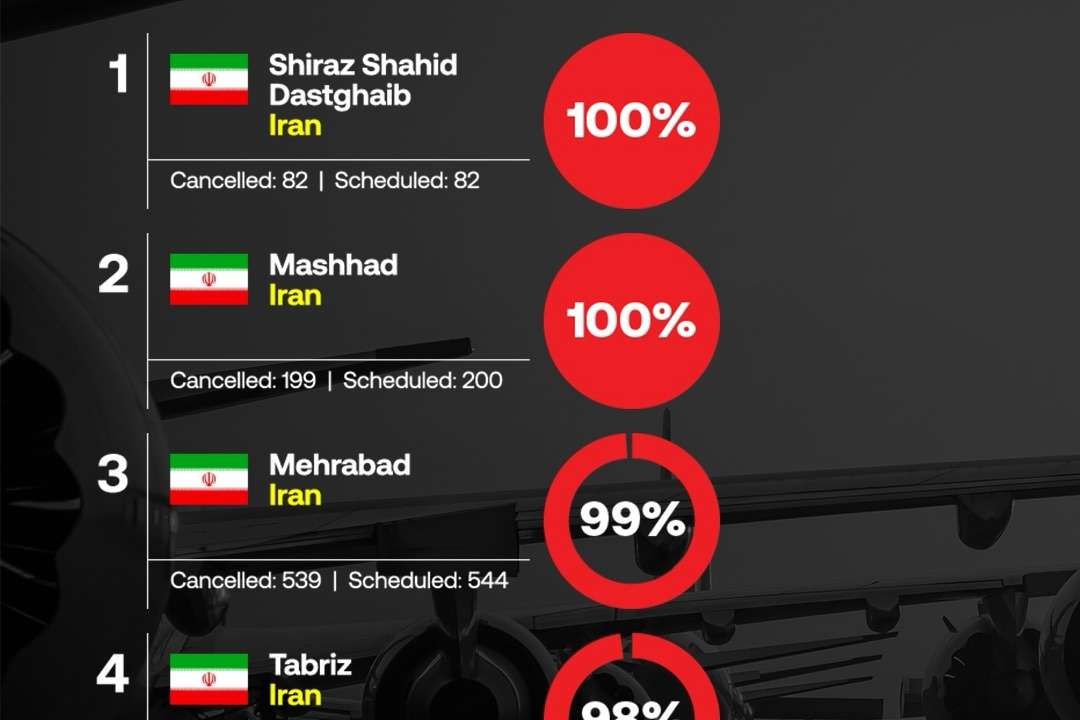
Available data shows the aviation crisis was particularly severe in Iran, where multiple airports experienced near-total shutdowns.
The worst-affected airports were concentrated in Iran, where cancellations reached unprecedented levels.
According to Cirium’s flight schedule analysis:
RECOMMENDED FOR YOU

More than 6 billion people are now online as global internet access reaches new high
- Shiraz Shahid Dastghaib International Airport (Iran) – 100% cancellation rate (82 cancelled out of 82 scheduled flights)
- Mashhad International Airport (Iran) – 100% cancellation rate (199 cancelled out of 200 scheduled flights)
- Mehrabad Airport, Tehran (Iran) – 99% cancellation rate (539 cancelled of 544 flights)
- Tabriz International Airport (Iran) – 98% cancellation rate (51 cancelled of 52 flights)
- Imam Khomeini International Airport, Tehran (Iran) – 98% cancellation rate (177 cancelled of 180 flights)
Aerospace Global News reports that the cancellations stem largely from temporary airspace closures, security concerns, and operational restrictions affecting airline scheduling.
Cirium analysts noted that a cancellation rate above 50% is already considered severe disruption, making the near-total shutdown seen in Iranian airports particularly striking.
While Iran recorded the highest cancellation rates, several airports in neighbouring countries also experienced significant operational disruptions.
Key airports impacted include:
- Basrah International Airport (Iraq) – 97% cancellations (56 of 58 flights)
- Damascus International Airport (Syria) – 96% cancellations (112 of 117 flights)
- Bahrain International Airport (Bahrain) – 95% cancellations (543 of 569 flights)
- Baghdad International Airport (Iraq) – 95% cancellations (226 of 238 flights)
- Hamad International Airport, Doha (Qatar) – 94% cancellations (2,071 of 2,192 flights)
- Kuwait International Airport (Kuwait) – 94% cancellations (817 of 865 flights)
- Sharjah International Airport (UAE) – 90% cancellations (899 of 997 flights)
Despite being one of the region’s largest global transit hubs, Hamad International Airport in Qatar still recorded over 2,000 flight cancellations, highlighting how even major aviation centres were not immune to the disruptions.
The Middle East sits on one of the busiest aviation corridors in the world, linking Europe, Asia, and Africa through major hubs including Doha, Dubai, and Kuwait.
When large-scale disruptions happen in the region, the impact spreads quickly across global aviation. It affects long-haul international flights, cargo operations, aircraft scheduling, and airline crew movements.
Airlines are often forced to reroute flights to avoid restricted airspace. That means longer routes, higher fuel consumption, increased operating costs, and extended travel times for passengers.
RECOMMENDED FOR YOU
Asia produces the largest share of global GDP
This story is written and edited by the Global South World team, you can contact us here.