Islam projected to overtake Christianity as world's largest religion by 2035
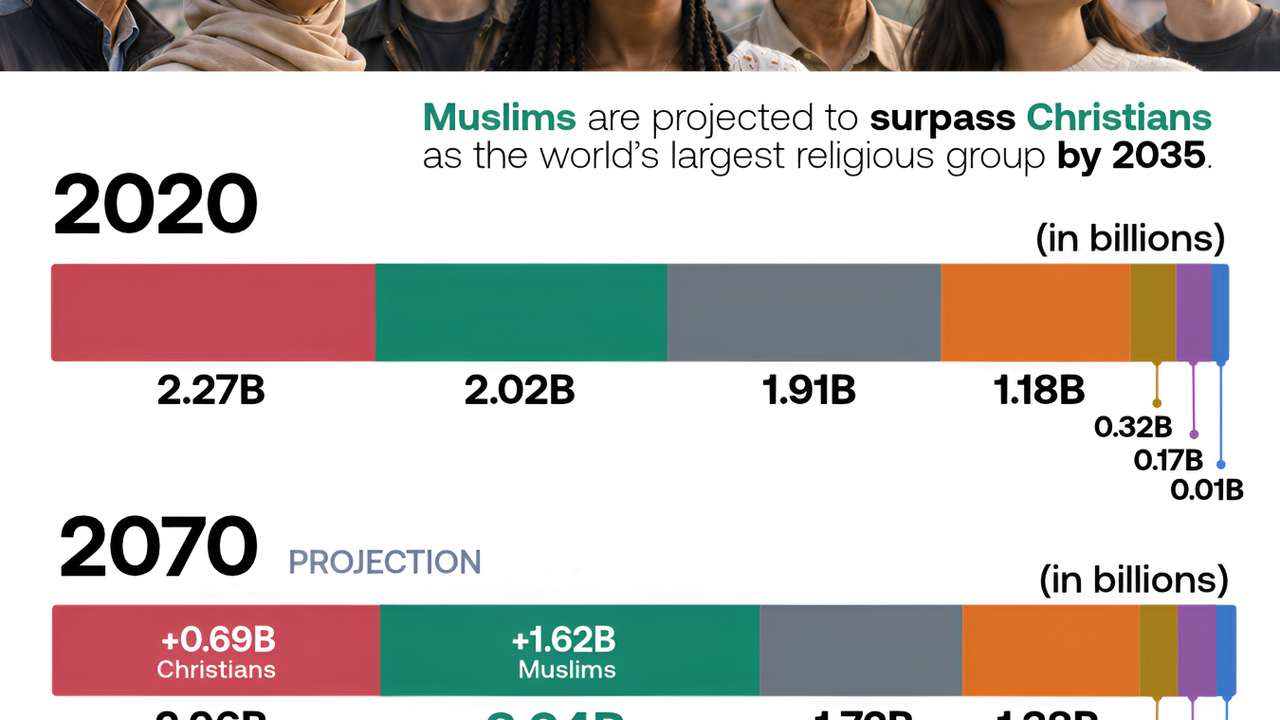
Islam is projected to become the world's largest religion by 2035, overtaking Christianity in a demographic shift driven by higher birth rates and younger populations, according to a Pew Research Centre report published on November 18, 2026.
Main points
- Islam could overtake Christianity by 2035.
- Muslims could number 3.64 billion by 2070.
- Africa will drive much of Christianity's growth.
Islam is projected to become the world's largest religion by 2035, overtaking Christianity in a demographic shift driven by higher birth rates and younger populations, according to a Pew Research Centre report published on November 18, 2026.
The study projects that the global Muslim population will grow by about 80%, from 2.02 billion in 2020 to 3.64 billion by 2070. The Christian population is expected to increase by 30%, from 2.27 billion to 2.96 billion.
By 2070, Muslims are projected to account for nearly 36% of humanity, compared with 29% for Christians.
The growth of Islam is largely attributed to demographic factors rather than religious conversion. Between 2020 and 2025, Muslim women had an estimated fertility rate of 3.1 children per woman, compared with 2.5 among Christian women.
RECOMMENDED FOR YOU

‘Your party drove Arab voters to polls’ – Herzog confronts Netanyahu ally over Israel election
Sub-Saharan Africa is expected to play a major role in the expansion of both religions. More than half of the world's Christians could live in the region by 2070, with the Democratic Republic of the Congo projected to overtake the United States as the country with the largest Christian population.
Meanwhile, Pakistan is expected to replace Indonesia as the country with the largest Muslim population, followed by India and Nigeria in the global ranking.
The Hindu population is projected to grow from 1.18 billion to 1.38 billion, while the Buddhist population could decline from 320 million to 250 million.
People with no religious affiliation are also expected to decline from 1.91 billion to 1.72 billion, largely because of population decline in China, despite growing religious disaffiliation in several Western countries.
Pew's projections account for fertility, age, migration, mortality and changes in religious affiliation. The findings remain conditional on demographic trends continuing over the coming decades.
This story is written and edited by the Global South World team, you can contact us here.