'All these governments have the same aim': a Palestinian perspective on Israel's settler expansion
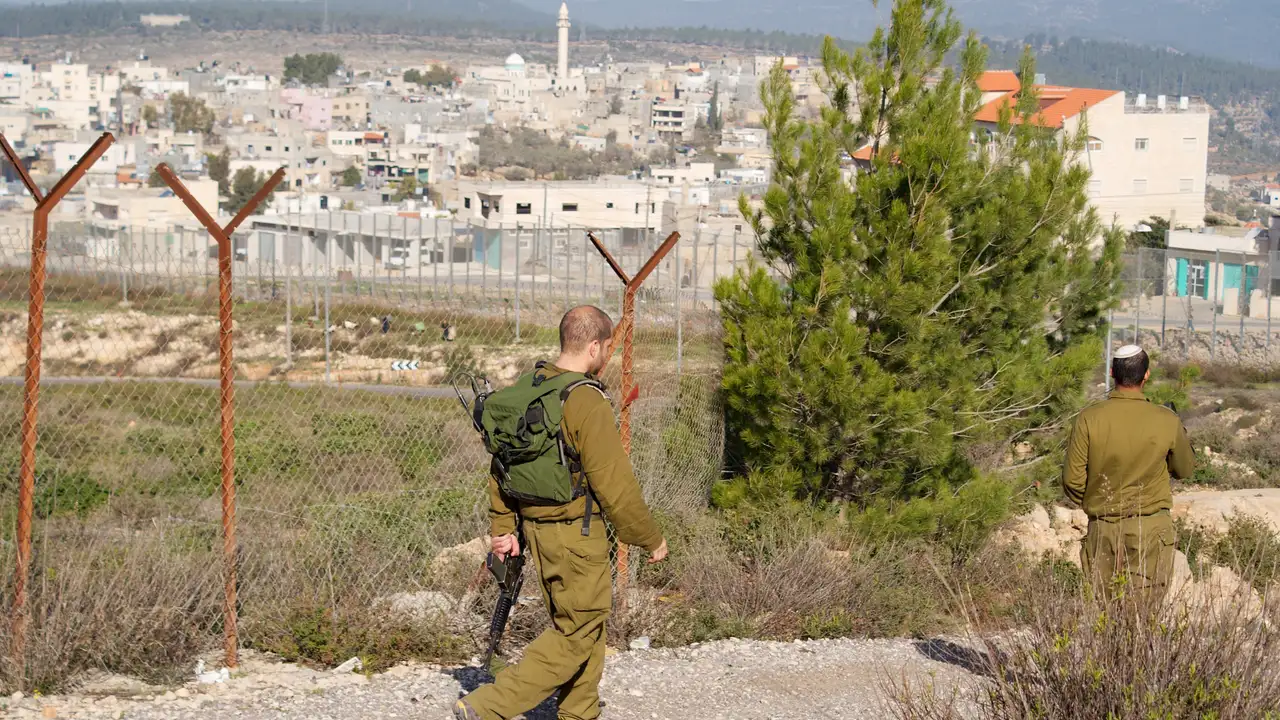
Since his brother was killed by an Israeli settler, Aziz Hathaleen has assumed a new job on top of his engineering work for the Palestinian Authority in Hebron: that of continuing his brother’s legacy of campaigning for the rights of Palestinian communities in the West Bank, including the Hathaleens’ native village of Umm al-Khair.
Umm al-Khair is a traditionally Bedouin community in the South Hebron Hills. The Hathaleens have deep-rooted connections to the area, having legally bought the land that Umm al-Khair now stands on after their forcible displacement during the establishment of the state of Israel in 1948, known among Palestinians as the Nakba.
Hathaleen, who works as the Director of Engineering at the Palestinian Ministry of Local Government in Hebron, was invited by the Britain Palestine Project to visit the UK in November to raise awareness about Israeli settler violence in the West Bank.
The subject is a deeply personal one for Hathaleen, given that his brother Awdah was killed by Israeli settler Yinon Levi in 2025.
RECOMMENDED FOR YOU
'Why hasn't mommy come home?' - Families await news as Indonesia factory fire leaves several missing
His sibling describes Awdah as an English teacher, a peace activist and advocate for nonviolence as well as the head and the heart of Umm al-Khair.
Hathaleen said that his brother’s death forms part of an ever-intensifying wave of settler violence which has engulfed West Bank Palestinian communities. According to the UN, as of June, an average of six incidents of settler violence against Palestinians was being reported every day, the highest figure of any year the international body has on record.
The attacks are multifaceted: settlers “destroy the economic situation, they destroy the main source of income [sheep herding], they destroy the life of these Bedouin communities”, Hathaleen explains. Nothing, he warns, is left untargeted: olive trees are cut, sheep are taken, and the community centre and the playground are subject to demolition orders.
Hathaleen stresses that the settlers’ attacks are enabled by the support of the central Israeli authorities, and he consistently refers to the Israeli government as the “settlers’ government”, emphasizing that the Israeli army and police protect the settlers in the region, not the Palestinians.
Israeli government officials, including Israeli Prime Minister Benjamin Netanyahu and President Isaac Herzog, have repeatedly denied state complicity in the facilitation of settler violence, and claim that the violent acts are limited to a small minority who act in contravention of the doctrine of the Israeli security forces, as well as wider Israeli laws and values.
The Israeli embassy in the UK had not responded to a request by Global South World for comment on Hathaleen’s allegations of Israeli governmental complicity in incidents of settler violence at the time of publication.
Isolation
Although settlements are seen as illegal under international law, successive Israeli governments have overseen and often facilitated settlement expansion.
According to an August briefing by the Wall and Settlement Resistance Commission, a Ramallah-based Palestinian body that documents Israeli settler expansion, some 780,000 Israeli settlers live in East Jerusalem and the West Bank, which are considered Palestinian territories under occupation by the International Court of Justice.
RECOMMENDED FOR YOU

'We are not going anywhere' – Lisbon housing protesters defy police clearances with new encampment
News of a potential change in government in Israel, where longstanding Israeli Prime Minister Netanyahu could be replaced by electoral rival Gadi Eisenkot, does not excite Hathaleen in the slightest: “all these systems, all these governments … [have] the same aim: transfer, displace Palestinian communities and take their land”.
Hathaleen explained how that displacement works where he lives. He describes how the nearby Israeli Carmel settlement, founded in the early 1980s, has gradually been encroaching on Umm al-Khair’s territory through the construction of new outposts, one of which is mere metres away from the Palestinians’ homes, obstructing access to their livestock and, therefore, their livelihood.
He explains that even the community’s children have difficulty accessing the local school because of settler harassment, which shapes everyday life for the Palestinian villagers.
There is no such thing as making a plan for the day and sticking to it, because settlers could attack at any point, morning or evening. React to the harassment? They might “kill you or arrest you”, the Palestinian activist alleges.
Hathaleen recounts how he was arrested after his brother's death and held for nine days by the Israeli security forces: while detained, “they attack[ed] me all the time, they kick[ed] me all the time”. One of his captors apparently bragged about his brother’s killing, of which Hathaleen was not yet aware, in his presence.
Justice is difficult to come by in the West Bank. Levi killed Awdah Hathaleen in 2025, and his indictment for reckless manslaughter in August 2026 marked the first time in nearly three years, according to Israeli human rights group B’Tselem, that an Israeli had been indicted over the killing of a Palestinian in the West Bank.
Israeli human rights organisation Yesh Din conducted a study of 1,701 instances of police investigations into offenses committed by Israelis against Palestinians in the West Bank between 2005 and 2024. Yesh Din found that only 3% of cases resulted in full or partial conviction, only 6.6% resulted in filed indictments and the vast majority of cases were discarded because of “failure by the police to name suspects or collect evidence.”
Levi had, even before the fatal shooting of Awdah, a history of violence against Palestinians, and was even subject to sanctions by the British, European Union and American (under Joe Biden) governments because of his aggression towards Palestinians. The Trump administration subsequently lifted the US sanctions.
RECOMMENDED FOR YOU

Argentina Roundup: Báez properties raided, Machado jailed in US, Neuquén sets first 2027 election
But even in the case of Levi, justice remains largely absent. According to Palestinian human rights organisation Al-Haq, the Israeli authorities “did not treat Levi or Avraham [another settler present] as criminal suspects following the incident” and instead Levi pointed out Palestinians for the authorities to subsequently detain.
After eventually being arrested at the scene, Levi was released under a three-day house arrest measure, Al-Haq reported.
According to the Palestinian organisation, within days of the incident, Levi returned to the village to continue the excavation work in the community that had led to the altercation and fatal shooting in the first place; Levi and Avraham were reportedly using an excavator to sever water pipes serving Umm al-Khair on the day of Awdah’s killing.
An indictment, of course, is no conviction, and Hathaleen said that Levi still roams free, harassing Palestinians. Settlers began constructing a new outpost in Umm al-Khair on the day of the interview, Hathaleen revealed, and Levi himself was there to assist with construction. Levi runs a construction company, Eyal Hari Yehuda Company, which helps build these settler outposts.
Levi’s actions appear to form part of a broader pattern of increasing settler violence. The last five years, Hathaleen says, have been particularly difficult as the pace of repression and government-backed settler expansion has quickened. “The situation: more difficult, more violence, more outposts”.
The response of the international community, he urges, must match that pace.
He encouraged people to come visit the community, enjoy the “hospitality” and “respect” that abounds in his village, but also bear witness to the harassment, spread the word of it and subsequently pressure the government, be it Britain’s or any other’s, to “do some things against what happens on the ground”.
The amplification of his brother’s message and activism for peace, to which Aziz Hathaleen applied that same refrain of “more and more”, also reportedly helps.
RECOMMENDED FOR YOU

‘Rabat must go’ – Chilean women demand Justice Minister's resignation over reduced sentences for sex offenders
“The voice of my brother, the story of my brother is more and more.”
“This is our life, this is our land, this is our story. I complete my brother’s way”, he said. “I must, I don’t have a choice. I must complete my brother’s way to show the world what happens on the ground”, he said.
Main image: Deposit Photos
This story is written and edited by the Global South World team, you can contact us here.
