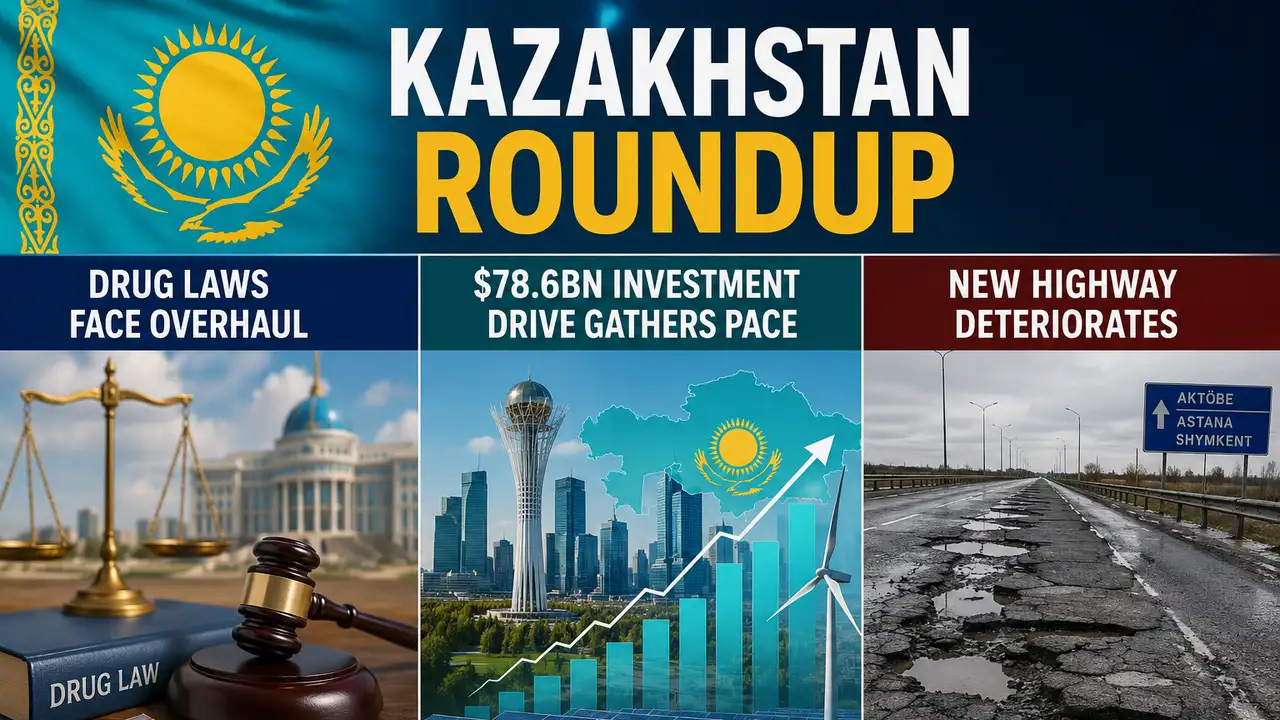
Kazakhstan Roundup: Drug laws face overhaul, $78.6bn investment drive gathers pace, new highway deteriorates
Kazakhstan considers ending criminal liability for some personal-use drug offences
Kazakhstan’s Interior Ministry has proposed a major change to the country’s drug laws that could remove criminal liability for some offences involving drugs intended for personal use rather than sale. The proposal is contained in a regulatory policy consultation document published on August 14, 2026 and opened for public discussion until September 8. It concerns amendments aimed at decriminalising certain forms of illegal handling of narcotic drugs, psychotropic substances and their analogues when there is no intention to sell them. The ministry is proposing that parts 1 and 2 of Article 296 of Kazakhstan’s Criminal Code be repealed or substantially reworked. Under the current law, part 1 covers non-medical drug consumption in public places, while part 2 covers illegal manufacture, processing, acquisition, possession and transportation without intent to sell. The latter can currently result in a fine of up to 160 monthly calculation indices, corrective labour, up to 160 hours of community service or arrest for up to 40 days. This does not amount to legalising drugs. The ministry is considering several models, including decriminalising possession without intent to sell when quantities remain within legally established limits, retaining criminal liability for manufacturing and processing, and introducing administrative penalties that could escalate for repeat offences.
New Taldykorgan–Ust-Kamenogorsk highway shows signs of deterioration after costing more than 180bn tenge
A highway between Taldykorgan and Ust-Kamenogorsk that cost more than 180 billion tenge is already showing signs of deterioration, prompting activists to demand further inspections and a longer warranty period. The road was constructed between 2018 and 2025 using borrowed funds from China’s Export-Import Bank. But an inspection conducted on August 21, 2026, by a group of activists led by Rollan Mashpiyev found numerous areas where the asphalt appeared to be peeling, cracking or deteriorating. In some locations, the problems appeared to extend beneath the asphalt to the road foundation. Mashpiyev said the group travelled from Semey to the Ayagoz area to examine the road and found that damage had become noticeably worse. The activists argue that the problem may extend beyond the quality of the asphalt itself. Mashpiyev said cracks had reappeared even in areas where asphalt had already been replaced, suggesting that defects could exist in the lower layers of the road.
Kazakhstan builds $78.6bn pipeline of investment projects targeting more than 88,000 jobs
Kazakhstan has assembled a portfolio of 215 investment projects worth $78.6 billion, as the government seeks to shift foreign and domestic capital towards manufacturing, advanced processing, technology and higher-value industries. The portfolio managed by KAZAKH INVEST is expected to create more than 88,000 jobs. Of the 215 projects, 93 worth $32.2 billion are already being implemented, while another 122 worth $46.4 billion remain under development. The strategy follows President Kassym-Jomart Tokayev’s 2025 address, Kazakhstan in the Era of Artificial Intelligence: Current Tasks and Solutions Through Digital Transformation. Rather than focusing solely on attracting larger amounts of capital, the government says it wants to change the structure of investment by prioritising manufacturing, deep processing, high-tech production and the localisation of goods with greater added value. Since rules governing investment agreements were introduced, Kazakhstan has signed 66 agreements worth more than 17.8 trillion tenge. Six were concluded in 2024, followed by 30 agreements worth around 11.2 trillion tenge in 2025.
Kazvodkhoz returns to profit after overhaul cuts receivables by 90%
Kazakhstan’s state water-management company Kazvodkhoz has returned to profitability after a restructuring programme that included management reforms, digitalisation, asset transfers and tighter financial controls. The Ministry of Water Resources and Irrigation said the state enterprise had eliminated its losses and ended 2025 with a profit, while its accounts receivable fell by 90%. One major change involved merging the Nurinsky Group Water Pipeline state enterprise with Kazvodkhoz. The government has also approved a roadmap to transfer non-core assets, including group water pipelines, into municipal ownership so Kazvodkhoz can concentrate more closely on its core water-management responsibilities. Financial management has also been digitalised. Since the beginning of 2026, Kazvodkhoz has completely stopped accepting cash payments for irrigation water. All contracts with water users are now concluded electronically through a new billing system. Vice Minister of Water Resources and Irrigation Zhandos Salimov said the transformation includes redesigning and automating business processes, creating systems for planning and assessing the performance of branches, centralising revenue and expenditure management and introducing project-management principles.
RECOMMENDED FOR YOU

A wake-up call: The countdown for Latin American democracy — Opinion
More than 283,000 cameras installed as Kazakhstan strengthens security in 7,656 schools
Kazakhstan has installed more than 283,000 surveillance cameras across 7,656 general education schools, as authorities strengthen security measures ahead of the new academic year. The Interior Ministry has declared 2026 the Year of Children’s Safety within the ministry, with measures focused on protecting children not only at school but also on streets, in public places and online. Of Kazakhstan’s 7,656 schools, 7,159, or 93.5%, are directly connected to police operational control centres or duty units, allowing law-enforcement agencies to respond more quickly when security incidents are detected. The ministry said its approach goes beyond surveillance. Preventing juvenile offences remains a priority, with authorities focusing on legal education, identifying problems at an early stage and providing individual support to children and families. President Kassym-Jomart Tokayev has also emphasised the importance of developing what authorities describe as a law-abiding generation, arguing that respect for the law and Constitution is important both to young people’s individual well-being and to Kazakhstan’s broader development.
This story is written and edited by the Global South World team, you can contact us here.