Nearly half in six Western countries want advanced AI development paused
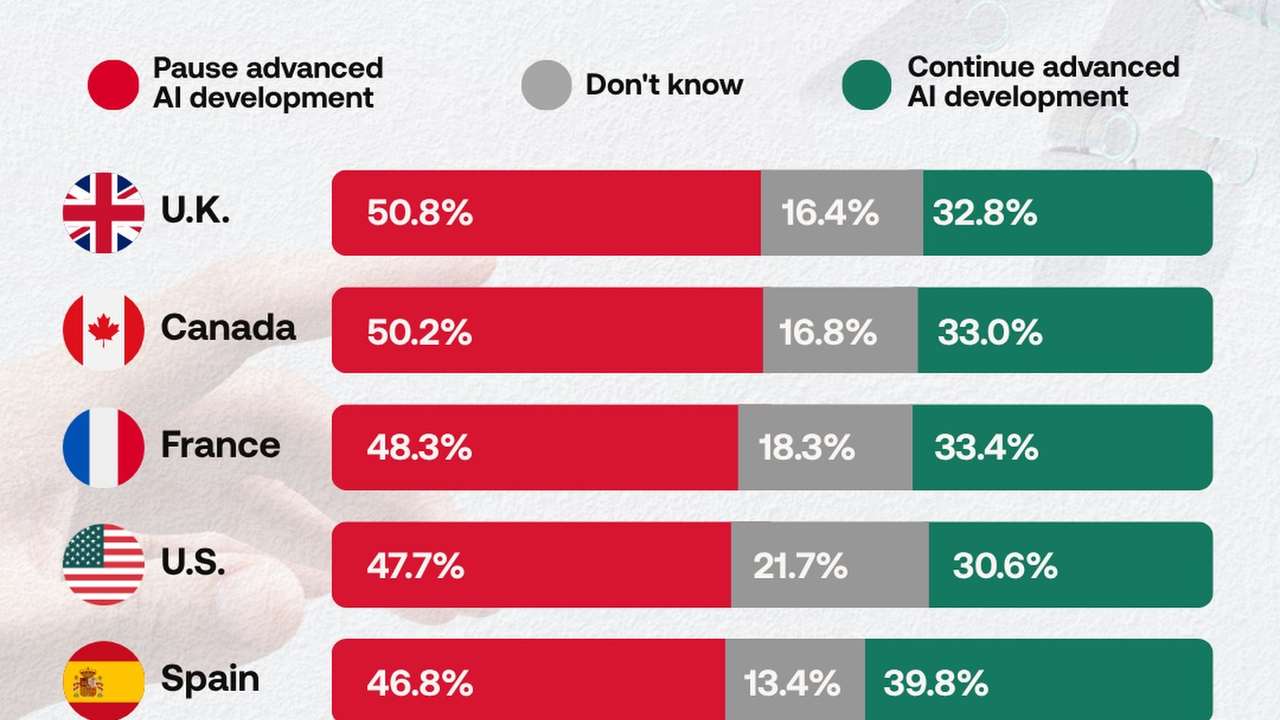
Nearly half of adults surveyed across six Western countries say the development of more advanced artificial intelligence should be paused, according to a new POLITICO poll that points to widespread public concern over AI's speed and potential risks.
Main points
- Support for an AI pause leads in all six countries
- Britain records the highest support at 50.8%
- Concerns about powerful machines date back more than a century
Nearly half of adults surveyed across six Western countries say the development of more advanced artificial intelligence should be paused, according to a new POLITICO poll that points to widespread public concern over AI's speed and potential risks.
The survey, conducted by Public First for POLITICO from September 13 to 15, 2026, questioned more than 2,000 adults each in Britain, Canada, France, the United States, Spain and Germany. The overall margin of error was about 2.2 percentage points.
In every country surveyed, more respondents favoured pausing advanced AI development than continuing it.
Support for a pause was highest in Britain at 50.8%, followed by Canada at 50.2%, France at 48.3%, the United States at 47.7%, Spain at 46.8% and Germany at 45.1%. Support for continuing development ranged from 30.6% in the United States to 39.8% in Spain.
RECOMMENDED FOR YOU
Six countries account for three-quarters of Europe’s unicorn startups
The results do not mean that majorities in all six countries favour a pause. Only Britain and Canada cross 50%, while elsewhere a pause is the largest single response, with substantial numbers saying they do not know.
Safety concerns cross political lines
POLITICO found that concerns about rapid AI development cut across political divisions in Europe and Canada, although opinions were somewhat more partisan in the United States. Among Americans who voted for Donald Trump in 2024, 44% favoured a pause, and 40% wanted development to continue.
The poll also found that 53% of respondents in both Britain and Canada preferred accepting the possibility of falling behind other countries in AI development if that meant prioritising security.
The findings come as governments and technology companies debate how to balance the economic and scientific opportunities offered by increasingly capable AI with concerns ranging from job disruption and misinformation to cybersecurity and the possibility of losing control of future systems.
The fear of machines surpassing humans is not new
Those concerns have deep historical roots. In 1863, English writer Samuel Butler published Darwin Among the Machines, arguing that machines were developing far faster than biological life and imagining a future in which humanity could become subordinate to them.
A century later, British mathematician I. J. Good developed the idea further. In his influential 1965 paper on an “ultraintelligent machine”, Good proposed that a machine capable of designing a more intelligent successor could set off an “intelligence explosion”, rapidly leaving human intelligence behind.
Philosopher Nick Bostrom brought similar concerns into modern AI debate with his 2014 book Superintelligence. He argued that a sufficiently capable AI pursuing goals poorly aligned with human interests could pose an existential risk, even without being deliberately hostile.
Those concerns reached a wider audience in 2023 when the Centre for AI Safety published a statement saying the risk of extinction from AI should be treated as a global priority alongside threats such as pandemics and nuclear war.
RECOMMENDED FOR YOU

Olympic flame arrives on African soil for first time as Senegal begins Dakar 2026 countdown
This story is written and edited by the Global South World team, you can contact us here.