Nigeria leads race to $100 billion GDP as Africa’s economic growth story accelerates
- #drug trafficking
- #Santiago Peña
- #renewable energy
- #violent crime
- #Paraguay
- #Claudia Sheinbaum
- #World Cup
- #historical injustices
- #Mahmoud Ali Youssouf
- #United Nations
- #SpaceExploration
- #TiangongSpaceStation
- #ChinaSpaceMission
- #Shenzhou23
- #patriarchy
- #Arab women
- #Feminism
- #IsraelGazaConflict
- #IndonesiaNews
- #GazaFlotilla
- #Visualized
- #World Visualized
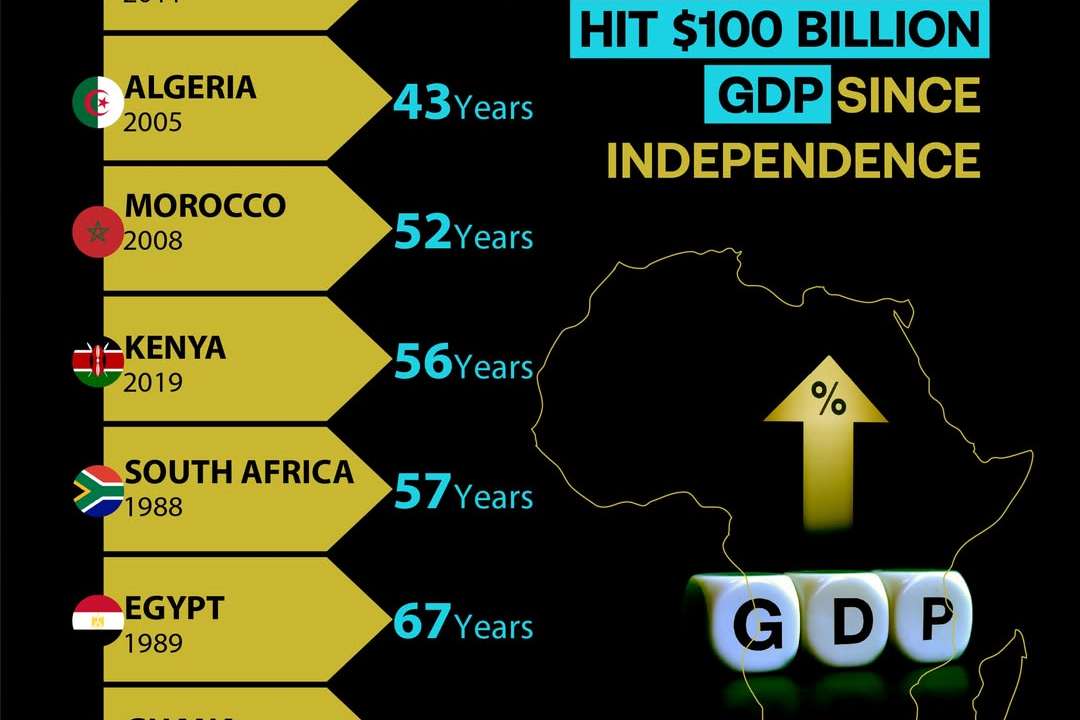
Nigeria reached the $100 billion gross domestic product milestone faster than any other African country after independence, underscoring the scale and pace of economic expansion among several of the continent’s largest emerging markets over the past four decades.
Nigeria reached the $100 billion gross domestic product milestone faster than any other African country after independence, underscoring the scale and pace of economic expansion among several of the continent’s largest emerging markets over the past four decades.
According to IMF data compiled by African business intelligence platform Intelpoint and visualised by World Visualized, Nigeria achieved a GDP above $100 billion in 1994, just 34 years after independence in 1960.
The ranking tracks how long African countries took to surpass the $100 billion GDP mark between 1988 and 2025, revealing significant differences in growth trajectories across the continent.
Angola ranked second, reaching the milestone 36 years after independence, while Algeria followed at 43 years. Morocco, Kenya and South Africa also featured prominently among Africa’s fastest-growing economies by long-term GDP expansion.
RECOMMENDED FOR YOU
Six countries account for three-quarters of Europe’s unicorn startups
The findings highlight how resource wealth, population growth, industrialisation and economic reforms have shaped Africa’s emergence as one of the world’s most dynamic economic regions.
Nigeria’s rise to a $100 billion economy was driven largely by oil exports, rapid urbanisation and its growing population, which is now estimated by the United Nations to exceed 220 million people.
As Africa’s largest oil producer for decades, Nigeria benefited heavily from petroleum revenues during the late 20th century, helping finance infrastructure, banking expansion and import-driven consumer growth.
Economic analysts say Nigeria’s large domestic market also gave it advantages unavailable to many smaller African economies.
Despite repeated currency crises, inflation shocks and governance challenges, the country remains one of Africa’s largest economies by nominal GDP alongside South Africa and Egypt.
The International Monetary Fund has projected continued medium-term growth for Nigeria, supported by services, telecommunications, financial technology and a fast-expanding digital economy.
Angola reached the $100 billion threshold in 2011, approximately 36 years after independence from Portugal in 1975.
The country experienced one of Africa’s fastest economic expansions during the 2000s, largely due to booming crude oil exports and rising Chinese investment after the end of its civil war in 2002.
RECOMMENDED FOR YOU

Burkina Faso to stop importing armoured vehicles, Traore says
At its peak, Angola became one of China’s largest African oil suppliers, helping fund large-scale infrastructure reconstruction projects including roads, railways and housing developments.
However, economists note that Angola’s heavy dependence on oil left the economy vulnerable to global commodity price swings, particularly during the 2014 oil market collapse.
Algeria and Morocco both ranked among the continent’s fastest economies to surpass a $100 billion GDP.
Algeria crossed the mark in 2005, driven largely by hydrocarbon exports. The country possesses some of Africa’s largest natural gas reserves and remains a major energy supplier to Europe.
Morocco reached the milestone in 2008 after decades of gradual industrial diversification and export-oriented growth.
Unlike several oil-dependent economies, Morocco expanded sectors including automotive manufacturing, phosphates, renewable energy and tourism.
The country has increasingly positioned itself as a manufacturing and logistics hub connecting Europe and Africa through major infrastructure projects such as the Tangier Med port complex.
Kenya became one of the newest African economies to exceed a $100 billion GDP, reaching the threshold in 2019.
RECOMMENDED FOR YOU

Sheinbaum rings historic bell as thousands fill Zocalo for Mexican Independence Day
The East African nation has built a reputation as one of the continent’s leading technology and financial centres, anchored by Nairobi’s role as a regional commercial hub.
Kenya’s economy has benefited from growth in mobile banking, agriculture, transport and digital services.
Ghana reached the $100 billion benchmark in 2025, according to the IMF-based Intelpoint analysis, highlighting the growing economic significance of West Africa beyond Nigeria.
The country has expanded rapidly over the past two decades through gold production, oil exports, cocoa trade and services growth.
Meanwhile, Ethiopia crossed the threshold in 2022 after roughly 81 years, despite never being formally colonised apart from a brief Italian occupation during the 1930s and 1940s.
Ethiopia recorded some of the world’s fastest growth rates during the 2000s and 2010s, powered by state-led infrastructure investment, manufacturing expansion and agricultural reforms.
However, conflict, debt pressures and foreign exchange shortages have recently slowed momentum in Africa’s second-most populous country.
RECOMMENDED FOR YOU
Norway has Europe’s highest petrol prices, Russia and Belarus remain cheapest