North Macedonia opposition wins big on election night
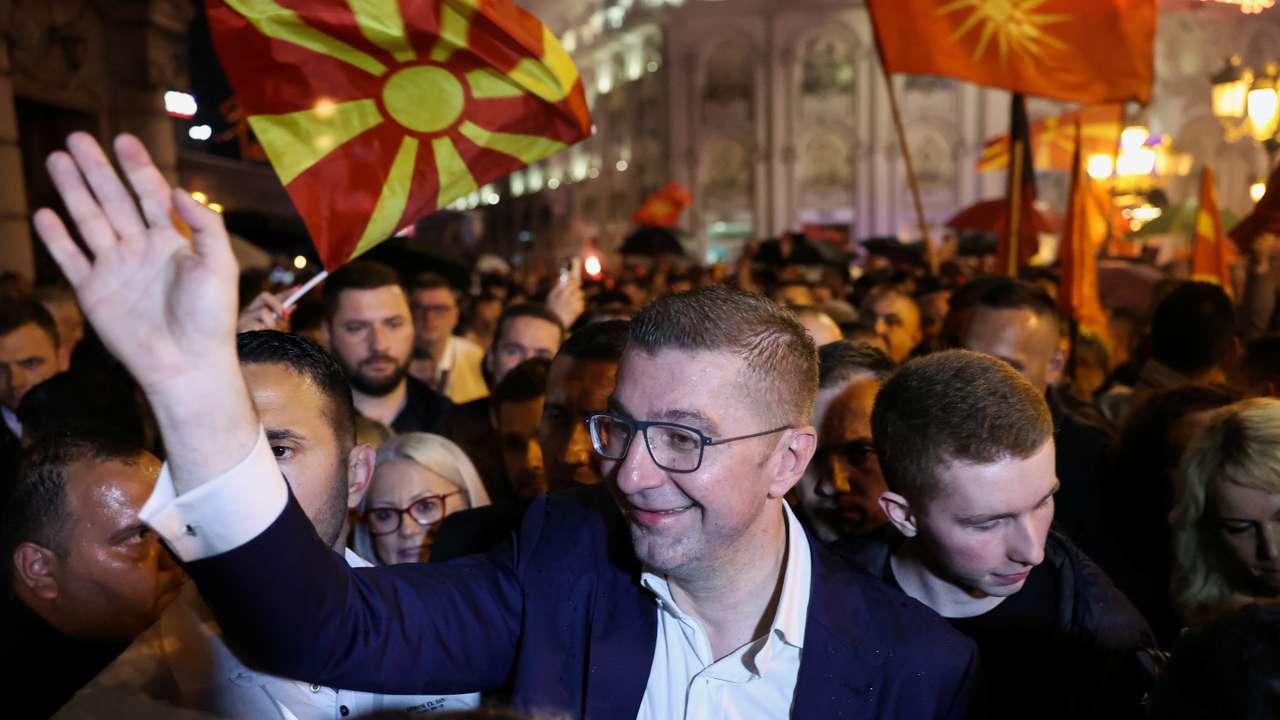
North Macedonia opposition wins big on election night
By Aleksandar Vasovic
North Macedonia's right-wing opposition won big in parliamentary and presidential elections on Wednesday, on a night that saw the Balkan country also elect its first female head of state.
Hundreds of jubilant supporters of the opposition VMRO-DPMNE party braved the rain outside their party headquarters in downtown Skopje waving national and party flags and dancing to folk music.
RECOMMENDED FOR YOU

Uganda Roundup: Besigye detention talks, Karamoja hunger crisis and parliament funding cuts
"Dear people of (North) Macedonia ... we have made it. Macedonia won. This is a historic victory of the people," VMRO-DPMNE leader Hristijan Mickoski told the crowd.
Results from the election commission showed VMRO-DPMNE held 42% of votes with 72% of votes counted in the parliamentary poll, versus 14% for SDSM, prompting SDSM leader Dimitar Kovacevski to concede defeat.
"The result is disappointing and this is a big blow to SDSM," Kovacevski told a news conference in which he also called for a thorough overhaul of his party.
Voters in the Balkan country of 2 million people have become frustrated with the sluggish advance of its bid to join the European Union, which was greeted with optimism in 2005 but has since become an emblem of North Macedonia's lost promise.
Enduring corruption and slow development have also soured voters against the ruling party.
In the run-off vote for the more ceremonial role of president, Gordana Siljanovska-Davkova, a university professor who was backed by the VMRO-DPMNE, beat the SDSM-backed incumbent Stevo Pendarovski in a landslide. Siljanovska-Davkova had 65% of votes versus 29% for Pendarovski, with more than 87% of votes counted.
"I was asking myself why did I deserve such a honour?" Siljanovska-Davkova told reporters shortly after being voted in as the country's first female president. "The reward is priceless for me, this is a huge responsibility."
The opposition will likely need to form coalitions with smaller partners to win a majority in parliament. Discussions are expected to take place in the coming days.
RECOMMENDED FOR YOU

Brazil's electoral court threatens Meta with US$198,000 daily fine over election content
Some voters expressed worry that the opposition's nationalist leanings could harm relations with neighbouring countries and its EU bid. Analysts do not expect great advances on EU integration under the opposition, which held power until 2017 and also came under fire for alleged graft.
"EU accession will not progress significantly under a potential VMRO-DPMNE government," said Mario Bikarski, Eastern and Central European analyst at risk consultancy Verisk Maplecroft.
FRICTIONS
In 2001, NATO pulled North Macedonia back from the brink of civil war during an ethnic Albanian insurgency and promised faster integration into the EU and NATO. Albanians account for about a quarter of the population.
North Macedonia's lack of EU progress has partly been due to frictions with neighbouring Greece and Bulgaria, both EU member states, but also to a failure to press economic and judiciary reforms. The country joined NATO in 2020.
The centre of the capital Skopje is dotted with unfinished or empty concrete and marble buildings erected during VMRO-DPMNE's last tenure, which ended when SDSM took power in 2017. A concert hall that burned down months ago awaits renovation.
Some towns and cities are among the most polluted in Europe, due in part to coal consumption and old cars. Much of the country's youth has emigrated abroad in search of better prospects.
While many were unsure of what the opposition could do to change things, some were hopeful.
RECOMMENDED FOR YOU

Mahama sets 2030 deadline to end Ghana's raw mineral exports
"This is great, North Macedonia is being returned to Macedonians, VMRO-DPMNE did it," said Pance Petkovski, 23, a student who watched election coverage on a TV in a Skopje cafe.
This article was produced by Reuters news agency. It has not been edited by Global South World.