Philippines, Germany commit to reaching defence pact this year
Philippines, Germany commit to reaching defence pact this year
By Karen Lema
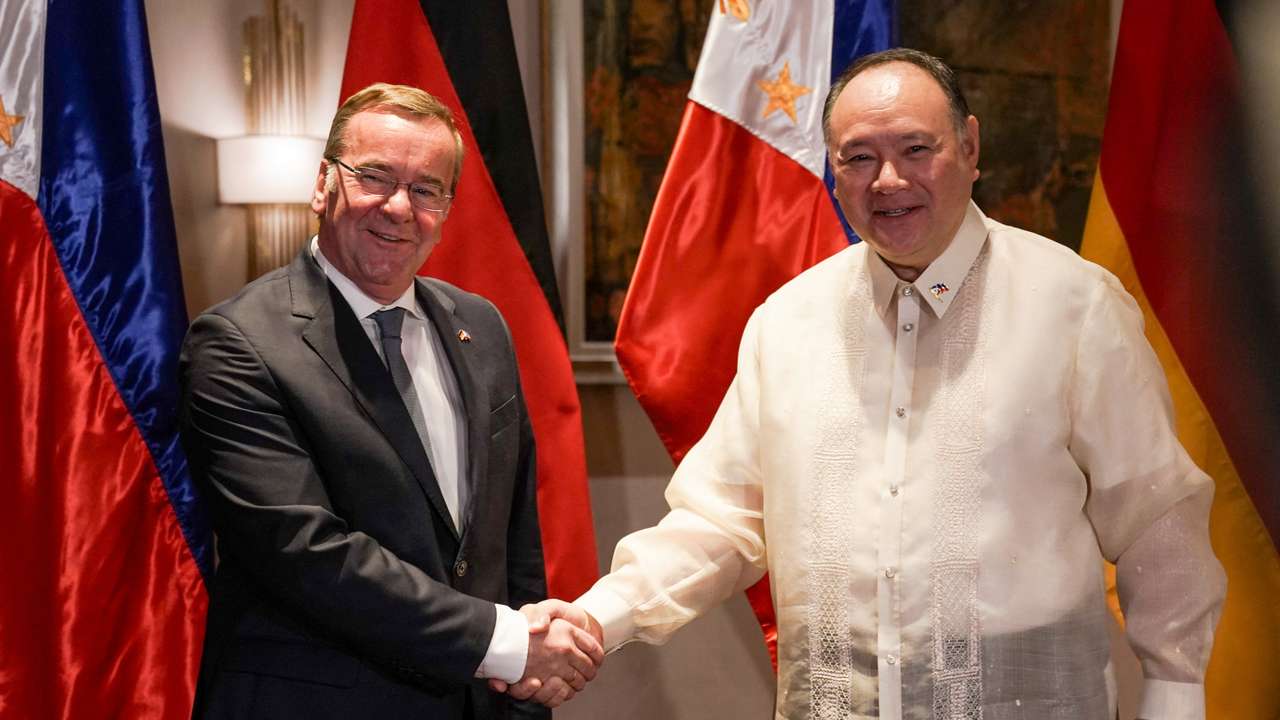
The Philippines and Germany on Sunday committed to signing a defence cooperation arrangement this year, vowing to stand for the international rules-based order in the Indo-Pacific region.
German Defence Minister Boris Pistorius and his Philippine counterpart Gilberto Teodoro committed to establishing long-term relations between their armed forces to expand training and bilateral exchanges, explore opportunities to expand bilateral armaments cooperation and engage in joint projects.
RECOMMENDED FOR YOU
New Asia Forum: Indonesia to set out progress on sustainable AI data centres
The two met in Manila during the first such visit by a German defence minister, as their countries mark 70 years of diplomatic relations.
Teodoro said the Philippines, seeking to modernise its military to boost external defence, will be "looking to engage Germany as a possible supplier of these capabilities".
"These are in the command and control, anti-access aerial denial, maritime domain, aerial domain and in higher technologically capable equipment," Teodoro told a press conference with Pistorius.
Manila and Berlin are deepening military ties as tensions have flared in recent months between China and the Philippines, which have traded accusations over run-ins in disputed areas of the South China Sea, including charges China intentionally rammed Manila's navy boats seriously injuring a Filipino sailor.
China claims sovereignty over most of the South China Sea, including areas claimed as exclusive economic zones by Vietnam, the Philippines, Malaysia, Brunei and Indonesia. In 2016, the Permanent Court of Arbitration in the Hague said Beijing's claims had no legal basis. China rejects that decision.
"This ruling remains valid, without any exceptions," said Pistorius. "It is our obligation to strengthen the maritime border and we are living up to it."
The South China Sea is a vital trade route with more than $3 trillion in ship-borne trade passing through it every year.
Teodoro said the Philippines was not provoking China and did not seek war, but reiterated Manila's stance that the only cause of conflict in the waterway "is China's illegal and unilateral attempt to appropriate most if not all of the South China Sea".
RECOMMENDED FOR YOU

Are universities failing us? Global South Thinkers LIVE
China has expressed concern about the growing ties between NATO members and Asian nations such as Japan, South Korea and the Philippines, as Washington and its partners expand alliances and partnerships, including those that span the globe.
Germany on Friday joined the U.S.-led United Nations Command in South Korea, becoming the 18th nation in a group that helps police the heavily fortified border with North Korea and has committed to defend the South in the event of a war.
Pistorius said that move was evidence of Berlin's strong belief that European security is closely linked to security in the Indo-Pacific region.
Germany's commitments and engagements in the region "are not directed against anybody," Pistorius said in Manila. "Instead, we are focussing on maintaining rules-based order, securing freedom of navigation and protecting trade routes."
This article was produced by Reuters news agency. It has not been edited by Global South World.