Qatari finance minister says Gaza war to slow Middle East economies
Qatari finance minister says Gaza war to slow Middle East economies
By Maha El Dahan and Dmitry Zhdannikov
The war in Gaza will hit economies across the Middle East if it is not resolved and the conflict urgently needs a non-military solution, Qatar's finance minister told Reuters.
Qatar, whose mediators are involved in talks on the release of Israeli hostages by Hamas, has also helped mediate in several regional conflicts including in Afghanistan.
RECOMMENDED FOR YOU

A wake-up call: The countdown for Latin American democracy — Opinion
"The solution is really to look for a permanent solution for the main issue in the Middle East which is the Palestinian problem ... This cannot be fixed by military actions," Qatar's Finance Minister Ali Al Kuwari said in Davos.
"If you leave them long term unresolved, we will always go through cycles of violence, cycles of unrest, and which always will slow down the region," he said on the sidelines of the World Economic Forum (WEF) in the Swiss mountain resort.
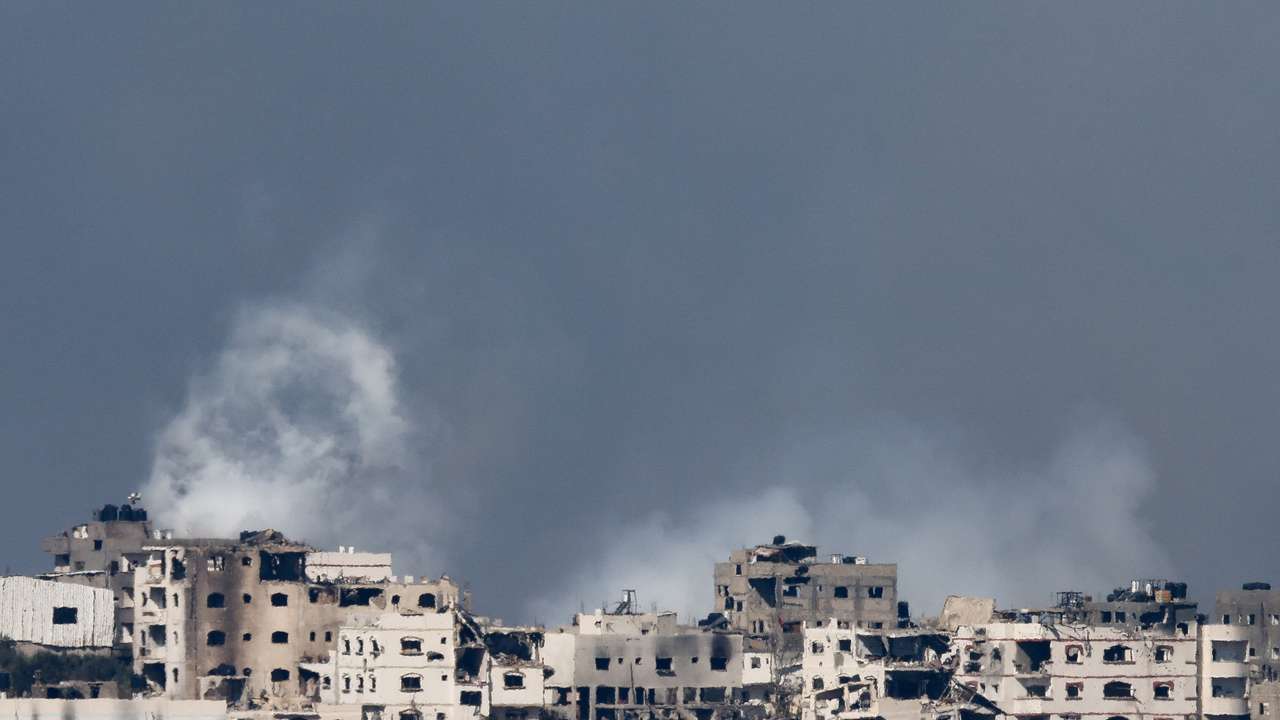
The war in Gaza began after Hamas militants invaded southern Israel on Oct. 7, killing 1,200 people and taking 240 hostages. Israel has responded with a siege, bombardment and invasion that Gaza health officials say has killed more than 24,000 people.
Iran-backed militias in Lebanon, Iraq and Yemen have also attacked targets in the region to support Palestinians.
Top LNG exporter Qatar is also one of the world's largest investors through its QIA sovereign wealth fund (SWF) and its assessment of risks has implications for its investments.
Kuwari said in an interview that Qatar would post a fiscal surplus again this year, albeit smaller, because it had forecast a very conservative oil price of $60 per barrel. The surplus would be bigger if prices stay at current levels of $78.
$1 TRILLION
Kuwari expects Qatar will post yet a fiscal surplus despite an expected 11% drop in revenues and a 1% rise in expenditure.
RECOMMENDED FOR YOU

‘Meta, don't meddle’ - Lula supporters protest alleged election bias in Brazil
"We like always to take a conservative view on the oil price when it comes to calculate the revenues," said Kuwari.
Any surplus is divided between state debt repayment, central bank reserves and the QIA, said Kuwari, who is a board member.
He declined to disclose how the money is being split or the value of the QIA's fund under management.
Qatar saw record revenues from gas exports in 2022, when global prices spiked after Russia invaded Ukraine.
The Sovereign Wealth Institute estimates Qatar has increased its assets under management to $475 billion over the past years.
Asked if QIA could grow this to $1 trillion, Kuwari said it was the fund's job to grow assets. "A trillion, two trillions, even three trillions is better than one,"
He said QIA was looking to invest in artificial intelligence firms alongside technology, infrastructure and pharmaceuticals, especially biomedicine.
Despite cutting back its stake in British bank Barclays last month, the QIA remains positive about Britain's economy, which Kuwari described as "strong and resilient".
RECOMMENDED FOR YOU

New Asia Forum: Indonesia to set out progress on sustainable AI data centres
Qatar plans to launch its first sovereign green bond "very soon", which Kuwari said would be its first external debt issuance in four years.
"We're not hungry for the money. It's purely to make a statement," he said. "The market is hungry for issuance. We've been approached by many investors."
Qatar, host of the FIFA World Cup 2022, is trying to diversify its economy away from oil and gas while attracting foreign investment.
Kuwari said the World Cup was still having a positive impact as the number of visitors grew to 4 million in 2023, topping 2.3 million in 2022 during the championship.
This article was produced by Reuters news agency. It has not been edited by Global South World.