Seven maritime chokepoints dominate the global shipping routes
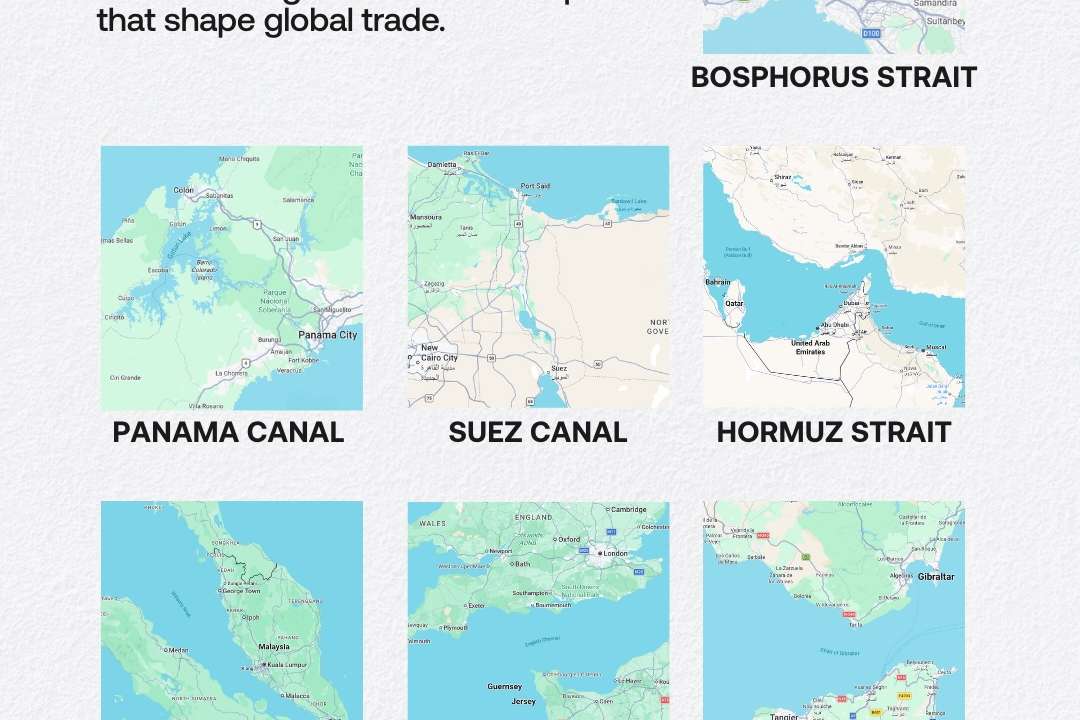
A handful of narrow sea passages account for a disproportionate share of global maritime trade, serving as critical arteries for energy supplies, container shipping, and raw materials, according to maritime data from Marine Insight and the global vessel-tracking platform Ship Traffic.
A handful of narrow sea passages account for a disproportionate share of global maritime trade, serving as critical arteries for energy supplies, container shipping, and raw materials.
These strategic chokepoints include the Suez Canal, the Panama Canal, the Strait of Hormuz, the Strait of Malacca, the English Channel, the Bosphorus Strait, and the Strait of Gibraltar. Together they form the backbone of international shipping, connecting the world’s major oceans and trade hubs.
Suez Canal
The Suez Canal in Egypt is one of the most important maritime shortcuts in the world.
Stretching about 193 kilometres, it links the Mediterranean Sea to the Red Sea, allowing ships travelling between Europe and Asia to avoid the long route around Africa.
RECOMMENDED FOR YOU
From Suomi to Zhongguo, why some countries have completely different names at home
According to maritime industry data, roughly 50 ships transit the canal daily, and the route carries around 12% of global trade, making it one of the busiest shipping corridors globally.
Strait of Hormuz
The Strait of Hormuz, located between Iran and Oman, is widely regarded as the most important oil chokepoint on the planet.
The narrow passage connects the Persian Gulf to the Gulf of Oman, through which more than 20,000 ships pass annually.
Energy analysts estimate that around 20% of global oil exports move through the strait, making it vital for international energy markets.
Strait of Malacca
The Strait of Malacca, located between Malaysia, Indonesia and Singapore, serves as the main shipping corridor linking the Indian Ocean to the South China Sea.
Roughly 260 vessels transit the route daily, according to maritime traffic data.
The passage is especially important for Asian manufacturing economies, including China, Japan and South Korea, which rely heavily on energy imports and global supply chains.
English Channel
The English Channel, separating southern England from northern France, is among the busiest sea routes in the world.
RECOMMENDED FOR YOU
Asia produces the largest share of global GDP
About 400 vessels pass through the channel every day, connecting Atlantic shipping routes to major ports in Northern Europe, including Rotterdam, Antwerp and Hamburg.
The channel stretches roughly 560 kilometres and plays a central role in trade flows between Europe and global markets.
Panama Canal
The Panama Canal, spanning roughly 82 kilometres across Panama, connects the Atlantic and Pacific oceans.
On average, about 32 ships transit the canal daily, according to maritime monitoring data.
The waterway provides a vital shortcut for trade between the United States, Asia and Latin America, significantly reducing travel distance and shipping costs.
Bosphorus Strait
The Bosphorus Strait, running through Istanbul, connects the Black Sea with the Sea of Marmara.
Although only about 30 kilometres long, the waterway handles heavy maritime traffic with around 48,000 ships passing annually, making it one of the busiest natural straits in the world.
The corridor is particularly important for the movement of grain, oil and regional trade from Black Sea countries.
RECOMMENDED FOR YOU

Bangladesh leads the world in share of farmland under irrigation
Strait of Gibraltar
The Strait of Gibraltar, located between southern Spain and northern Morocco, forms the entrance to the Mediterranean Sea from the Atlantic Ocean.
Approximately 300 ships transit the strait daily, carrying cargo and oil between Europe, Africa, the Middle East and global markets.
At its narrowest point, the passage is only about 14 kilometres wide, underscoring its role as a major global shipping chokepoint.
Why these routes matter
More than 80% of global trade moves by sea, according to international shipping estimates.
Because many shipping routes converge at a few narrow passages, disruptions caused by conflict, accidents or environmental factors can quickly affect supply chains worldwide.
Industry experts say the concentration of global maritime traffic in these chokepoints highlights both the efficiency and vulnerability of modern trade networks.