Sweden election leaves centre-left bloc narrowly ahead as right loses majority
Sweden’s centre-left opposition held a narrow lead after Sunday’s general election, putting Prime Minister Ulf Kristersson’s right-leaning bloc at risk of losing power after four years in government.
Key points
- Centre-left parties lead with 49.5% of the vote
- Social Democrats remain Sweden’s largest party
- Sweden Democrats fell to third place
Sweden’s centre-left opposition held a narrow lead after Sunday’s general election, putting Prime Minister Ulf Kristersson’s right-leaning bloc at risk of losing power after four years in government.
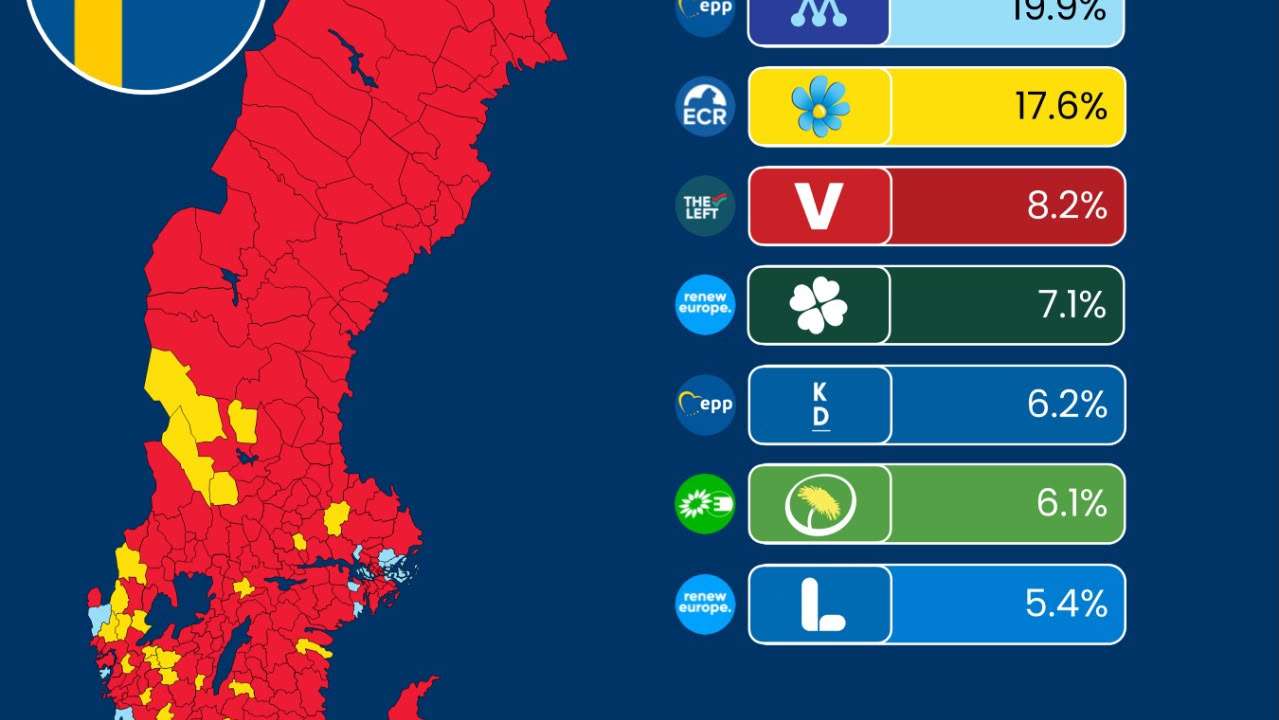
Preliminary results showed the Social Democrats, Left Party, Centre Party and Greens together taking about 49.5% of the vote, compared with 49.1% for the Moderates, Sweden Democrats, Christian Democrats and Liberals. The difference between the two sides was only tens of thousands of votes.
The Social Democrats, led by former prime minister Magdalena Andersson, remained the country’s largest party with 28.1%, although their support fell from the 2022 election.
The Moderate Party of Kristersson moved into second place with 19.9%, while the Sweden Democrats slipped to third with 17.6%. The Sweden Democrats had won 20.5% in 2022, meaning their support fell by about three percentage points.
RECOMMENDED FOR YOU
Argentina takes Britain to International Court, demands halt to Falklands oil project
The Left Party received about 8.2%, followed by the Centre Party on 7.1%, Christian Democrats on 6.2%, Greens on 6.1% and Liberals on 5.4%.
Sweden Democrats lose ground
The result marks a significant reversal for the Sweden Democrats. The anti-immigration party had become Sweden’s second-largest party in 2022 and spent the following four years supporting Kristersson’s minority government from outside the cabinet.
In 2026, however, it lost support for the first time since entering parliament in 2010 and fell behind the Moderates.
The Liberals, meanwhile, performed better than many pre-election polls had suggested. The party cleared Sweden’s 4% threshold for parliamentary representation, an important result for the right-leaning bloc because falling below it would have cost the alliance seats.
Preliminary calculations put the centre-left parties on course for about 176 of the Riksdag’s 349 seats, against 173 for the right, giving the opposition a potential three-seat majority.
That could open the way for Andersson, who served as prime minister from 2021 to 2022, to return to office. But forming a government may still be difficult because the four opposition parties disagree on several issues and have not committed to governing together.
The election is not over yet
The result remains preliminary. Sweden’s Election Authority says late advance votes are counted on the Wednesday after election day, followed by a separate final count. The definitive parliamentary result and seat allocation are expected about a week after the election.
That distinction matters because the contest is extremely close. Neither bloc can safely claim victory while outstanding ballots could still affect the distribution of seats.
RECOMMENDED FOR YOU
Brazil election 2026: Lula overturns Flávio Bolsonaro's lead in more than 200 municipalities to win presidency
This story is written and edited by the Global South World team, you can contact us here.