The Amazon spans nine territories but one country dominates
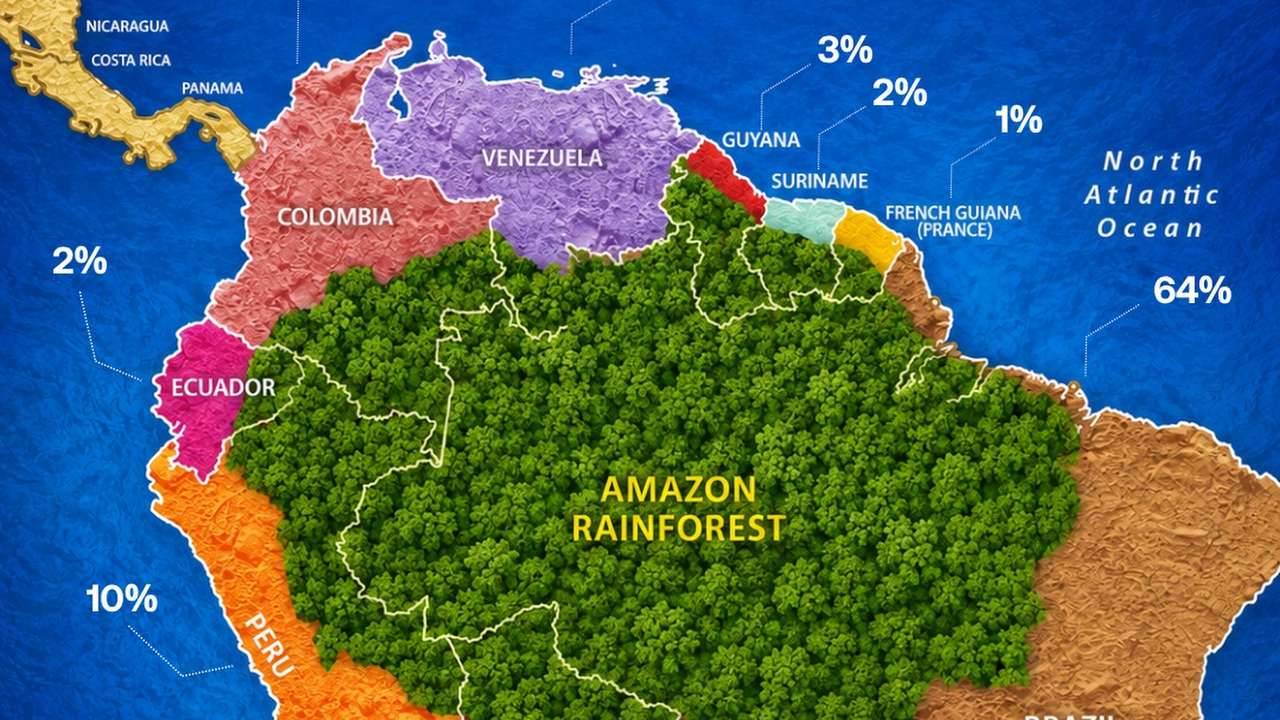
The Amazon rainforest stretches across nine countries and territories in South America, with Brazil containing about 64% of its total area, reinforcing the country's central role in protecting the world's largest tropical rainforest, according to the World Wildlife Fund (WWF) and Encyclopaedia Britannica.
The Amazon rainforest stretches across nine countries and territories in South America, with Brazil containing about 64% of its total area, reinforcing the country's central role in protecting the world's largest tropical rainforest, according to the World Wildlife Fund (WWF) and Encyclopaedia Britannica.
Covering approximately 6 million square kilometres (2.3 million square miles), the Amazon extends beyond Brazil into Peru, Colombia, Bolivia, Venezuela, Guyana, Suriname, Ecuador and French Guiana, an overseas department of France.
Brazil accounts for roughly 64% of the rainforest, followed by Peru (10%). Colombia, Venezuela and Bolivia each contain about 6%, while Guyana holds around 3%. Ecuador and Suriname each account for about 2%, and French Guiana contains approximately 1%.
The Amazon is the largest continuous tropical rainforest on Earth and is home to an estimated 10% of all known species, including thousands of mammals, birds, reptiles, amphibians, fish and insects. Scientists estimate that the forest also contains around 390 billion individual trees representing roughly 16,000 species.
RECOMMENDED FOR YOU
Which Georgia is closer to you?
The rainforest plays a critical role in regulating the global climate. According to WWF, its forests store vast quantities of carbon and recycle enormous volumes of water through evapotranspiration, helping to generate rainfall across much of South America. The Amazon River, which drains the basin, carries more freshwater into the oceans than any other river in the world.
More than 47 million people live in the Amazon Basin, including over 2 million Indigenous people from hundreds of distinct ethnic groups whose communities have managed and depended on the forest for generations, according to Conservation International and WWF.
Despite its global importance, the Amazon continues to face mounting pressure from deforestation, illegal logging, mining, agricultural expansion, road construction and climate change. WWF warns that continued forest loss could push parts of the Amazon toward an ecological tipping point, where large areas may no longer be able to sustain tropical rainforest ecosystems.
Conservation efforts increasingly rely on cooperation among all Amazon countries. The Amazon Cooperation Treaty Organisation (ACTO), created in 1995, brings together the eight sovereign Amazon nations to coordinate policies on conservation, sustainable development and scientific research across the basin.
Scientists and conservation organisations say protecting the Amazon is not solely a regional issue but a global one, given its influence on biodiversity, freshwater resources and climate systems far beyond South America.
This story is written and edited by the Global South World team, you can contact us here.