Total Solar Eclipse sweeps across Spain in historic celestial event
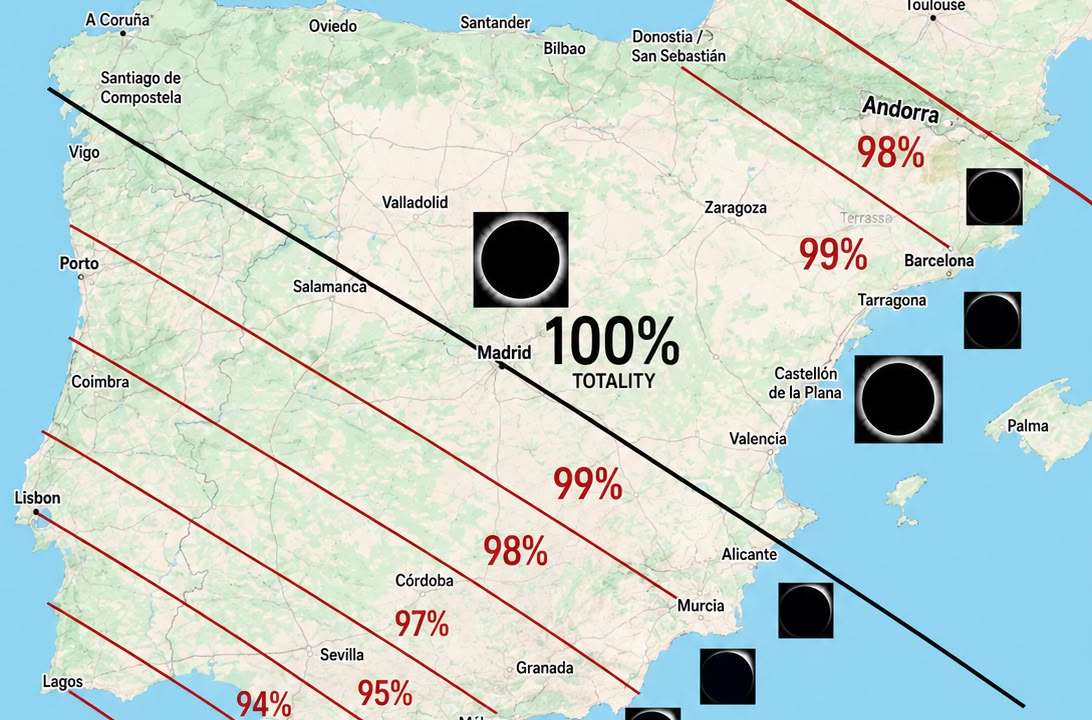
A total solar eclipse swept across Spain on Wednesday evening (August 12, 2026), briefly plunging parts of the country into darkness as the Moon completely covered the Sun in the first total eclipse visible from mainland Spain in more than a century.
Key Points
- Total solar eclipse swept across Spain on August 12
- Totality crossed northern and eastern Spain before sunset
- Spain faces another total solar eclipse in 2027
A total solar eclipse swept across Spain on Wednesday evening, briefly plunging parts of the country into darkness as the Moon completely covered the Sun in the first total eclipse visible from mainland Spain in more than a century.
The August 12 eclipse crossed northern Russia, Greenland, Iceland and the Atlantic before reaching the Iberian Peninsula, according to NASA. Spain was one of the final major land areas along the path of totality.
The Moon’s shadow moved across northern and eastern Spain, with totality visible from areas including A Coruña, Oviedo, León, Bilbao, Zaragoza and Valencia, as well as parts of the Balearic Islands.
Totality occurred at around 8:28 p.m. in León, 8:29 p.m. in Zaragoza and 8:32 p.m. in Valencia, according to NASA calculations. The fully eclipsed phase generally lasted less than two minutes.
RECOMMENDED FOR YOU

More than 6 billion people are now online as global internet access reaches new high
The timing made the Spanish eclipse particularly striking. The Sun was already low on the western horizon when the Moon blocked it, creating a brief period of darkness shortly before sunset.
Outside the path of totality, millions of people still witnessed a deep partial eclipse. Madrid and Barcelona experienced about 99% solar coverage, while southern Spain also saw most of the Sun obscured.
The event marked the beginning of an unusual three-year sequence of major solar eclipses over Spain.
A second total solar eclipse will cross southern Spain on August 2, 2027, followed by an annular solar eclipse on January 26, 2028, according to Spain’s National Geographic Institute.
Scientists also used Wednesday’s eclipse to study the Sun and Earth’s atmosphere. NASA-backed research included observations of the solar corona and measurements of atmospheric changes caused by the sudden loss of sunlight.
For Spain, the brief spectacle represented a rare astronomical milestone, with the Moon’s shadow crossing the country and delivering totality to parts of the Iberian Peninsula for the first time in generations.
This story is written and edited by the Global South World team, you can contact us here.