Uruguay stands out as Latin America's most urban nation
- #Kyaw Moe Tun
- #cotton production
- #Min Aung Hlaing
- #GlobalShipping
- #BreakingNews
- #BangkokFire
- #Israel Defence Forces
- #Sabra
- #Nayib Bukele
- #field hospital
- #El Salvador
- #USDiplomacy
- #ElMayoZambada
- #ClaudiaSheinbaum
- #civilian casualties
- #war crimes
- #humanitarian crisis
- #NATOSummit
- #GlobalSecurity
- #MarkRutte
- #Visualized
- #World Visualized
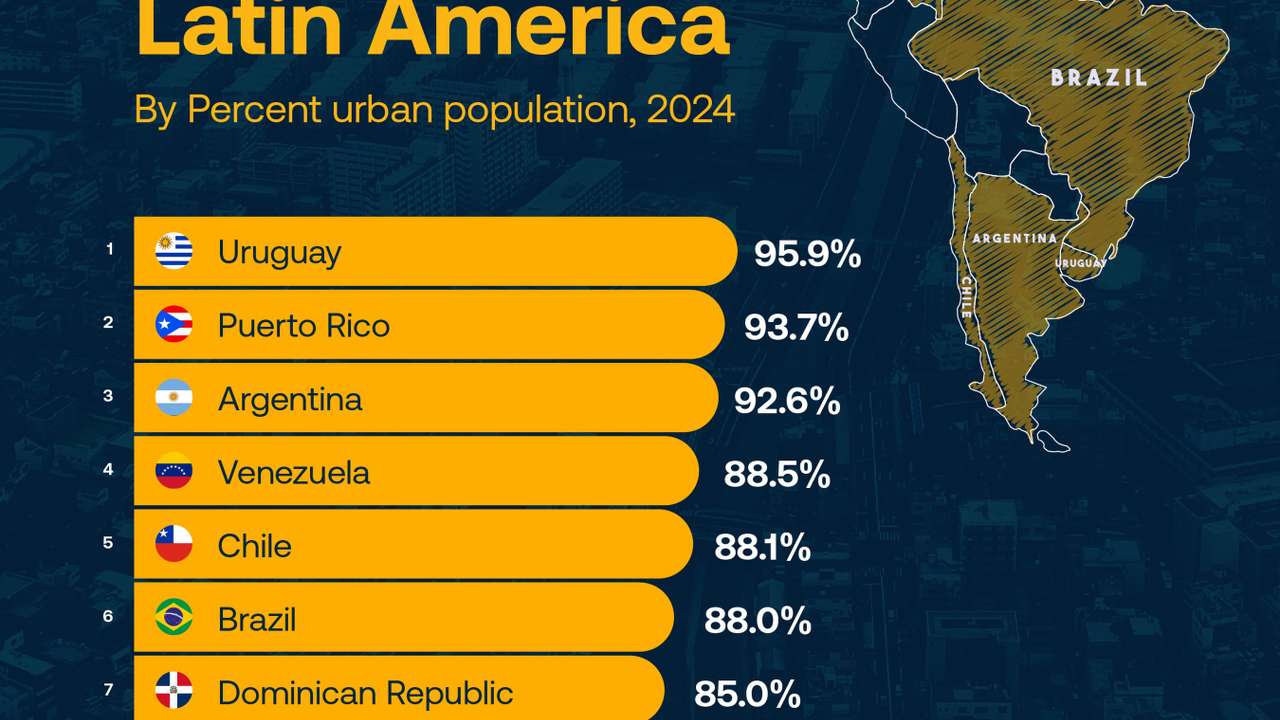
Uruguay has the highest share of urban residents in Latin America, with 95.9% of its population living in urban areas in 2024, according to the United Nations Population Division's World Urbanisation Prospects.
Main Points
- Uruguay leads Latin America with 95.9% urban population.
- Argentina, Venezuela and Chile rank among the region's most urbanised countries.
- Latin America's rapid urban growth continues to reshape major cities.
Uruguay has the highest share of urban residents in Latin America, with 95.9% of its population living in urban areas in 2024, according to the United Nations Population Division's World Urbanisation Prospects.
The UN estimates that nearly all Uruguayans now live in cities and towns, reflecting one of the world's most urbanised societies. The country's population is heavily concentrated around Montevideo, which, together with its surrounding metropolitan area, accounts for more than half of the national population.
Puerto Rico ranks second with 93.7%, followed by Argentina at 92.6%. Venezuela places fourth with 88.5%, narrowly ahead of Chile at 88.1% and Brazil at 88.0%.
Among Latin America's largest economies, urban populations now dominate national demographics.
RECOMMENDED FOR YOU
From Suomi to Zhongguo, why some countries have completely different names at home
Brazil, the region's most populous country, has almost nine in ten people living in urban areas. São Paulo, Rio de Janeiro, Brasília, Belo Horizonte and Salvador remain among the country's largest metropolitan centres.
Mexico ranks tenth with 81.9%, driven by continued growth around Mexico City, Guadalajara and Monterrey. Colombia follows closely with 82.7%, where Bogotá, Medellín, Cali and Barranquilla account for a significant share of the country's population.
The Dominican Republic records 85.0%, while Costa Rica reaches 83.2%, with urban growth concentrated around Santo Domingo and the Greater Metropolitan Area of San José, respectively.
According to the United Nations, Latin America and the Caribbean is one of the world's most urbanised regions, with urbanisation accelerating rapidly throughout the second half of the 20th century as millions of people moved from rural areas to cities in search of employment, education and healthcare.
The UN projects that urbanisation will continue increasing across much of the region over the coming decades, although growth is expected to slow as many countries approach saturation levels where the overwhelming majority of their populations already live in urban areas.
This story is written and edited by the Global South World team, you can contact us here.