U.S. and Israel conduct more than 5,000 strikes in 10 days, Iran responds with about 3,000 attacks
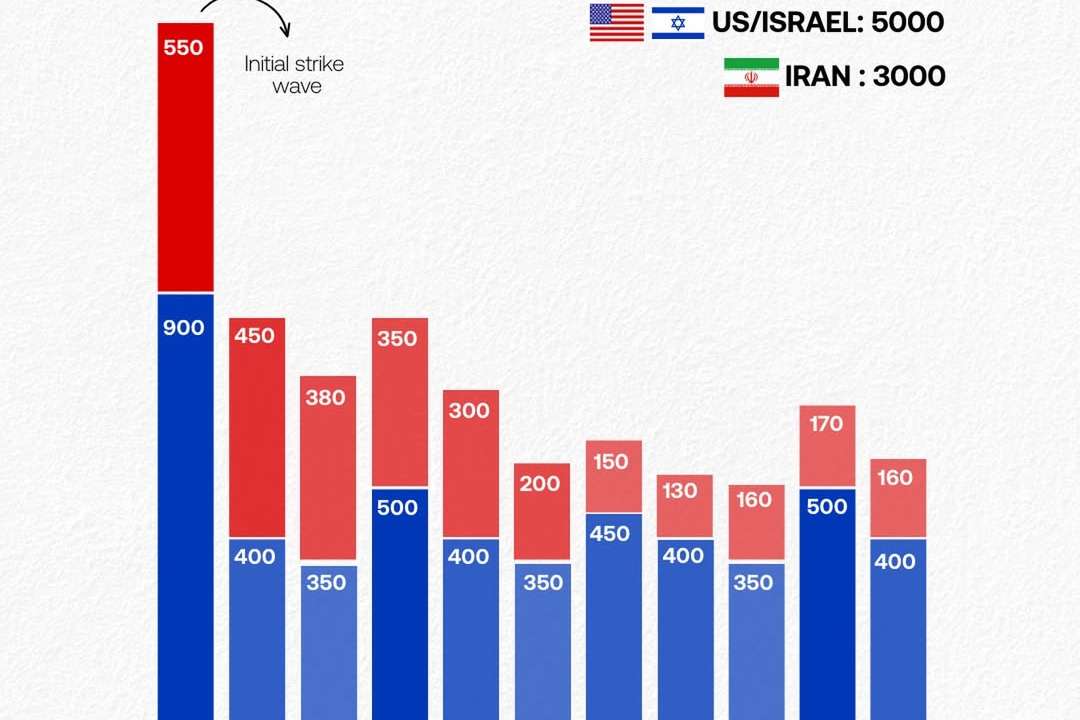
A surge in military activity between U.S.–Israel forces and Iran saw thousands of strikes exchanged over 10 days, highlighting the intensity of the escalating confrontation in the region, according to data compiled by Eigenrac Risk Management.
A surge in military activity between U.S.–Israel forces and Iran saw thousands of strikes exchanged over 10 days, highlighting the intensity of the escalating confrontation in the region, according to data compiled by Eigenrac Risk Management, a Dubai-based security risk advisory company.
The analysis shows that between February 28 and March 10, U.S. and Israeli forces carried out around 5,000 strikes, while Iran launched roughly 3,000 attacks during the same period.
The figures illustrate the scale and pace of operations as both sides exchanged sustained waves of military strikes across multiple days.
The conflict began with a major initial escalation on February 28, when the combined U.S.–Israel strike wave reached roughly 900 attacks, according to the data.
RECOMMENDED FOR YOU
From Suomi to Zhongguo, why some countries have completely different names at home
Iran responded with about 550 strikes, marking the opening phase of the confrontation.
After the initial surge, both sides continued launching attacks throughout early March.
Eigenrac Risk Management’s estimated daily counts show the following pattern:
Destructions from tensions
Apart from the UAE and Qatar, Bahrain was caught in the crossroads after an Iranian drone reportedly struck fuel storage facilities near Bahrain International Airport on Muharraq Island.
The attack reportedly occurred late at night on March 12 in Muharraq Governorate, where the kingdom’s main airport and several energy storage sites are located.
Bahraini authorities said the drone hit fuel tanks, igniting a large fire that sent thick plumes of smoke into the sky and prompted emergency warnings for nearby residents to remain indoors and close windows to avoid inhaling smoke from the burning fuel.
Additionally, oil prices have climbed again after three additional cargo vessels were struck in the Gulf. Brent crude surged more than 9% during Asian trading, briefly pushing above $100 (£74.79) per barrel before retreating slightly to around $97.50.
RECOMMENDED FOR YOU
Asia produces the largest share of global GDP
The International Energy Agency, on Thursday, March 12, said the conflict in the Middle East was "creating the largest supply disruption in the history of the global oil market".