U.S. overtakes Qatar as world’s top Liquefied Natural Gas exporter

The United States has emerged as the world’s leading exporter of liquefied natural gas (LNG), capping a decades-long shift in global energy dominance that has moved from North Africa to Asia, the Middle East and now North America.
The United States has emerged as the world’s leading exporter of liquefied natural gas (LNG), capping a decades-long shift in global energy dominance that has moved from North Africa to Asia, the Middle East and now North America.
Data compiled from energy agencies and industry analyses, including the U.S. Energy Information Administration (EIA), show the U.S. has held the top spot since 2023, overtaking long-time leader Qatar and reshaping global gas supply dynamics.
The LNG industry has undergone several distinct phases over the past three decades, driven by infrastructure investment, resource discoveries and changing demand patterns.
In the early years, Algeria led global LNG exports between 1990 and 1994, leveraging its pioneering facilities at Arzew. According to Britannica, Algeria was among the first countries to commercialise LNG exports, giving it an early strategic advantage.
RECOMMENDED FOR YOU

France split into three nearly equal populations shows how unevenly the country is settled
That lead faded as newer producers scaled faster. By the mid-1990s, Indonesia took over (1995–2005), supported by large export terminals such as Bontang and Arun, and long-term contracts with Asian buyers, particularly Japan. Industry analyses from Incorrys note that this period coincided with a surge in LNG demand across the Asia-Pacific region.
From 2006 to 2021, Qatar dominated the global LNG market, setting a new benchmark for scale and efficiency.
Backed by the massive North Field, the world’s largest natural gas reservoir, Qatar expanded production through its Ras Laffan industrial complex. According to industry data and EIA assessments, Qatar at times accounted for over 30% of global LNG supply, cementing its role as the central player in international gas markets.
Its success was built on long-term contracts, cost advantages and the ability to deliver large, consistent volumes to Europe and Asia.
The balance shifted again in 2022, when Australia briefly became the top exporter, driven by major offshore LNG projects including Gorgon, Wheatstone and Ichthys.
However, analysts note that Australia’s lead was short-lived, as production growth plateaued and operational constraints limited further expansion.
Since 2023, the United States has taken the lead, powered by the shale gas revolution and the rapid expansion of LNG export terminals along the Gulf Coast.
According to the U.S. Energy Information Administration, the country’s export capacity has grown sharply in recent years, supported by facilities in Texas and Louisiana. The U.S. model differs from traditional exporters, offering flexible contracts and destination-free cargoes, making it particularly attractive to buyers.
RECOMMENDED FOR YOU
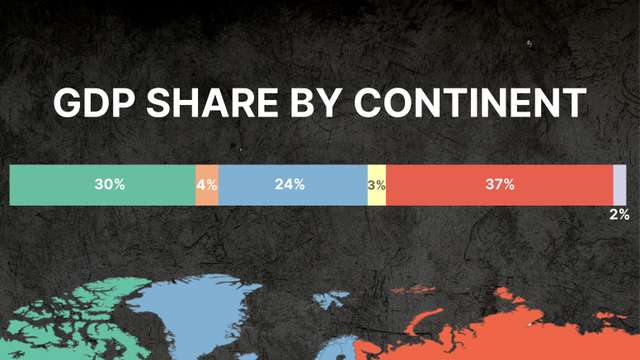
Asia produces the largest share of global GDP
Strong demand from Europe — especially following efforts to reduce reliance on Russian pipeline gas — and continued growth in Asian markets have accelerated U.S. exports.
Geopolitics and demand reshape the market
The shift in LNG leadership reflects broader geopolitical and economic changes.
- Europe’s energy security concerns have boosted demand for U.S. LNG
- Asia remains a key growth market, led by China, Japan and South Korea
- Flexible supply models are increasingly valued over rigid long-term contracts
Britannica notes that LNG plays a critical role in global energy systems by enabling natural gas to be transported across oceans, linking producers and consumers that are not connected by pipelines.