Who would lose most if the Strait of Hormuz closes?
Rising tensions in the Middle East have once again drawn attention to the Strait of Hormuz, one of the world’s most strategically important shipping routes for oil and gas.
Rising tensions in the Middle East have once again drawn attention to the Strait of Hormuz, one of the world’s most strategically important shipping routes for oil and gas.
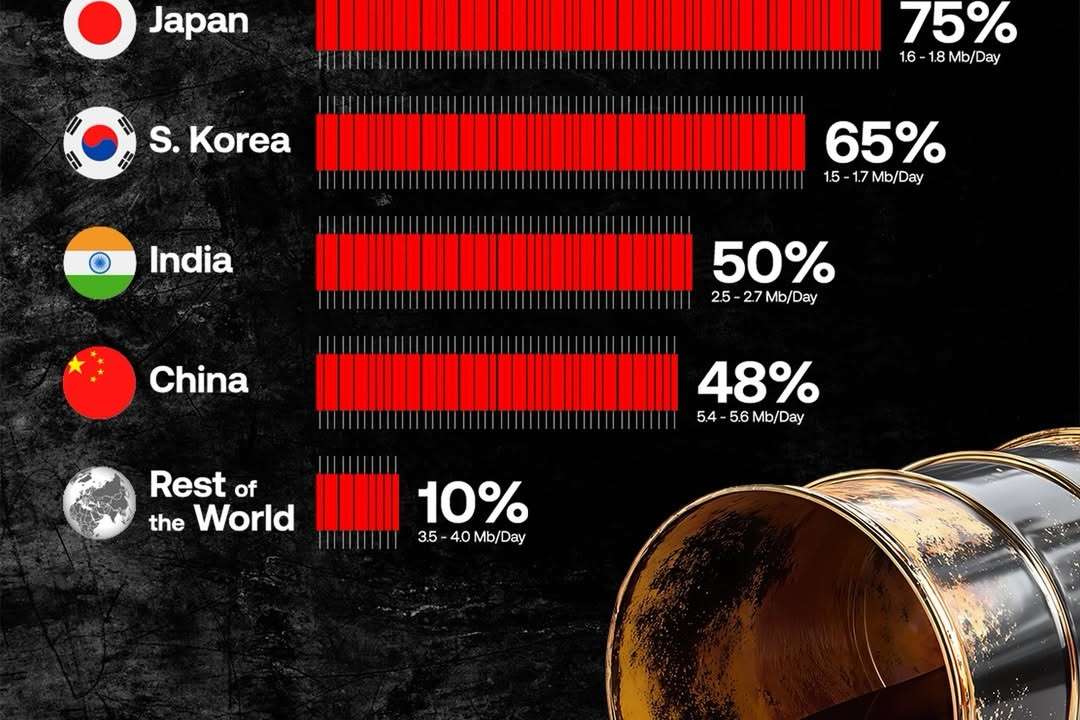
The above map shows that Japan, South Korea, India and China would be among the biggest losers if the Strait of Hormuz were blocked, reflecting their heavy reliance on crude oil shipped from the Persian Gulf.
The Strait of Hormuz, located between Iran and Oman, connects the Persian Gulf to the Arabian Sea and is widely considered the most critical oil transit chokepoint in the world. According to energy analytics firm Kpler, roughly 20% of the world’s oil supply passes through the strait every day, making it essential to global energy markets.
Any disruption would send shockwaves through global trade, pushing oil prices higher and threatening energy security for countries that rely heavily on Gulf crude.
RECOMMENDED FOR YOU
From Suomi to Zhongguo, why some countries have completely different names at home
The waterway is only about 33 kilometres wide at its narrowest point, meaning shipping lanes are particularly vulnerable to military conflict or blockades.
Japan appears to be the most vulnerable major economy in the graphic. Around 75% of its crude oil imports pass through the Strait of Hormuz, equivalent to roughly 1.6 to 1.8 million barrels per day.
The Japan Times has reported that the country remains deeply dependent on Middle Eastern oil despite efforts to diversify energy sources since the 2011 Fukushima disaster. Much of Japan’s crude still comes from Gulf producers such as Saudi Arabia, the United Arab Emirates and Kuwait.
Because Japan imports nearly all of its oil, any disruption in the strait could immediately affect fuel prices, electricity costs and industrial production.
South Korea follows closely behind Japan in exposure. Around 65% of its crude oil imports transit the Strait of Hormuz, or approximately 1.5 to 1.7 million barrels per day.
India, the world’s third-largest oil importer, would also face major disruptions. Roughly half of India’s oil imports pass through the strait, amounting to 2.5 to 2.7 million barrels per day, according to energy shipping data cited by Kpler.
India’s dependence on Gulf crude has grown alongside its rapidly expanding economy. Analysts note that energy security remains a key concern for the country as demand for fuel continues to rise.
Reporting from The Better India has highlighted how India has been trying to reduce vulnerability by increasing strategic petroleum reserves and diversifying supply sources, including imports from Russia and the United States.
RECOMMENDED FOR YOU
Why Gaddafi once wanted Switzerland split between three countries
China, the world’s largest crude oil importer, is also significantly exposed. About 48% of Chinese oil imports pass through the Strait of Hormuz, equivalent to around 5.4 to 5.6 million barrels per day.
However, China’s broader supply network gives it slightly more flexibility than other Asian economies. Beijing imports oil from a wide range of producers, including Russia, Brazil and West Africa.
While Asian economies are the most exposed, the entire world would feel the effects of a Hormuz disruption.
Swiss private bank Union Bancaire Privée (UBP) has warned that any closure of the strait could trigger a sharp surge in global oil prices because such a large share of supply flows through the corridor.
UBP analysts say that even a temporary disruption could push oil prices significantly higher and disrupt global supply chains.
The impact would extend far beyond the countries that directly import Gulf crude, affecting everything from transport costs to food prices worldwide.