Why are millions leaving Southern Asia while Western Asia draws more migrants?
- #Claudia Sheinbaum
- #World Cup
- #historical injustices
- #Mahmoud Ali Youssouf
- #United Nations
- #SpaceExploration
- #TiangongSpaceStation
- #ChinaSpaceMission
- #Shenzhou23
- #patriarchy
- #Arab women
- #Feminism
- #IsraelGazaConflict
- #IndonesiaNews
- #GazaFlotilla
- #Eliud's World Tour
- #Cape Town
- #Kipchoge
- #Riek Machar
- #Salva Kiir
- #Visualized
- #World Visualized
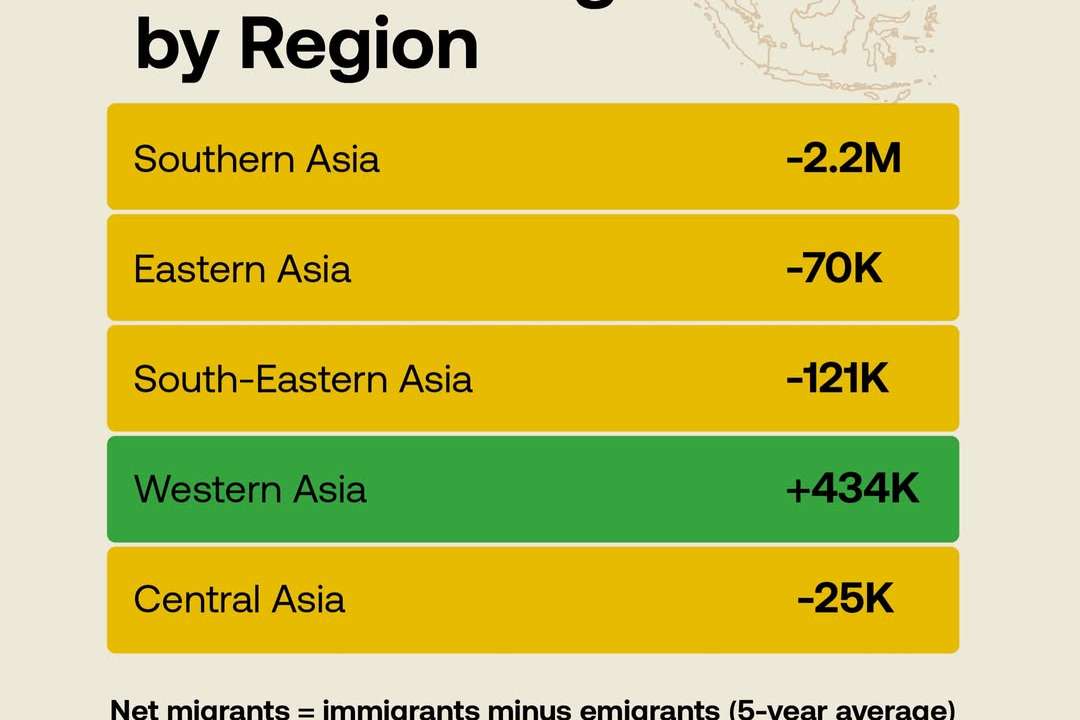
Southern Asia recorded the largest net migration loss in Asia, while Western Asia remained the region’s strongest migration destination, according to migration data compiled from the UN Population Division, Worldometers, the World Bank and international migration studies.
Main Points
- Southern Asia recorded Asia’s largest net migration loss at -2.2 million people over a five-year average period.
- Western Asia was the only Asian region with positive net migration, gaining around 434,000 people.
- Gulf economies continue attracting millions of migrant workers from South and Southeast Asia seeking jobs and higher wages.
Southern Asia recorded the largest net migration loss in Asia, while Western Asia remained the region’s strongest migration destination, according to migration data compiled from the UN Population Division and international migration studies.
A visual analysis published by Seasia Stats and World Visualized showed Southern Asia posting a net migration balance of -2.2 million people over a five-year average period, far exceeding outflows recorded in Eastern, South-Eastern and Central Asia.
Western Asia stood out as the only Asian subregion with positive net migration, recording a net gain of approximately 434,000 people.
Net migration measures the difference between immigrants entering a region and emigrants leaving it.
RECOMMENDED FOR YOU

EU opens door to Canada becoming its first associate member
Migration experts say Western Asia’s positive migration trend is largely driven by Gulf economies, including Saudi Arabia, the United Arab Emirates, Qatar and Kuwait, which rely heavily on foreign labour across construction, healthcare, domestic work and technology sectors.
The World Bank and the International Organisation for Migration have repeatedly identified the Gulf region as one of the world’s largest migrant worker destinations due to higher wages and strong labour demand.
Large migrant populations from India, Pakistan, Bangladesh, Nepal and the Philippines continue moving to the Gulf in search of economic opportunities.
Southern Asia’s large negative migration balance reflects longstanding outward migration patterns from countries such as India, Pakistan, Bangladesh and Nepal.
Economic opportunity, overseas employment, education and family reunification remain among the biggest drivers of migration from the region, according to UNESCO and UN migration reports.
India alone has one of the world’s largest overseas diasporas, with millions of citizens living and working abroad.
Eastern Asia and South-Eastern Asia also recorded net migration losses, though at much smaller levels compared to Southern Asia.
Ageing populations, slowing economic growth and changing labour markets are believed to be reshaping migration trends in countries including China, Japan and South Korea.
RECOMMENDED FOR YOU

Europe leads world in milk and dairy consumption at 221 kg per person
Meanwhile, Southeast Asian nations continue experiencing both outbound labour migration and growing urban migration within the region.
The International Organisation for Migration estimates there were more than 281 million international migrants worldwide in recent years, with Asia remaining central to global migration flows.
This story is written and edited by the Global South World team, you can contact us here.