Yugoslavia and Iran: Two nations with different histories but a similar shape
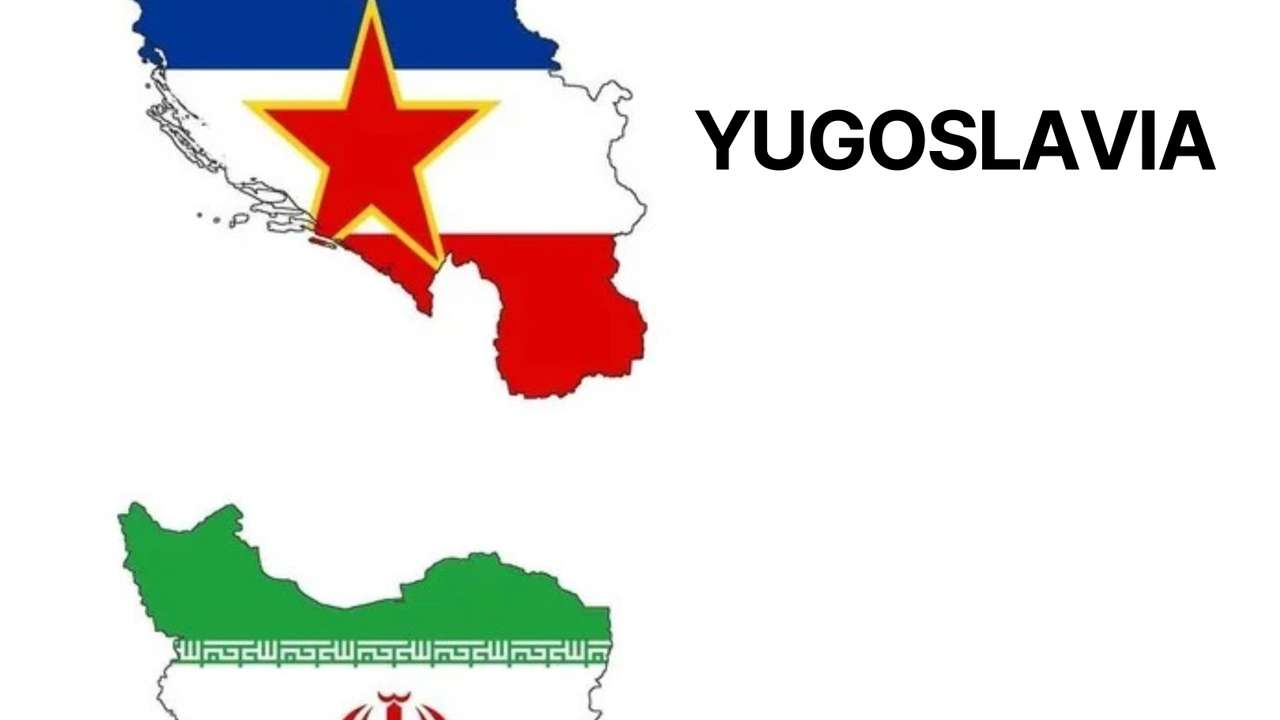
Few countries illustrate the complexity of twentieth-century geopolitics like Yugoslavia and Iran. One was a multi-ethnic socialist federation that emerged after the Second World War in the Balkans, while the other is a centuries-old civilisation that evolved from ancient Persian empires into a modern Middle Eastern state.
Few countries illustrate the complexity of twentieth-century geopolitics like Yugoslavia and Iran. One was a multi-ethnic socialist federation that emerged after the Second World War in the Balkans, while the other is a centuries-old civilisation that evolved from ancient Persian empires into a modern Middle Eastern state.
Despite their very different historical paths, the two countries share an unexpected similarity: their geographic outlines appear remarkably alike when placed side by side on a map.
Yet beyond that coincidence, the stories of Yugoslavia and Iran reveal two very different political journeys shaped by revolution, empire, and regional power struggles.
Yugoslavia: A Balkan Federation born from war
Yugoslavia was created after World War I in 1918 as the Kingdom of Serbs, Croats and Slovenes, bringing together several South Slavic territories that had previously been part of the Austro-Hungarian and Ottoman empires. In 1929, the state officially became known as Yugoslavia, meaning “Land of the South Slavs.”
RECOMMENDED FOR YOU
From Suomi to Zhongguo, why some countries have completely different names at home
After the Second World War, the country was transformed into the Socialist Federal Republic of Yugoslavia under the leadership of Josip Broz Tito, a communist revolutionary who led the anti-Nazi resistance movement during the war.
According to Britannica, Tito established a federation consisting of six republics, Serbia, Croatia, Bosnia and Herzegovina, Slovenia, Montenegro and Macedonia, along with two autonomous provinces within Serbia.
Unlike most Eastern European communist states, Yugoslavia pursued an independent path during the Cold War. Tito broke with Soviet leader Joseph Stalin in 1948, allowing Yugoslavia to operate outside the Soviet bloc while still maintaining a socialist system.
The country later became a founding member of the Non-Aligned Movement, positioning itself between the Western and Soviet camps.
Yugoslavia covered roughly 255,800 square kilometres and stretched from the Adriatic Sea to the Balkan interior, encompassing mountains, coastlines and fertile plains.
Iran: A state rooted in ancient civilisation
Iran’s history stretches back thousands of years, making it one of the oldest continuously inhabited political regions in the world. The country was historically known as Persia, home to powerful empires such as the Achaemenid Empire, founded by Cyrus the Great in the 6th century BCE, which once ruled territory from the Mediterranean to Central Asia.
Modern Iran began to take shape during the 20th century under the Pahlavi dynasty, which pursued rapid modernisation and centralisation of the state. In 1979, however, the Iranian Revolution transformed the country into an Islamic republic following the overthrow of Shah Mohammad Reza Pahlavi.
The revolution, led by Ayatollah Ruhollah Khomeini, reshaped Iran’s political system and its relationship with Western powers.
RECOMMENDED FOR YOU
Asia produces the largest share of global GDP
Today, Iran is one of the largest countries in the Middle East, covering about 1.65 million square kilometres, according to the World Bank and CIA World Factbook. Its geography includes vast deserts, major mountain ranges such as the Zagros and Alborz, and strategic access to the Persian Gulf and the Strait of Hormuz, one of the world’s most important energy shipping routes.
Although Yugoslavia and Iran share surprisingly similar outlines on a map, their physical geographies and political histories developed independently.
Yugoslavia’s borders were shaped largely by European treaties, ethnic distributions and post-war political arrangements, while Iran’s boundaries reflect centuries of imperial expansion and negotiations with neighbouring states.
Cartographers often point out that such similarities are simply the result of how natural features, coastlines and historical borders intersect over time.
The dissolution of Yugoslavia
While Iran remains a single nation-state, Yugoslavia no longer exists. After the death of Tito in 1980, economic instability and rising nationalism weakened the federation. The country ultimately collapsed during the Yugoslav Wars of the 1990s, which followed the declarations of independence by several republics.
Between 1991 and 2006, Yugoslavia gradually fragmented into the independent states known today as Slovenia, Croatia, Bosnia and Herzegovina, North Macedonia, Serbia, Montenegro and Kosovo.