27 years ago a US history teacher reacted to a TV report. His actions helped transform a Chinese desert and inspire the world
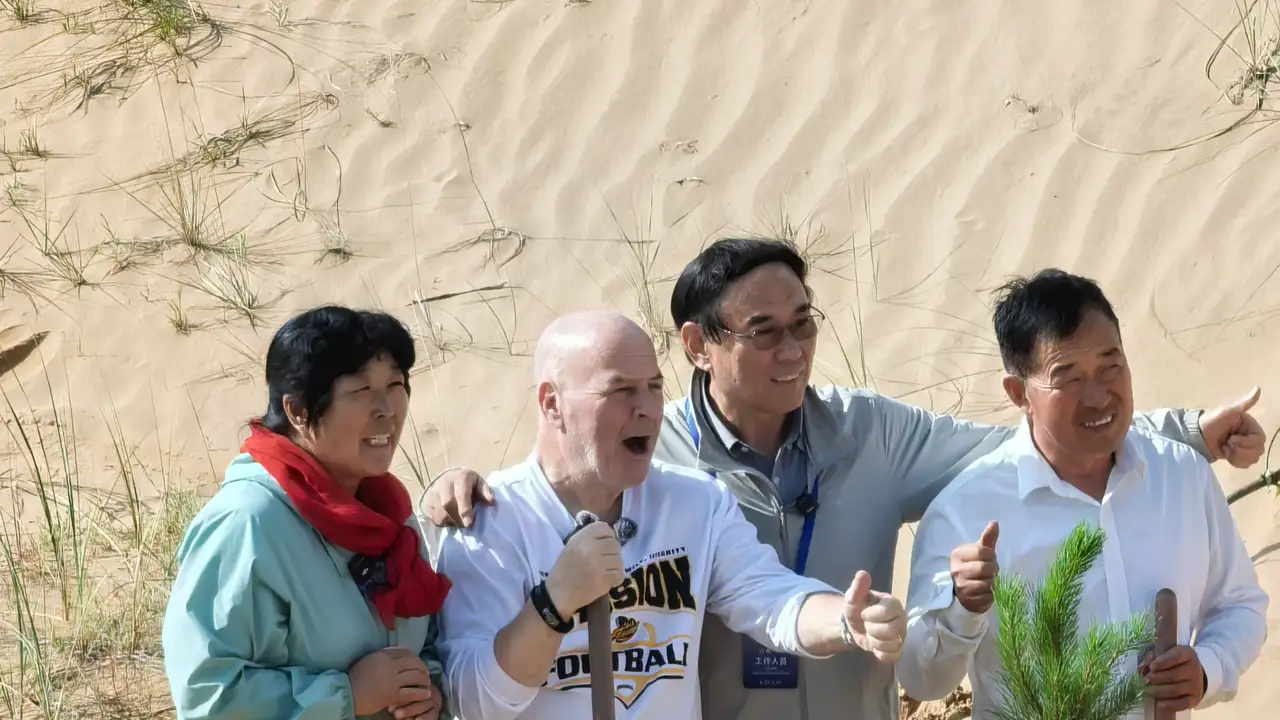
More than 20 years ago, an American history teacher sponsored a Chinese desert-control worker to plant trees.
Today, that project has helped create a lush forest where once was just arid sand and rock.
The story exemplifies how cooperation and mutual support can deliver dramatic change across vast distances.
RECOMMENDED FOR YOU

The war in Iran is still ongoing: how much more can the global economy take?
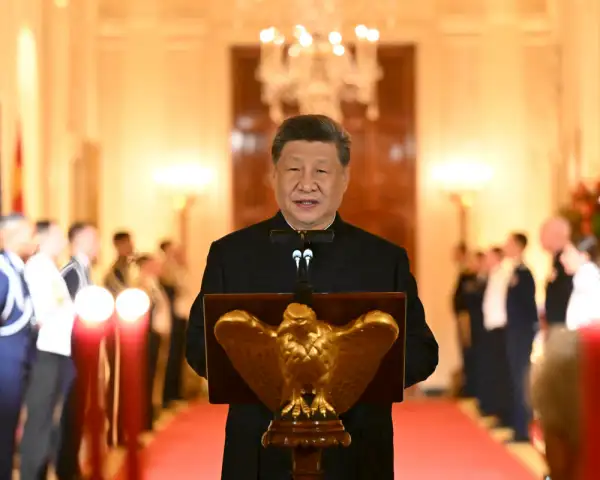
The two people were recently united and their story became an inspiration for millions in China. The country's president Xi Jinping used the anecdote in his White House speech to express the opportunities and benefits of partnership.
A story that touched the world
In the converging media newsroom of CGTN (China Global Television Network) in Beijing's CBD, time is always measured in minutes and seconds. As a journalist here, my daily routine is typically filled with real-time data from various digital platforms, breaking news, geopolitical machinations, and transformational international issues. The data curves of international social media on the screens constantly fluctuate wildly with global conflicts and economic turmoil. In this information age full of uncertainty and polarised social network groups, people seem to have grown accustomed to the confrontation and divergence of international current affairs, alongside the absurd and outrageous remarks of politicians.
However, in the summer of 2026, a news story with no conflict, no special effects, and a protagonist who is an elderly man with a slightly faltering gait, profoundly moved our entire newsroom. As footage from our frontline colleagues continuously poured into headquarters from Washington, Beijing, Inner Mongolia, and Henan, the series of reports we helped produce and distribute surpassed 5 million views on social platforms within just a few hours. Domestically, from Weibo to WeChat, and from Douyin to Bilibili, a succession of trending topics brought tears to the eyes of countless social media users who are usually accustomed to partings and reunions.
The protagonists of the story are 69-year-old retired American history teacher Ronald Sakolsky (affectionately called "Saikaosi" by his Chinese friends) and Yin Yuzhen, a "desert-control hero" from the Mu Us Sandy Land in Inner Mongolia, China. What moved me most as a media professional is that the true starting point of this transnational bond, hailed as a "miracle" around the world, was exactly 27 years ago at the CCTV English Channel (the predecessor of CGTN), where I work.This is a reunion 27 years in the making, a mutual journey spanning mountains and seas between ordinary people, and the most heartwarming event we international journalists have witnessed in our careers.
The news report which started it all
To properly tell today's story, we must turn the clock back to 1999. At that time, Sakolsky was just an ordinary middle school history teacher in the suburbs of Pittsburgh, Pennsylvania. His life trajectory seemingly had no intersection with China. In a televised interview, Sakolsky recalled that incredible beginning: one day, whilst waiting at a doctor's clinic, he casually flipped through a magazine and noticed a four-line advert in an inconspicuous corner seeking American teachers willing to teach English in China.
As if guided by destiny, he made the phone call and even gave up a family gathering to fly to New York for an interview. With the full support of his four children and family, he travelled to Luoyang, Henan Province to teach, as one of 14 teachers selected from across the United States through the Sino-US Teacher Exchange Programme.
RECOMMENDED FOR YOU

Why I'm not cheering for a winner in the AI race. Opinion
One evening in Luoyang, Sakolsky turned on the television and tuned in to CCTV's English news. The screen was broadcasting an environmental report filmed by our channel's reporters deep in the Mu Us Sandy Land.
It lasted a mere three minutes and seven seconds.
The footage showed a Chinese peasant woman named Yin Yuzhen. Carrying heavy saplings, she trudged through the howling winds and deserted wasteland, sinking with every step. The fierce wind lashed at her chapped face, yet her eyes revealed a stubborn resolve.
"I didn't know why, and I can never explain why, but I just started crying as I watched," Sakolsky recalled in front of the camera. Those three minutes of footage acted like a seed, instantly striking the softest part of his heart. He decided he had to help this Chinese woman.
In an era without smartphones, where the Mu Us Sandy Land barely had roads or landline telephones, conveying kindness required unimaginable hardship. Over two months, Sakolsky contacted over a dozen organisations via the internet. Eventually, a Boston-based charity agreed to provide an unconditional donation of 5,000 US dollars. After completing the formalities, these charitable funds crossed the Pacific and arrived in Beijing in December 1999, subsequently transferred to Yin Yuzhen by relevant Chinese organisations.
This is the power of news and imagery, representing our original aspiration as television professionals; you never know in which corner of the globe a true story you broadcast will light a fire.
$5,000, 50,000 trees
For Yin Yuzhen in 1999, 5,000 dollars was an enormous sum, sufficient to change her family's destiny. Yet, she kept only one dollar as a memento, exchanging the rest entirely for saplings. She and her husband planted over 50,000 saplings, one by one, into the vast expanse of sand. In the spring of 2000, before finishing his teaching stint and returning home, Sakolsky made a special journey to the Mu Us Sandy Land in Wushen Banner, Inner Mongolia, where he met the desert renewal worker who had occupied his thoughts and saw the "Sakolsky Forest" named after him. Amidst the endless yellow sand, the two jointly planted a poplar sapling as thick as a finger. Facing the swirling sandstorms, Sakolsky was pessimistic about the tree's chances of survival. Yin Yuzhen, however, firmly believed that with persistence, the desert would one day become a forest. She also left a brick monument there to record this friendship that spanned the ocean, inviting Sakolsky to return one day and see the changes for himself.
RECOMMENDED FOR YOU

Brazil has a special place in Trump’s tariff plan. How’s it working out?
After that farewell, due to limited communication possibilities and the passage of time, they completely lost contact.
This separation lasted a long 26 years.
Over that time, Yin Yuzhen, her family, and volunteers have persisted in planting trees, managing over 47 square kilometres of sandy land. The saplings bought with the $5,000 donation have grown into more than 50,000 large trees, forming a forest in the desert. Far across the ocean, Sakolsky never forgot his Chinese memories. After returning to the US, he displayed a replica terracotta warrior in his classroom, using it as a window to share Chinese history and the desert-control story with successive classes of students.
They both silently guarded their promise in their respective worlds.
A reunion without translation
In May 2026, Yin Yuzhen posted a plea on social media to "find relatives on behalf of the trees". In the internet age, a relay of love engaging people in both China and the US unfolded rapidly. In just 26 hours, netizens located Sakolsky, far away in Pittsburgh.
On the evening of Saturday, 22 August, as I tapped open the interview footage of Sakolsky at Washington Dulles Airport sent back by our team on the ground, I went from being relaxed to deeply engrossed, eventually watching with tears in my eyes. He said, "I am an 'old insider'. For the past three months, everything has felt like a dream. Only now do I realise it's real. When I see her again, I will immediately give her a huge hug. The first time I hugged her, she was very nervous and just stood there rigidly. This time she won't. I will definitely cry this time too. Just thinking about seeing her today has already brought tears to my eyes". Released that night, the video surpassed 5 million views on Douyin in just a few hours and became a trending topic. The audience was moved, just as I was, by that promise spanning 26 years and the genuine emotion.
23 August. An airport in Inner Mongolia. The exit doors slowly opened, and Sakolsky rode the escalator down holding a bouquet of flowers. The 69-year-old's steps were less nimble than before. Yin Yuzhen was waiting for him at the bottom of the stairs. She still wore a plain green jacket and a red silk scarf specially chosen for the reunion. When their eyes met in the crowd, time seemed to stand still.
RECOMMENDED FOR YOU

Different times, shared hearts: What brings China and the US together — Opinion
Without polite pleasantries, and before the translator even had a chance to speak, the two hurried forward, embraced tightly, and wept.
"I am back," Sakolsky said in rusty yet deeply emotional Chinese. "I've finally waited long enough for you!" Yin Yuzhen sobbed.
When Sakolsky stepped back into Yin Yuzhen's old house, which once stood amidst the desert, she turned his palms over, filled with mixed emotions. She served him a steaming bowl of white noodles. Over 20 years ago, when Sakolsky first visited, this was the same meal Yin Yuzhen had prepared to host him. Upon parting, she also brought out a cross-stitch piece. She had spent over two months stitching this artwork stitch by stitch, just to give it to her American friend after so many years. "We didn't need language at all," Sakolsky noted in an interview. "We were communicating with our hearts".
The most touching scene occurred when they returned to the spot where they had planted the tree. Comparing it with an old photograph, the small, finger-thick poplar sapling inserted into the yellow sand back then had grown into a towering tree over ten metres tall. Sakolsky opened his arms, trying to embrace the thick trunk. He pressed his face against the bark and closed his eyes, as if listening to the wind rustling through the leaves. In an interview, Sakolsky shed tears of excitement, saying, "It's like embracing your own child. You plant it in the soil and watch it grow. As a parent, seeing your child grow makes you very proud".
"Back then, there was only sand here, not even a single small tree. She just kept digging with a stick and planting saplings. You ask me what a hero is? It's hard for people to stay with their families and plant trees for 40 years, yet Yin Yuzhen's family did exactly that. They achieved the impossible; they are the true heroes," Sakolsky said emotionally. The old brick bearing his name had been replaced by Yin Yuzhen with a sturdy granite stele. Sakolsky took a pen and drew a small tree on the stele, connected to a heart underneath, with their initials written on either side.
Yin Yuzhen's accent is very similar to the dialect of my hometown in northern Shanxi. Seeing her roll out noodles, stitch shoe soles, and do cross-stitch for Sakolsky felt like looking at a relative from my hometown. Although illiterate, she practised English with the reporters and called Sakolsky "Brother". Yin Yuzhen has insisted on not cutting her long hair for over forty years because she feels that "the trees recognise her braids, and if she cuts them, the trees might not know her". She treats the trees as her children. In a documentary by Benteng Media, when interviewed by a journalist, she said, "Being a good mother to trees doesn't mean you can be a good mother to your children. My children suffered with me. I don't even know my grandson's name or his age. Do you think I'm a competent grandmother? A competent mother?" Her son joked with her, "When you're old, the trees will eat with you, drink with you, and go shopping with you". She replied, "At the very least, if the trees live, I am happy". The reporter told her, "We interviewed your son and asked him what his mother is like in his heart". Yin Yuzhen curiously asked, "What did he say?" The reporter replied, "He said my mum is an amazing person, she is my role model". Facing the camera, Yin Yuzhen lost her earlier cheerfulness. Her face turned solemn, her eyes reddened, and after a moment of silence, she choked up and said, "I truly owe them too much".
"Without CCTV, this story wouldn't exist"
As a member of CGTN, I also felt a strong sense of professional pride and historical continuity during this reporting.
RECOMMENDED FOR YOU

The US wants to divide the world over AI: opinion
In the green woods of Mu Us, Sakolsky met Wang Xiaofei and Li Si'en, the cameraman and reporter who filmed that three-minute news segment 27 years ago. As three pairs of calloused hands clasped together, Sakolsky said affectionately, "Without CCTV, this story wouldn't exist today".
In media interviews, Sakolsky demonstrated the wisdom of a historian and the warmth of an ordinary elderly man. Wei Xuejiao, a reporter for CCTV's "News 1+1," asked him: "What unique value do you think this spontaneous bond between individuals holds in today's world?"
Sakolsky's answer was profound: "Look at the world today, it's filled with conflict, wars, and bickering between governments. Yet, two ordinary people, even without a shared language, can connect simply through emotion and belief to contribute to afforestation for a beautiful China. That is the revelation here. If Ms Yin and I can do it, others can do the same".
Sakolsky told us that this trip to China made him feel as though China had stepped into the "22nd century," or was even marching towards the "23rd century". He marvelled at the speed of China's high-speed rail and specifically took photos while experiencing autonomous driving, joking, "Otherwise, no one would believe there was no driver in the car". At the same time, at the National Museum of China and the Longmen Grottoes in Luoyang, he felt China's cherishing and inheriting of historical culture. In his view, this perhaps embodies the "way of balance" emphasised by Chinese culture: drawing experience from the past, understanding it, learning from it, and then moving forward.
Building a "Bridge" for the World
Over the past few days, my colleagues in the newsroom have been busy translating and filtering a massive volume of comments from around the world. Behind the 50 million views, we witnessed human resonance transcending national borders.
A Nepalese social media user commented, "Mr Sakolsky is a friend of the Chinese people, I salute him". An American commented, "What an inspiring story. In this hostility-filled world, these two are role models for humanity's story of peace". Many more are urging, "If we could all seek common ground while putting aside differences like they do, discarding prejudice and cooperating for mutual benefit, how wonderful our world would be!"
Why could a heartwarming story with almost no suspense or conflict trigger a global sensation in today's algorithm- and traffic-driven era? Sakolsky is no politician, and Yin Yuzhen is no celebrity; they are the most ordinary individuals among the masses. It is precisely this authenticity from a grassroots perspective that pierces through the grand barriers of geopolitics.
RECOMMENDED FOR YOU

Kuwait Roundup: New arbitration law advances, Canada investment ties deepen and Hormuz security dominates talks
As Sakolsky analogised during his visit to the Ministry of Foreign Affairs: "The leaders of the two countries can lay the first brick to improve relations, but who continues to lay the other bricks to truly extend this bridge? It is us, the ordinary people".
Epilogue: A Seed, a Forest, and a Mission
On 1 September, carrying a backpack filled with gifts from Chinese friends, Sakolsky departed from Beijing Capital International Airport to return to the US. Before leaving, he and Yin Yuzhen shared another tight embrace. At the time of parting, he made a promise to Yin Yuzhen, "I will come back when your son gets married. I love you". Anyone who has seen this video knows the weight of this "I love you". This is a profound love for humanity, transcending race, nationality, language, mountains, and seas.
Upon arriving in the US and accepting an interview, Sakolsky said with red eyes: "I left a piece of my heart in China. After returning to America, I will tell my family and the American public that the American and Chinese people are the same. We must find a way to get along; this is vital for the two nations, and vital for the entire world".
He also said something to our camera that I remember to this day: "If a seed can grow into a tree, as I told the media in the woodland, you are those branches. The branches extend outwards and drop new seeds. The seeds then grow into large trees, generating even more branches".In front of my computer, I type the final line of these notes. Twenty-seven years ago, my predecessors planted a seed of kindness with a 3-minute television report; twenty-seven years later, our generation of journalists has used omni-media lenses, social network matrices, and in-depth interviews to ensure this fully-grown "miracle forest" is seen by the world.
This is a mutual journey spanning 27 years for Sakolsky and Yin Yuzhen, and it also represents the relay of a mission across eras for us media professionals. Looking at the continuously climbing engagement metrics on the screen, I know deep down that this tree of friendship, spanning 27 years, has been planted into the hearts of tens of millions of netizens worldwide through our screens.As long as this heart remains, the bridge remains. As long as the seed continues to sprout, the oasis will never be buried by the wind and sand.
This story is written and edited by the Global South World team, you can contact us here.
