Brazil election 2026: Catholics favour Lula as evangelicals back Flávio Bolsonaro ahead of runoff
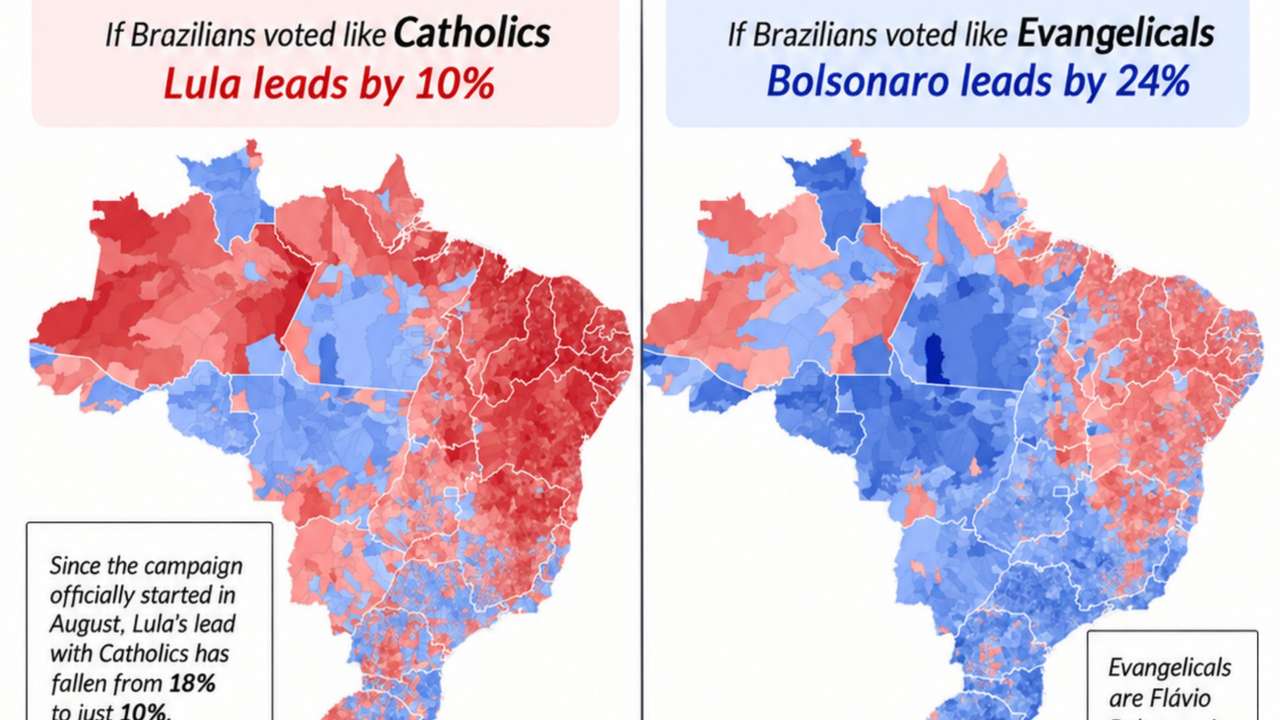
Religion has emerged as a major dividing line in Brazil's presidential election, with Catholic voters leaning towards President Luiz Inácio Lula da Silva and evangelical Christians strongly backing his conservative rival, Flávio Bolsonaro, ahead of the October 25 runoff.
Main points
- Lula leads among Catholic voters.
- Flávio Bolsonaro has strong evangelical support.
- Religious divisions could influence the October 25 runoff.
Religion has emerged as a major dividing line in Brazil's presidential election, with Catholic voters leaning towards President Luiz Inácio Lula da Silva and evangelical Christians strongly backing his conservative rival, Flávio Bolsonaro, ahead of the October 25 runoff.
A map published by The World in Maps, using polling data from Datafolha and Brazilian newspapers Globo and Folha de S.Paulo, illustrates how voting preferences differ between the country's two largest Christian communities.
The infographic shows Lula leading Bolsonaro by 10 percentage points among Catholics, while Bolsonaro holds a 24-point advantage among evangelicals. The figures reflect voting intentions rather than confirmed election results.
Catholic voters remain an important source of support for Lula, although his advantage has narrowed during the campaign.
RECOMMENDED FOR YOU
Six countries account for three-quarters of Europe’s unicorn startups
The infographic indicates that his lead among Catholics has fallen from 18 percentage points in August to 10 points.
A Datafolha survey conducted on October 6–7 also found Lula ahead among Catholics, with 53% support compared with 41% for Bolsonaro.
Evangelicals strongly favour Bolsonaro
Evangelical Christians have emerged as Bolsonaro's strongest religious voting bloc.
The same October 6–7 Datafolha survey showed Bolsonaro leading Lula by 69% to 25% among evangelical voters, a much wider gap than the one shown in the infographic.
The divide is also visible geographically. An analysis of Brazil's October 4 first-round results by UOL found that Bolsonaro received 52% of valid votes in municipalities with above-average evangelical populations.
Lula performed better in predominantly Catholic municipalities, although his support in those areas was lower than in the previous presidential election.
Religious divide shapes the runoff
The religious vote could prove important in a closely contested election.
Bolsonaro won 47.03% of valid votes in the October 4 first round, ahead of Lula's 45.16%. Neither secured the majority needed to win outright.
RECOMMENDED FOR YOU

Madagascar Roundup: Child food poverty hits 77%, growth rebound forecast for 2027 and northern risk mapping begins
The two candidates will now compete in the October 25 runoff, with both campaigns seeking to strengthen support among religious communities.
However, religion alone does not determine voting behaviour. Income, education, regional differences and political preferences also influence how Brazilians vote.
The figures highlight a central challenge for both candidates: Lula must limit Bolsonaro's advantage among evangelicals, while Bolsonaro needs to attract more Catholic voters to expand his support.
This story is written and edited by the Global South World team, you can contact us here.