Brazil has a special place in Trump’s tariff plan. How’s it working out?
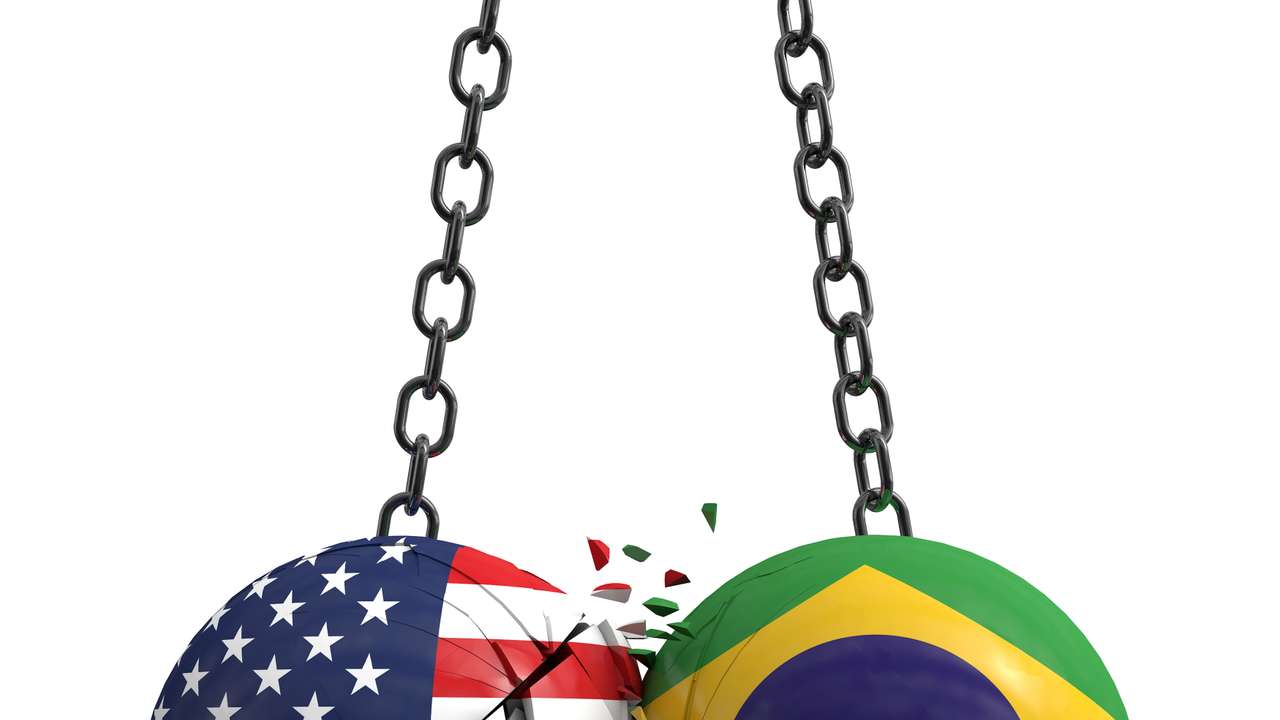
Six months after the US Supreme Court declared Donald Trump's original swingeing tariffs unconstitutional, the revised duties have reframed the terms of international trade.
The ruling was supposed to be a reset. Instead, the White House rebuilt almost the entire tariff wall on different legal foundations within five months — and in some cases built it higher. For exporters across the Global South, the practical difference has been less about the rate they pay than about the certainty that the rates are now here to stay.
Most economists agree that the measures are "lose-lose".
"In general, tariffs are bad for everybody. They are bad for the United States and bad for the rest of the world. Like higher oil prices, they constitute a shock, but the size of that shock varies from country to country," observes Marcelo Estevao, chief economist at the Institute of International Finance (IIF).
RECOMMENDED FOR YOU

Drones join search for bodies among rubble in La Guaira after twin quakes
On 20 February 2026, the Supreme Court struck down the "Liberation Day" reciprocal duties of April 2025. Trump’s team immediately came back with new measures.
The net effect, according to the Budget Lab at Yale, is an average US statutory tariff rate of 11 percent as of 11 August 2026, on track for 11.8 percent by year-end — roughly where it stood before the Supreme Court intervened. Setting aside the 2025 peak, the Budget Lab records that as the highest since the early 1940s.
And when the World’s biggest economy puts up the walls, few countries are untouched.
The IMF's July 2026 World Economic Outlook update puts global growth at 3.0 percent in 2026, recovering to 3.4 percent in 2027 — against an average of 3.5 percent across 2024 and 2025. World trade volume growth is forecast to fall to 3.5 percent this year, down from 5.0 percent in 2025.
Brazil: singled out, and adapting
The hardest hit nations are big exporters whose leaders have refused to align themselves behind the US leader. Near the top of the list, Brazil, facing a headline rate of up to 37.5 percent, the highest of any large economy outside China. As a country running a trade deficit with the US, Brazil is also unique because its original tariffs were explicitly linked to political events rather than trade - the prosecution of former president Jair Bolsonaro.
The measures bite unevenly. Around two-thirds of Brazilian exports to the US escape the new duties altogether — coffee, orange juice, beef, cocoa, aircraft, petroleum and iron ore were all excluded to protect American consumers. What remains in scope is the higher-value industrial production: machinery, electrical equipment, tyres, sugar, apparel, granite and gold.
In certain sectors, the impact has been severe.
"For us, [the tarifaço, or steep tariff rises] is a structural and extremely significant problem," explains André Passos Cordeiro, Executive President of the Brazilian Chemical Industry Association, Abiquim. "In some cases, it is making continued production unviable."
RECOMMENDED FOR YOU
Global oil chokepoints under scrutiny as tensions expose fragile energy lifelines
Because Brazil isn't just hit by the direct impact of higher costs to export. It has also suffered as Chinese manufacturers with similar challenges have redirected their production, swamping the Brazilian market to the point that imports now account for half of domestic consumption.
Abiquim estimates that the tariffs are costing the industry $133 million a year. The situation would be even worse, Cordeiro says, were it not for government measures to maintain duties on Chinese imports and support the industry through its Brasil Soberano financial support programme.
Another industry hit hard has been footwear, with Brazilian companies already locked in a cutthroat competition with manufacturers in Vietnam, Indonesia and China. In July, the industry imported more than it sold abroad for the first time since records began 29 years ago. Exports were down 18 percent in value terms during the first seven months of 2026.
"Given the prospect of declining exports, it has become even more urgent to adopt safeguards and other trade defense instruments to protect the domestic market from the significant and harmful increase in imports," Haroldo Ferreira, Executive President of the Brazilian Footwear Industries Association, Abicalçados told Global South World.
These numbers impact businesses and their workers each day. Both industry group leaders called for the government to add to the support measures already in place to protect jobs.
The pivot east
While other sectors have also suffered badly, the economy overall has been relatively resilient as exporters have found new markets away from the US.
The redirection has been fast and measurable. In the first half of 2026 the US took just 9.4 percent of Brazil's exports — the lowest share since records began in 1997, down from 12.1 percent a year earlier. Sales to the US fell 13 percent to $17.4 billion even as Brazil's total exports rose 11.5 percent. China, India and Morocco saw sharp jumps as export destinations.
"The impact on GDP and inflation was as limited as it could have been," notes Alex Agostini, Chief Economist at Austin Ratings. "Diversification is necessary; Brazil cannot remain dependent on the United States. I do not see it as harmful; on the contrary, I think it is positive for Brazil."
RECOMMENDED FOR YOU
How a $317 million cocaine bust led to Liberia's former vice president's arrest
Agostini says Brazil's competitiveness in global trade means it is able to find new buyers for the goods no longer heading north to the US.
Ultimately, the biggest loser from the trade war could be the US.
The Budget Lab at Yale estimates the tariffs now in place cost the average American household around $1,100 a year.
"Politically, it backfired on Donald Trump. He attacked Brazilian democracy and saw that there is nothing undermining it. It backfired badly, and that is why his disapproval ratings have been rising," Agostini concludes.
The IIF's Estevao agrees: "The situation is not good for Latin America, but I think it is worse for the United States in the long term. Alliances and economic relationships are changing… if the region continues to be pushed in this direction, countries will have a stronger incentive to diversify their dependence."
[Image: Deposit Photos]
This story is written and edited by the Global South World team, you can contact us here.


