Chile Roundup: Kast launches jobs drive, security reform faces rewrite and Argentina challenges Falklands flights
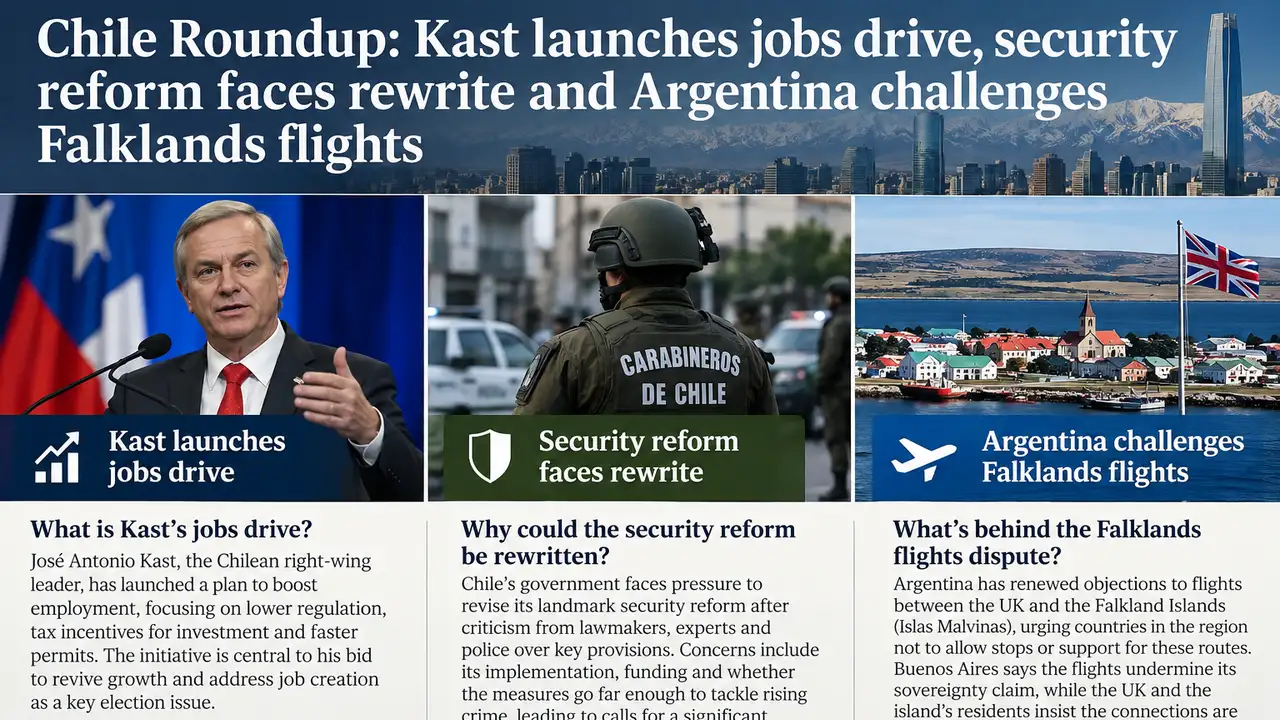
Kast launches Chile Despega plan to create more than 100,000 jobs
President José Antonio Kast has launched the Chile Despega employment plan, committing around 1.3 trillion Chilean pesos to measures aimed at creating more than 100,000 jobs and reviving investment as unemployment remains elevated. Kast presented the programme at La Moneda on September 28, joined by government ministers, political party representatives, workers and business groups. The government said the initiative is intended to provide an immediate response to a labour market in which unemployment has remained above 8% for 43 consecutive months and reached 9.5%. The plan has four main components: accelerating public investment and projects that can be executed quickly; expanding hiring and direct-employment incentives; improving liquidity for businesses and suppliers; and implementing employment measures at regional and local levels. Public projects involving infrastructure, reconstruction, housing, and municipalities are expected to accelerate from the final quarter of 2026, with physical investment increasing further in 2027. The government is also planning an additional 800 billion pesos for fast-execution projects.
Government opens talks on replacing disputed security reform
Chile's government has signalled that it is prepared to withdraw its controversial constitutional security reform if lawmakers can reach agreement on an alternative proposal with broader congressional support. The initiative was introduced on August 17 as part of the government's Agenda Against Organised Crime and Terrorism, or ACOT. Among its most contested provisions was the creation of an additional state of constitutional exception that could remain in force for as long as 240 days. Senator Pedro Araya, president of the Senate Constitution Committee, said on September 28 that the government had indicated its willingness to withdraw the existing proposal if lawmakers produced a replacement capable of addressing the security issues the original bill was intended to tackle. Araya said the goal was to develop a consensual proposal “in which both the government and the opposition can make clear what the central issues are that can help in matters of public security.” The emerging alternative would drop the proposed new state of exception and instead modify Chile's existing state-of-emergency framework to deal more directly with organised crime. Senators from different political blocs have been discussing the replacement text.
Argentina launches legal and diplomatic action over British flights from Punta Arenas
Argentina has announced sanctioning procedures, criminal complaints and diplomatic action after identifying flights operated by British company Thales UK Limited between Chile's Punta Arenas and the Falkland/Malvinas Islands. The government of President Javier Milei said the aircraft carried UK registration and operated on the Falkland/Malvinas–Punta Arenas route without authorisation from Argentine authorities. Buenos Aires claims sovereignty over the islands and refers to them as the Malvinas, while Britain administers them as the Falkland Islands. Argentina's presidency said: “The Argentine Republic will not stand idly by and will continue defending its sovereign rights firmly.” Buenos Aires said it would use diplomatic, administrative and legal mechanisms available under domestic and international law. The Milei administration has separately instructed its Foreign Ministry to begin arbitration proceedings under the UN Convention on the Law of the Sea over the British-backed Sea Lion oil project in the North Falkland Basin. Argentina has demanded that Britain prevent the start or continuation of hydrocarbon exploitation activities and has warned that it could seek provisional measures from the International Tribunal for the Law of the Sea.
Pérez Mackenna defends relations with both China and the United States
Foreign Minister Francisco Pérez Mackenna has defended Chile's approach to its relationships with China and the United States following questioning in the Chamber of Deputies on September 28. The session was the first time a Chilean foreign minister had been subjected to the Chamber's formal interpellation procedure since that mechanism was introduced. Socialist deputy Nelson Venegas led the questioning, which covered Chile's relationship with Washington and Beijing, sovereignty issues, the Strait of Magellan and the government's involvement in the US-backed Shield of the Americas security initiative. After the session, Pérez Mackenna summarised the government's position: “We aim to have the best possible relations with China and the United States.” He said Chile sees China primarily as its leading commercial partner, accounting for around 40% of the country's foreign trade, while describing the United States as an important strategic partner across areas including defence, telecommunications and software. Pérez Mackenna rejected suggestions that ties with Washington compromised Chilean decision-making. “While I am foreign minister, Chile's sovereignty will be defended with all our strength.”
RECOMMENDED FOR YOU

Asia and Europe dominated the world’s biggest cities in 1700
Chile declares three days of mourning after killing of corporal Cristopher Aguilera
Chile's government declared September 28, 29 and 30 national days of mourning following the killing of Carabineros corporal second class Cristopher Aguilera Fernández during a police operation in Lo Espejo, Santiago. Aguilera, 30, was carrying out preventive patrol and inspection duties with another officer on September 27 when they encountered an armed man. Investigators said the man produced a firearm with an extended magazine and opened fire on the officers. Aguilera suffered a serious gunshot wound and was taken to Clínica Las Condes, where he later died. His colleague returned fire, killing the alleged attacker at the scene. Prosecutors identified the gunman as Venezuelan national Brayan Farías Díaz and said he had previous detentions, including for carrying a bladed weapon and bribery. Aguilera was born in Peñaflor on July 15, 1996 and joined Carabineros in January 2018. He became a corporal second class in 2022 and had received 10 commendations during his career, including recognition for operations involving robbery, drug trafficking and illegal weapons. He was also the father of a baby under one year old. The government announced three days of national mourning beginning September 28. Kast also led a minute's silence at La Moneda. “When a Carabinero dies, a part of Chile dies,” the president said.
This story is written and edited by the Global South World team, you can contact us here.