Nvidia's $4.5 trillion market value rivals the economies of Japan and Britain
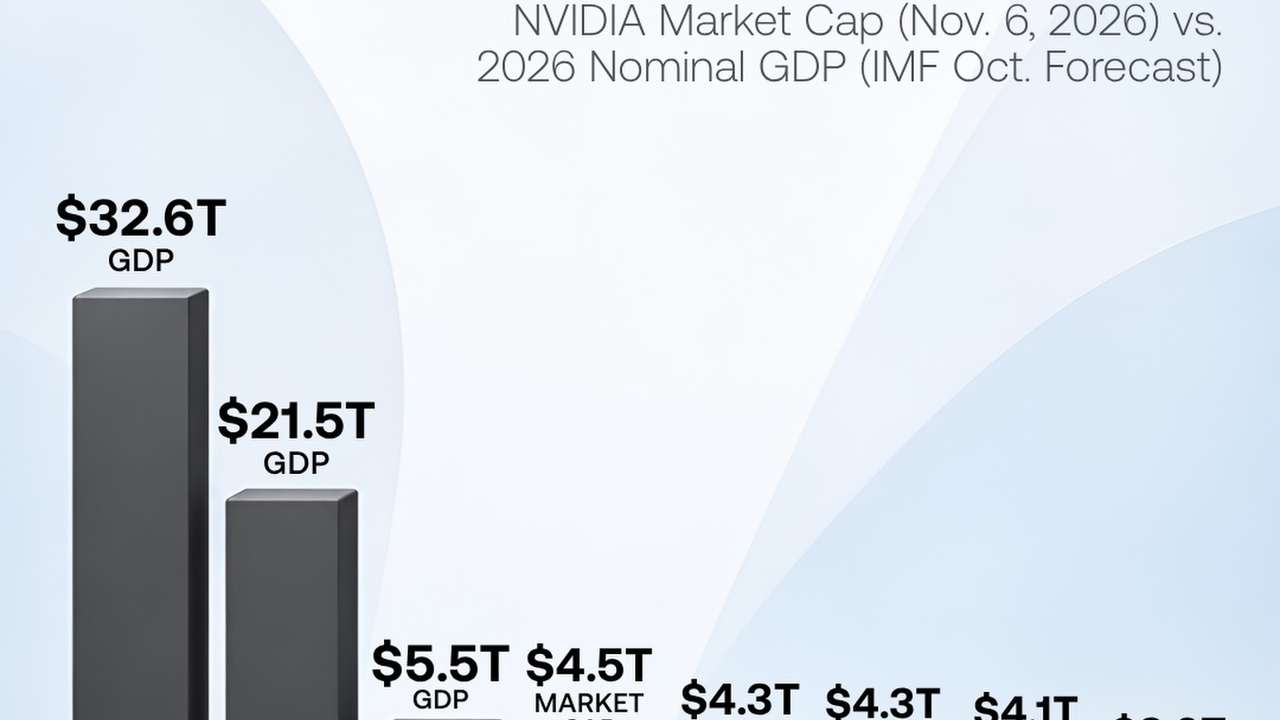
US chipmaker Nvidia was valued at approximately $4.5 trillion on November 6, 2026, putting its stock market valuation above the projected annual economic output of Japan, Britain, India and France, according to figures presented by World Visualized.
Main points
- Nvidia was valued at approximately $4.5 trillion on November 6.
- Its valuation exceeded the projected 2026 GDP of Japan, Britain, India and France.
- Nvidia's market value fell to about $4.1 trillion by November 10.
US chipmaker Nvidia was valued at approximately $4.5 trillion on November 6, 2026, putting its stock market valuation above the projected annual economic output of Japan, Britain, India and France, according to figures presented by World Visualized.
Nvidia's valuation highlights the extraordinary rise of the artificial intelligence industry, which has driven demand for the company's advanced chips used to train and operate AI systems.
The comparison, based on YCharts market data and the International Monetary Fund's October 2026 World Economic Outlook, places Nvidia ahead of several of the world's largest economies.
Japan's nominal gross domestic product (GDP) is projected at approximately $4.3 trillion in 2026, roughly the same as Britain's, while India's is estimated at $4.1 trillion and France's at $3.6 trillion.
RECOMMENDED FOR YOU

‘Trump behind bars’ - Iran's bizarre street display draws crowds in Tehran
Germany, with projected GDP of $5.5 trillion, remains above Nvidia's valuation. The United States and China are substantially larger, with projected economic output of $32.6 trillion and $21.5 trillion, respectively.
Nvidia's market value has fluctuated sharply. YCharts recorded a valuation of $4.507 trillion on November 6, falling to $4.078 trillion by November 10. That decline illustrates how quickly stock market valuations can change.
The comparison also measures two different things. Market capitalisation represents the value investors place on a company's outstanding shares at a particular moment. GDP measures the value of goods and services produced by an economy over a year.
Nvidia is therefore not economically larger than Japan or Britain simply because its stock market valuation exceeds their annual GDP.
Nevertheless, the figures show how investor expectations surrounding artificial intelligence have pushed Nvidia into a valuation range comparable with the annual output of major industrial economies.
This story is written and edited by the Global South World team, you can contact us here.