How a false claim about Brazil’s patron saint became a presidential election issue
Key Takeaways
- A false claim linking Flávio Bolsonaro to a 2007 bill that sought to change the status of Our Lady of Aparecida as Brazil’s patron saint became campaign ammunition for Lula’s Workers’ Party (PT) and prompted a public statement from the Brazilian Bishops’ Conference (CNBB).
- A 72-hour institutional standoff pitted the Supreme Federal Court (STF) against the Superior Electoral Court (TSE) after Justice Flávio Dino overturned a ruling by Justice André Mendonça concerning a social media post by Antonio Tabet.
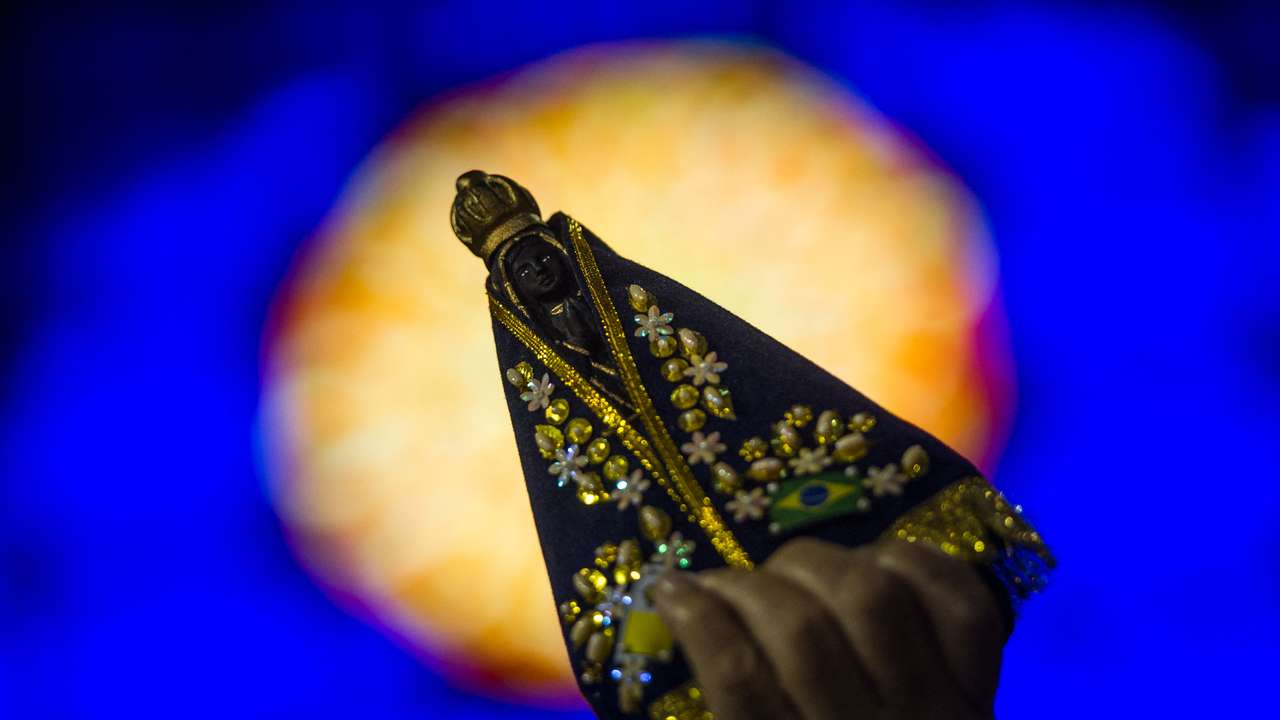
With one week to go before the first round of Brazil’s presidential election, a 2007 bill proposing to restrict the title of Brazil’s patron saint, held by Our Lady of Aparecida, to Catholics began circulating on social media and was used to undermine the candidacy of Senator Flávio Bolsonaro (PL).
The proposal, authored by former congressman Victorio Galli, then a member of the PMDB, was shelved years ago by the Chamber of Deputies. It gained traction after being falsely associated with Bolsonaro, fueled by the fact that he is an evangelical Christian and has previously commented on the relationship between religion and the state. Bolsonaro, however, has never introduced any proposal to change the saint’s official status.
The controversy escalated when actor and comedian Antonio Tabet posted a message claiming that “the militia family hates Black women so much that it decided to attack Our Lady of Aparecida.” Bolsonaro’s legal team then took the case to the Electoral Court, alleging that the post spread disinformation.
The post received millions of views and gave President Luiz Inácio Lula da Silva’s (PT) campaign an opportunity to use the controversy against his opponent while seeking to expand its support among religious voters.
First Lady Janja da Silva became directly involved by sharing messages expressing devotion to Brazil’s patron saint, while Vice President Geraldo Alckmin (PSB) also joined the discussion. The episode prompted reactions from the Brazilian Bishops’ Conference (CNBB) and led Flávio Bolsonaro to accuse members of the organisation of acting politically against his candidacy.
RECOMMENDED FOR YOU

Madagascar Roundup: Child food poverty hits 77%, growth rebound forecast for 2027 and northern risk mapping begins
In response to Bolsonaro’s accusations and the spread of false narratives, the CNBB released a video statement saying that “democracy is also a space where our differences can coexist with respect and freedom” and that “a lie cannot be fought with another lie.” The organization rejected suggestions that it had become institutionally involved in the partisan dispute.
The controversy forced the PL candidate to publicly deny any connection to the 2007 bill and to hold live broadcasts alongside religious leaders in an effort to contain the political fallout and prevent an erosion of support among moderate Catholic voters.
The judicial dispute and the weight of the polls
The episode also triggered institutional friction between the Superior Electoral Court (TSE) and the Supreme Federal Court (STF) in less than 72 hours.
Acting as a member of the Electoral Court, Justice André Mendonça granted a request from Flávio Bolsonaro’s campaign and ordered the removal of Tabet’s post and related content, imposing a daily fine of R$30,000 for non-compliance. Mendonça argued that action was necessary to curb false narratives in the final stretch of the campaign.
The following day, however, Supreme Court Justice Flávio Dino granted a constitutional complaint filed by the comedian’s defence and overturned Mendonça’s decision. Dino argued that the measure amounted to prior censorship and said the Electoral Court could not presume that the expression “militia family” referred directly to Flávio Bolsonaro.
Dino’s ruling prompted TSE President Justice Kassio Nunes Marques to contact STF President Edson Fachin to protest what he viewed as direct interference in the Electoral Court’s jurisdiction and to defend the court’s autonomy in overseeing election advertising.
Alongside the controversy among Catholic voters, the religious debate has also generated tensions within the evangelical camp because of pressure from conservative allies over André Mendonça’s handling of the Banco Master case.
Mendonça was appointed to the Supreme Court by Jair Bolsonaro after the former president famously pledged to nominate a “terribly evangelical” justice. He has recently faced public criticism from Bolsonaro supporters over positions they consider inconsistent with the expectations of the political base that backed his appointment, highlighting tensions between religious political constituencies and the actions of Brazil’s highest courts.
RECOMMENDED FOR YOU
US is the world’s top military power in 2026
Lula’s campaign strategy and Flávio Bolsonaro’s response also reflect the religious breakdown in the latest voting-intention polls.
A Quaest poll released on Monday showed Lula with 39% of first-round voting intentions, compared with 34% for Flávio Bolsonaro. The religious breakdown, however, revealed a sharp divide: Lula had 48% support among Catholics, compared with 27% for Bolsonaro. Among evangelical voters, Flávio led with 46%, against 27% for Lula.
With Lula reaching 48% among Catholics and increasingly associating his campaign with religious symbols in the final stretch, the PT is seeking to consolidate its advantage and capitalise on Flávio’s weaker performance among Catholic voters. The PL candidate, meanwhile, is working to contain the damage among Catholics while maintaining the cohesion of his evangelical base amid the controversies surrounding the Supreme Court.
This story is written and edited by the Global South World team, you can contact us here.
