Hungary's opposition leads in polls, far-right party gains support

Hungary's centre-right Tisza party leads Prime Minister Viktor Orban's governing Fidesz before an April 12 election, while the far-right Our Homeland is gaining support, two opinion polls showed on Wednesday.
Nationalist Orban faces the biggest challenge to his rule in 16 years although the outcome of the vote remains highly uncertain, with opinion polls showing that many voters are still undecided.
The poll by Zavecz Research, conducted between February 22 and 28, shows that Tisza widened its lead to 12 points among decided voters from 10 points in a January poll.
The poll, published by news site 24.hu late on Tuesday, showed 50% of decided voters supported Tisza, up from 48% in January, while 38% backed Fidesz, down from 39% a month earlier.
RECOMMENDED FOR YOU
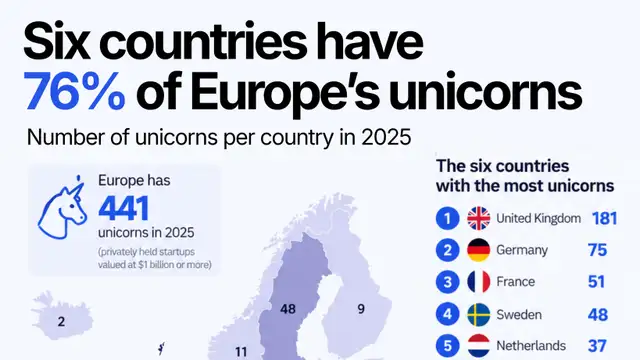
Six countries account for three-quarters of Europe’s unicorn startups
Zavecz showed 38% support for Tisza among all voters, while Fidesz was backed by 32%.
According to their data, some 20% of respondents said that they still did not know who to back, down from 23% in February.
Tisza is led by former government insider Peter Magyar who has said his party would curb corruption, unlock billions of euros in frozen European Union funds to boost the economy, and firmly anchor Hungary in the EU and NATO.
A second poll, published by newspaper Nepszava on Wednesday and conducted by Publicus Institute, showed 47% of decided voters supporting Tisza and 39% backing Fidesz, as support for both parties was down 1 percentage point since a January poll.
While most polls have shown a Tisza lead, Fidesz points to other surveys that still show it on course to victory, though its opponents say these have mainly been conducted by institutes with financial or personal ties to the ruling party.
Both polls showed that the far-right Our Homeland (Mi Hazank) would be the only other party to pass the 5% threshold required for entry into parliament.
Zavecz Research put support for Our Homeland at 7% among decided voters, up from 5% a month ago. Publicus said that 6% of decided voters back the far-right party, up from 5% in January.
This article was produced by Reuters news agency. It has not been edited by Global South World.