One question blocks peace in Ukraine: Opinion
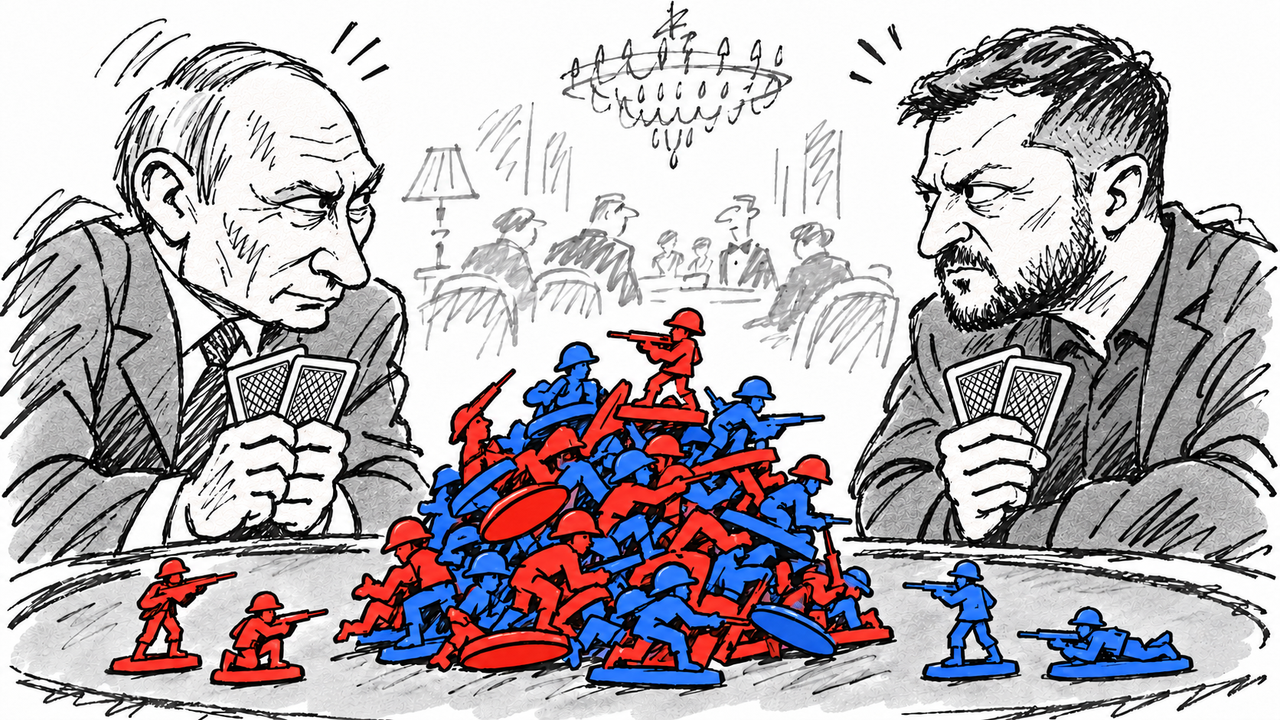
Peace in Ukraine is blocked not only by the lack of a treaty text but, above all, by a question that no leader involved can survive politically: "Why now, and not sooner?"
Ukraine
Let’s start with Volodymyr Zelenskyyy. If he signs a compromise today, every Ukrainian will ask why he didn't do it in Istanbul in the spring of 2022, when the dead were numbered in the thousands, not the hundreds of thousands, and territorial losses were far smaller. I am not saying a treaty text was ready to be signed there. The two sides' drafts still differed. But a negotiating window existed, and it closed. Why not three years ago, or two, or even last year? Each year of war has meant hundreds of thousands of dead and wounded, and destruction measured in hundreds of billions. A compromise signed today turns every one of those years, retroactively, into avoidable mistakes. No election campaign can answer that charge, and no commander can look the mother of a fallen soldier in the eye.
The mechanism is the same as for a gambler who has bet everything. The more he has lost at the table, the harder it is to stand up, because leaving means admitting the loss. So he plays one more hand, then another. The costs already paid stop being a lesson and become a trap.
Russia
Paradoxically, Vladimir Putin is caught in the same trap, even though the blame for the war is his, not Zelensky's. That blame doesn't disappear, but it doesn't change the geometry of the problem either. Putin promised "denazification," "demilitarization," and a short war. If he ends it today with a modest result, he has to explain why so many young Russians died, why the economy was sacrificed, and how many families are in mourning for something that looked achievable without an invasion. Like any dictator, he answers not to voters but to the elites who keep him in power: the army, the security services, the great fortunes. They accepted his war because they believed it would be short and victorious. A dictator can't lose an election, but he can lose the circle that holds him up, and that means his end.
RECOMMENDED FOR YOU
Spain at a Crossroads: Immigration, corruption and Palestine shape voters’ choices
The result is a perverse symmetry: each leader is a prisoner of his own sacrifices. Every soldier who falls at the front makes leaving the war harder. So the war feeds itself. It no longer continues because someone hopes to win, but because no one can afford to explain what everything that has happened so far meant. In such conditions, peace cannot come from good faith, and appeals to the "courage of peace" are useless. It can come in only two ways.
Rest of the World
The first: one of the two leaders disappears from the equation, through elections, regime change, or biological or political exhaustion. A successor can say, "I didn't start this, I didn't make those decisions, I'm just closing the chapter." He can sign what his predecessor couldn't afford to. It's the most brutal solution, though not the most probable, because no one can schedule a leader's disappearance.
The second: the international community "builds" an honorable solution for both. Not a just exit, since none exists, but one that lets each side say it didn't give in, it accepted a solution that came from outside. For Kyiv there is even a constitutional instrument: changing the country's territory requires a national referendum. A referendum answers "why now?" directly, and it gives politicians the "not me, but you" they so badly want. The risk doesn't vanish; it just shifts from one man to a whole people, who then decide with their eyes open. Diplomacy here, unfortunately, doesn't mean finding justice. It means offering a door through which someone can leave without looking as if he surrendered.
This is where the responsibility of Washington, Beijing, Ankara, and the European capitals comes in. Each of them talks about peace, but offers too few real, concrete solutions: formulas that skillfully defer the impossible issues, credible security guarantees, and a narrative that doesn't sound like capitulation. Whoever demands peace without offering a way out is, in effect, demanding that one of the two leaders commit political suicide on live television. And those who promise military support "for as long as it takes," without saying what kind of outcome justifies it, should understand that such support, without a realistic political objective, is not a strategy. It is merely a race toward an ending that is dangerous for everyone. The war in Ukraine will not stop when the ammunition runs out, but only when someone finds an ending that both sides can announce without shame.
Silviu Predoiu is a former Romanian intelligence official and presidential candidate. The opinions expressed in this article are his own and do not represent Global South World.
