The future of food: Africa and New Asia are building a two-way food trade
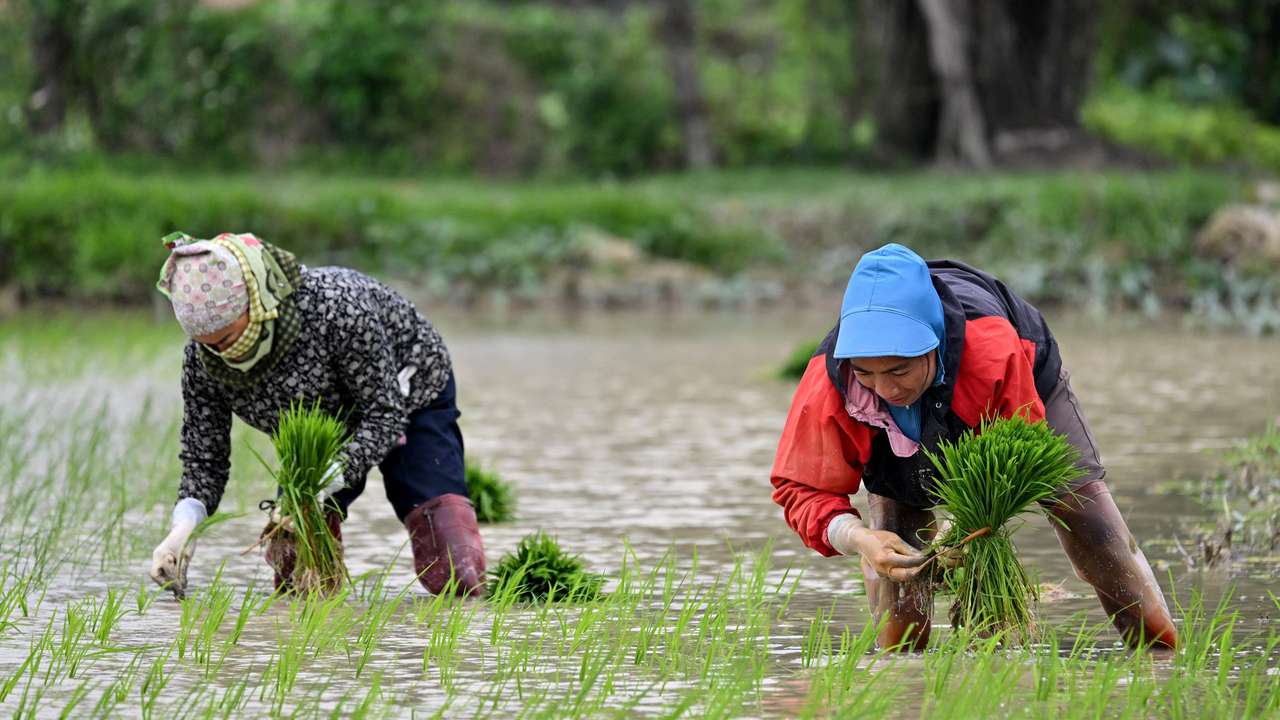
From rice imports to fertiliser exports and African cashew mills, more of the value in food trade between Africa and New Asia now depends on how much processing stays near the farm.
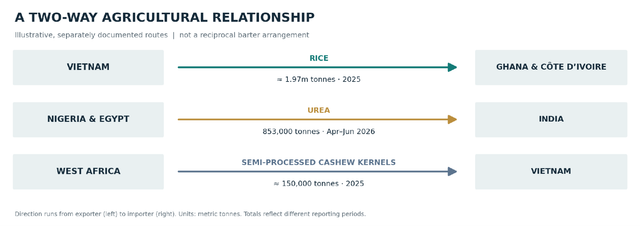
Jollof rice is a point of national pride in both Ghana and Nigeria, but much of the rice in the pot is grown in Asia. Vietnam shipped 919,214 tonnes of rice to Ghana in 2025, according to Vietnamese customs data. Nigeria is an even larger market: the US Department of Agriculture expects it to import 2.9 million tonnes in 2026/27.
Rice has linked Asia and Africa for generations, but the agribusiness ties are now expanding and developing as economies mature and relationships deepen.
Fertiliser made in Africa reaches Asian farms, and African factories handle cashew processing that was once done abroad.
Rice as a trading commodity
In 2023, Indian restrictions on rice exports pushed up prices around the world, and Africa was particularly exposed. World prices rose about $100 a tonne above their level before the ban, and researchers at the International Food Policy Research Institute estimated that this cost rice consumers in sub-Saharan Africa an extra $3.8 billion. In Ghana, local farms supply about 56% of the rice the country eats, according to Food and Agriculture Minister Eric Opoku, and the government wants to raise that share. Opoku says an import ban is not the answer. Instead, he plans to tie import permits to partnerships with Ghanaian farmers.
RECOMMENDED FOR YOU

Thieves drill through wall, steal $3 million in Chile bank heist
Asian supply is changing too. Indonesia imported 4.52 million tonnes of rice in 2024 and only 451,000 tonnes in 2025, according to Statistics Indonesia (BPS). Its agriculture ministry now projects a surplus of 3.67 million tonnes in 2026, with production of 34.77 million tonnes against demand of 31.10 million tonnes, and has agreed a first export shipment of 1,000 tonnes to Malaysia. If that surplus holds, Indonesia would join Vietnam, India and Thailand as a potential supplier, giving importers such as Ghana and Nigeria more choice.
Farm trade between the two regions already runs in both directions. South Africa exported $2.8 billion of agricultural products to Asia in 2024, mainly citrus, apples, wool and nuts, up from about $1.9 billion in 2015, according to South Africa’s National Agricultural Marketing Council (NAMC). It imported $2.2 billion of farm goods from Asia, led by rice and palm oil.
Fertiliser flows east
Fertiliser is where the direction of trade has changed most clearly. Gulf producers, long among Asia’s most important suppliers, export about 21 million tonnes of urea a year, according to the OPEC Fund, and the 2026 disruption to shipping through the Strait of Hormuz held up much of that trade. By April 2026, India was paying nearly twice as much for urea as it had two months earlier, Bloomberg reported. African producers added resilience to supply: India imported 609,000 tonnes from Egypt and 244,000 tonnes from Nigeria between April and June 2026, according to Indian commerce ministry figures.
African producers are investing to hold that position. In June 2026, Africa Finance Corporation committed $600 million to Dangote's $7 billion fertiliser expansion, which aims to raise Nigeria's urea capacity from three million to nine million tonnes a year and to build a three-million-tonne plant in Ethiopia. The same plants supply African farmers, who need affordable fertiliser to raise their own yields, so the expansion serves both markets. Southeast Asian capital is part of this growth. Singapore-based Indorama runs the Indorama Eleme fertiliser complex in Rivers State, Nigeria, which can produce about 2.8 million tonnes of urea a year, and a third production line due in 2026 would lift that to 4.2 million tonnes, according to the NTU-SBF Centre for African Studies in Singapore.
Cashews: processing moves closer to the farm
Cashews show how the division of work between the two regions is changing. When Olam began shipping raw Nigerian cashews to India in 1989, Asian factories did most of the processing and kept most of the value. In 2012, the Singapore-based group opened a $30 million processing plant in Bouaké, Côte d'Ivoire, which local media described at the time as the largest of its kind in the world.
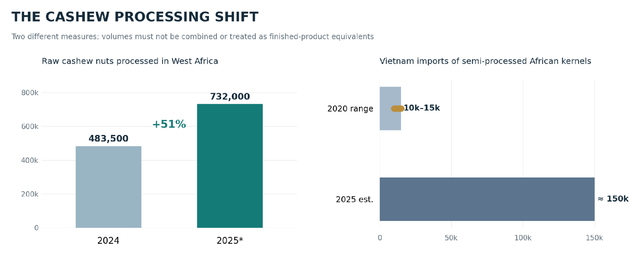
West African processing has grown quickly since then. Factories in the region processed an estimated 732,000 tonnes of raw cashews in 2025, up about 51% from 483,500 tonnes in 2024, according to provisional figures from N'kalô, with Côte d'Ivoire leading the growth. Asian processors have adjusted. Vietnam's cashew association, VINACAS, estimates that the country bought about 150,000 tonnes of semi-processed African kernels in 2025, up from 10,000–15,000 tonnes in 2020. African plants now do more of the early processing, which creates jobs near the farms, while Vietnamese plants finish, pack and sell the kernels to buyers around the world.
RECOMMENDED FOR YOU
Angola Roundup: Government defends 2027 budget, Zaire targets 37 projects and AU health ministers meet in Luanda
Finance decides who gains
The gains are not evenly spread. In Nigeria, only five cashew processors were operating in February 2026, using less than 18% of their combined capacity, according to BusinessDay. Jim Fitzpatrick, a tree-nut market analyst, says processors in the region often lack the working capital to buy enough of the crop during the short harvest.
Asian companies and development lenders are now putting money into that gap. In February 2026, Singapore-based Robust International secured a $75 million debt facility, fully guaranteed by GuarantCo, with M&G Investments buying the notes, to build a second cashew plant in Ogun State and take its capacity from 100 to 220 tonnes a day. GuarantCo expects the plant to buy from about 10,000 farmers, add $335 million in export revenue over the life of the guarantee and create up to 900 jobs, with as many as 78% of them for women. In October 2026, the IFC disclosed a proposed loan of up to $72 million to Nigeria's Johnvents Industries, including $18.4 million for working capital, for a sesame plant in Nigeria and a cashew plant in Côte d'Ivoire. The IFC board is due to consider it in December 2026.
Rice still dominates the trade, and Africa still depends on Asian supply. Around it, a more balanced relationship is taking shape. African urea now supports Asian harvests, African mills carry out the first stage of cashew processing for Vietnamese finishers, and Asian investors are financing plants in Nigeria and Côte d'Ivoire. Each of these keeps more of the value near African farms and gives Asian buyers a more secure supply.
The World Bank Group expects Africa’s agrifood economy to reach $1 trillion by 2030 and plans to double its annual agribusiness investment to about $9 billion by then. Capturing more of that value will depend on higher yields and on finance at harvest time.
Food and agribusiness investment between Africa and New Asia is on the program at the New Asia Forum, which convenes in Bali on 3 and 4 December 2026.
New Asia Forum. Gateway to the New Asia. Where Vision is Invested. Request an invitation
RECOMMENDED FOR YOU

Five lessons from Go Global South for entrepreneurs expanding across borders
