Russia's presidential election: the who, what and when?
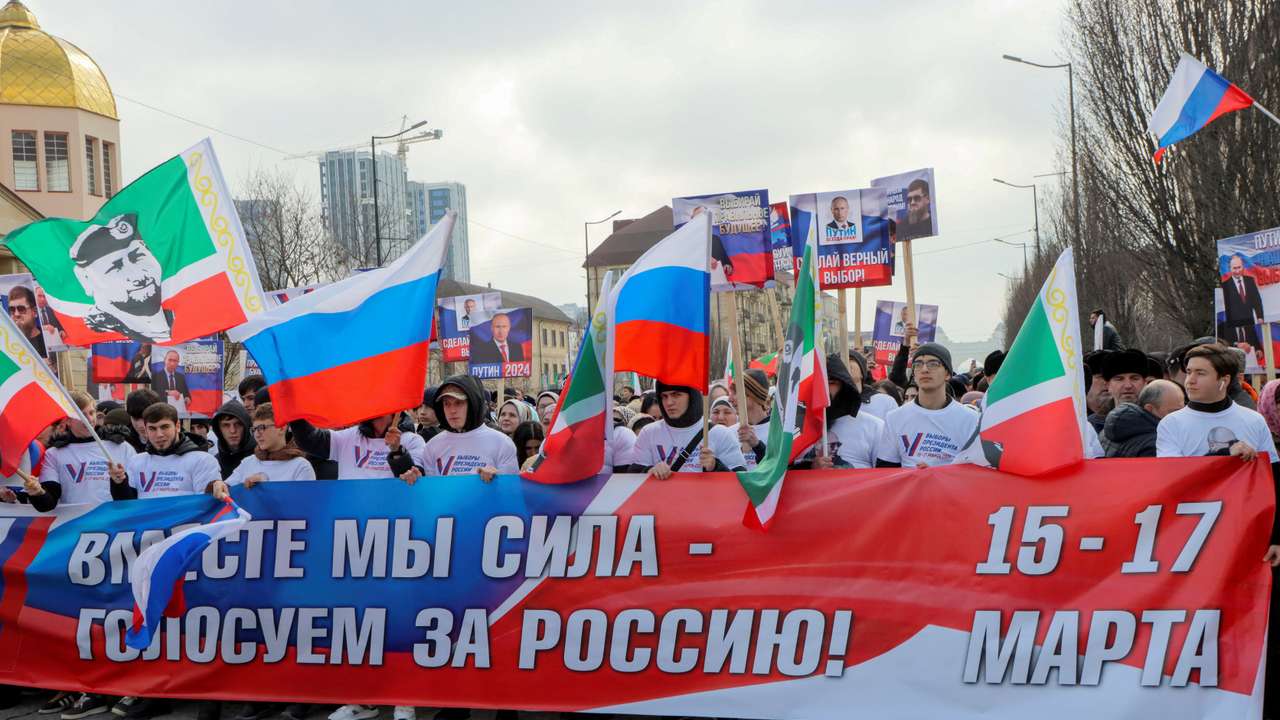
Russia's presidential election: the who, what and when?
Russia will hold a presidential election on March 15-17 which President Vladimir Putin is certain to win, barring an unexpected development. That will give the longest serving Kremlin chief since Josef Stalin another six-year term in power.
How will it work?
WHEN?
RECOMMENDED FOR YOU

New Asia Forum targets $30 billion in investment at inaugural Bali gathering
The election will be held on March 15-17. Results will follow shortly afterwards and the winner will be inaugurated in May.
Voting will also take place in what Russia calls its new territories - parts of Ukraine now controlled by Russian forces which have been placed under Russian law.
Ukraine says it will not rest until it has ejected every last Russian soldier from the annexed territories.
A remote online voting system will be available for the first time in a Russian presidential election.
HOW MANY VOTERS?
There are 112.3 million people with the right to vote in the election. Another 1.9 million people abroad have the right to vote and 12,000 in Baikonur, a cosmodrome which Russia rents in Kazakhstan.
Around 70-80 million people usually cast ballots. Turnout in 2018 was 67.5%.
WHO IS RUNNING?
RECOMMENDED FOR YOU
Zelensky accuses US of diverting missiles to Middle East as Ukraine awaits supplies
Putin is running against Communist Nikolai Kharitonov, Leonid Slutsky, leader of the nationalist Liberal Democratic Party, and Vladislav Davankov of the New People party.
Boris Nadezhdin, an anti-war candidate, was barred from running as was Yekaterina Duntsova.
Further details on the candidates can be found here.
PUTIN
Putin, 71, a former KGB lieutenant colonel, was appointed acting president by Boris Yeltsin on the last day of 1999. He won the 2000 presidential election with 53.0% of the vote and the 2004 election with 71.3% of the vote.
In 2008, Dmitry Medvedev ran for president and Putin served
as prime minister before winning 63.6% of the vote in the 2012
presidential election and 76.7% in 2018.
RECOMMENDED FOR YOU
Brazil's presidential election exposes challenge of ensuring equal treatment on Big Tech platforms: Opinion
HOW LONG CAN A RUSSIAN PRESIDENT RULE?
Putin has already served as president for longer
than any other Russian ruler since Josef Stalin, beating even
Soviet leader Leonid Brezhnev's 18-year tenure.
The 1993 Russian constitution, based loosely on France's
1958 constitution, was seen by some in the West as a development
that would lead to democracy in post-Soviet Russia.
It originally specified that a president could only serve two terms of four years if they were back-to-back.
RECOMMENDED FOR YOU
‘We cannot lose our rights’ - Lula supporters rally in Rio ahead of Bolsonaro runoff
But amendments in 2008 extended the presidential term to six
years, while amendments in 2020 formally reset Putin's own presidential term tally to zero from 2024, potentially allowing him to remain in power until 2036. The changes also banned ceding any territory.
DEMOCRACY OR DICTATORSHIP?
The West casts Putin as a war criminal, a killer and a dictator, but opinion polls at home show he has approval ratings of 85% - higher than before the invasion of Ukraine.
The Kremlin says Putin enjoys overwhelming support from the
Russian people, that Russia does not want to be lectured by the
West about democracy.
Russian officials say the West is trying to undermine Russia by casting doubt on the legitimacy of the election.
RECOMMENDED FOR YOU
Colombia museum controversy sparks protests as riot police return to Bogota streets
Supporters say Putin halted the spiral of decline which peaked with the 1991 collapse of the Soviet Union and restored at least some of the clout once held by the general secretaries who ruled the Soviet Union while standing up to what the Kremlin casts as a declining West led by the United States.
Much of the Russian opposition - which ranges from hardline communists to radical nationalists - adheres to the formal rules of the tighty-controlled political system and, despite having seats in parliament, does not oppose the Kremlin on major issues. Pro-Western liberals do have any seats in parliament.
Supporters of late opposition politician Alexei Navalny are either in jail or have fled abroad. Other opponents, like former oil tycoon Mikhail Khodorkovsky, are also living abroad.
They cast Putin as a mafia-style godfather who has constructed a system of personal rule reliant on corruption. Putin's opponents have been predicting since 1999 that turmoil will one day bring down the system he presides over.
PROTESTS?
Yulia Navalnaya, the widow of Russian opposition leader Alexei Navalny, has said that the scale of public support for him since his death was proof that his cause lived on, and called for a massive election day protest against Putin.
Navalny, in one of his last public messages, had urged people to protest against Putin by voting en masse at noon local time on March 17, forming large crowds and overwhelming polling stations.
Navalnaya took up her husband's call.
RECOMMENDED FOR YOU
Ebola returns to Nigeria after decade as Abuja residents express fear and doubt
"This is a very simple and safe action, it cannot be prohibited, and it will help millions of people see like-minded people and realise that we are not alone," she said. "We are surrounded by people who are also against war, against corruption and against lawlessness."
Russian nationalist ex-militia commander Igor Girkin, who was jailed for four years in January, said that the March
election would be a "sham" with the winner already clear.
Girkin, who does not recognise Ukraine as a sovereign state and says much of it is part of Russia, said Russia would face defeat in the war unless it sacked top commanders and began to fight in a much more serious way.
WHAT DO ELECTION MONITORS SAY?
The Organization for Security and Co-operation in Europe's Office for Democratic Institutions and Human Rights (ODIHR) said in January that it was deeply regrettable that Russia had decided not to invite OSCE observers to the election.
"We regret that conditions have deteriorated so much in the Russian Federation that we cannot deploy observers for the presidential election in March," said Pia Kauma, President of the OSCE Parliamentary Assembly.
"The very first election observation mission organized by the OSCE PA was to Russia in 1993, and since then we have observed ten national elections in the country. It is very unfortunate that democratic backsliding has reached such a critical point that we cannot be on the ground to observe this year, but we will of course continue to follow the situation closely."
RECOMMENDED FOR YOU
‘Absolutely not true’ - Zelensky rejects Trump's claims over rising US diesel prices
In 2018, ODIHR said that there were intense efforts to promote turnout and that citizens voted in significant numbers.
"Yet restrictions on the fundamental freedoms of assembly, association and expression, as well as on candidate registration, have limited the space for political engagement and resulted in a lack of genuine competition," it said.
"While candidates could generally campaign freely, the extensive and uncritical coverage of the incumbent as president in most media resulted in an uneven playing field. Overall, election day was conducted in an orderly manner despite shortcomings related to vote secrecy and transparency of counting."
This article was produced by Reuters news agency. It has not been edited by Global South World.