Oil tankers on fire after colliding close to Singapore, crew rescued
Oil tankers on fire after colliding close to Singapore, crew rescued
By Jeslyn Lerh, Florence Tan and Jonathan Saul
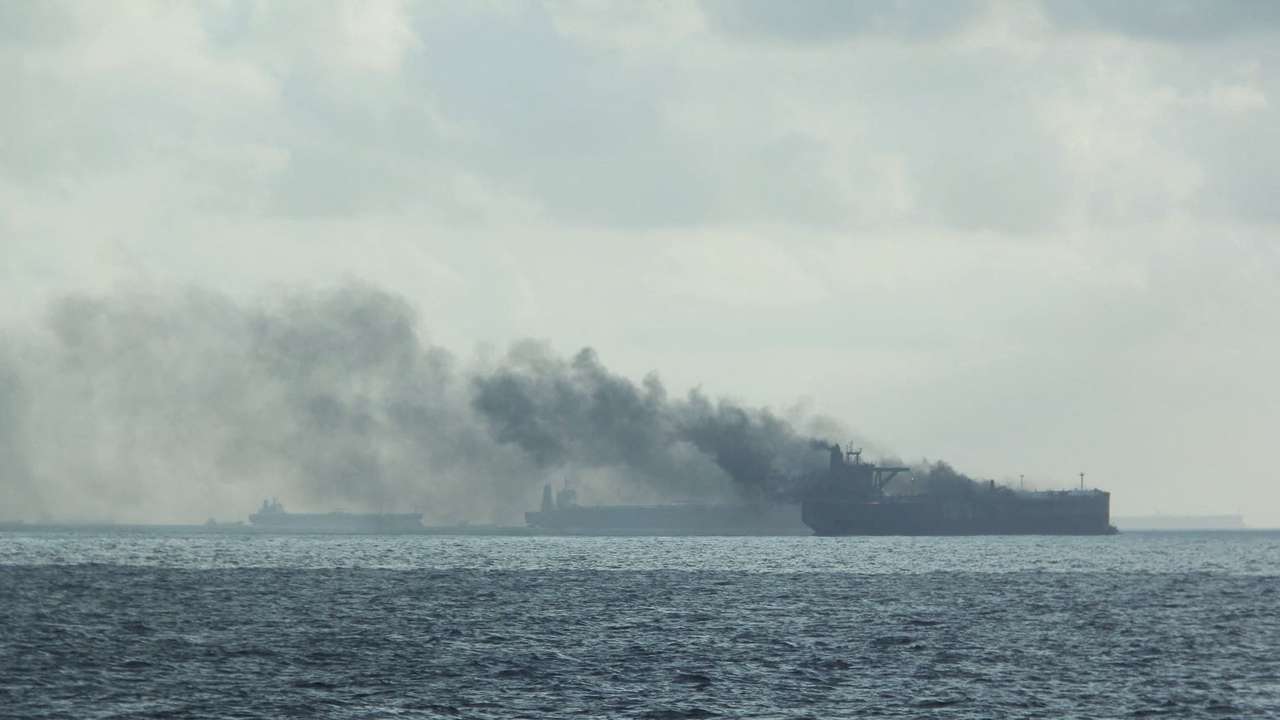
Two large oil tankers were on fire on Friday after colliding near Singapore, the world's biggest refuelling port, with two crew members airlifted to hospital and others rescued from life rafts, authorities and one of the tanker operators said.
Singapore is Asia's biggest oil-trading hub and the world's largest bunkering port. Its surrounding waters are vital trade waterways between Asia and Europe and the Middle East and among the busiest global sea lanes.
RECOMMENDED FOR YOU

A wake-up call: The countdown for Latin American democracy — Opinion
The Singapore-flagged tanker Hafnia Nile and the Sao Tome and Principe-flagged tanker Ceres I were about 55 km (34 miles) northeast of the Singaporean island of Pedra Branca on the eastern approach to the Singapore Straits, the Maritime and Port Authority of Singapore (MPA) said.
The 22 crew of the Hafnia Nile and the 40 on the Ceres I were all accounted for, said the MPA, which was alerted to the fire at 6:15 a.m. (2215 GMT).
Hafnia, the operator of Hafnia Nile, confirmed the vessel collided with Chinese-owned Ceres I. Hafnia added in a statement that a tug is on scene to assist the ship, which is drifting toward open sea. Specialized tugs are en route to join firefighting efforts and are expected to arrive within hours.
The exact circumstances leading to the incident are unknown.
Photographs released by the Singapore Navy showed thick black smoke billowing from one tanker and crew being rescued from life rafts and flown to hospital.
Environmental authorities in neighbouring Malaysia said they had been told to prepare for potential oil spills.
Norway’s Gard, one of Hafnia Nile’s insurers, told Reuters it was too early to assess the environmental impact.
"We are supporting our member as they are dealing with the incident," Gard said.
RECOMMENDED FOR YOU
New Asia Forum: Indonesia to set out progress on sustainable AI data centres
Navigational traffic had not been affected, although the status of the vessels or any pollution was unknown at present, a spokesperson at the UN's International Maritime Organization (IMO) said.
"No aerial surveillance has been conducted so far," the spokesperson said.
"Salvage and firefighting assets have been arranged by both vessel owners to support the firefighting efforts and subsequent towage of the vessels to safety."
The IMO spokesperson said a salvage team had been appointed and was en route to the area.
The 74,000-deadweight-tons capacity panamax tanker Hafnia Nile was carrying about 300,000 barrels of naphtha, according to ship-tracking data from Kpler and LSEG.
The Ceres I is a very large crude carrier supertanker, which ship-tracking data last showed was carrying around 2 million barrels of Iranian crude.
"The Ceres I has been a boat that has gone dark many times over the years," said Matt Stanley, head of market engagement EMEA & APAC with Kpler, referring to when vessels switch off their AIS tracking transponders.
Stanley said the last AIS signal the vessel transmitted around March indicated it was carrying Iranian crude, which the U.S. has tried to curtail, including imposing sanctions on ports, vessels and refineries involved in the trade.
RECOMMENDED FOR YOU
Fertilizer shipments through Strait of Hormuz fall to zero as food security fears grow
"She was at anchorage (on Friday). We can be fairly sure that she was carrying Iranian crude and was going to China," Stanley said.
SHADOW FLEET RISKS
S&P Global said in an April report that China buys around 90% of Iran's crude exports, often at discounted prices.
The Ceres I has not moved since July 11, according to LSEG shipping data.
The area Ceres I is anchored in is known to be used by so-called dark fleet ships for the transfer of Iranian oil in contravention of U.S. sanctions, said Michelle Wiese Bockmann, principal analyst at Lloyd's List Intelligence.
"The Ceres I has repeatedly been involved in transferring or shipping Iranian oil in breach of U.S. sanctions," she said.
Shipping sources have said the tanker was also involved in transporting Venezuelan oil, which is also under U.S. sanctions, to China in recent years.
The China-based owner of the Ceres I could not immediately be reached for comment. China has repeatedly said it opposes unilateral sanctions.
RECOMMENDED FOR YOU

Are universities failing us? Global South Thinkers LIVE
Up to 850 oil tankers are estimated to operate the shadow fleet transporting oil from countries such as Iran and Venezuela as well as Russia, which has multiple restrictions on its oil exports.
Shipping industry officials have warned that safety issues are growing because of the ageing and unregulated vessels.
The Ceres I vessel was built in 2001 while the Hafnia Nile was built in 2017, shipping data showed. It was unclear who provided insurance for the Ceres I, which was not covered by top-tier providers such as Gard, according to other data.
This article was produced by Reuters news agency. It has not been edited by Global South World.